Haryana CMO unveils unique project for 400 horticulture crop clusters
Synopsis
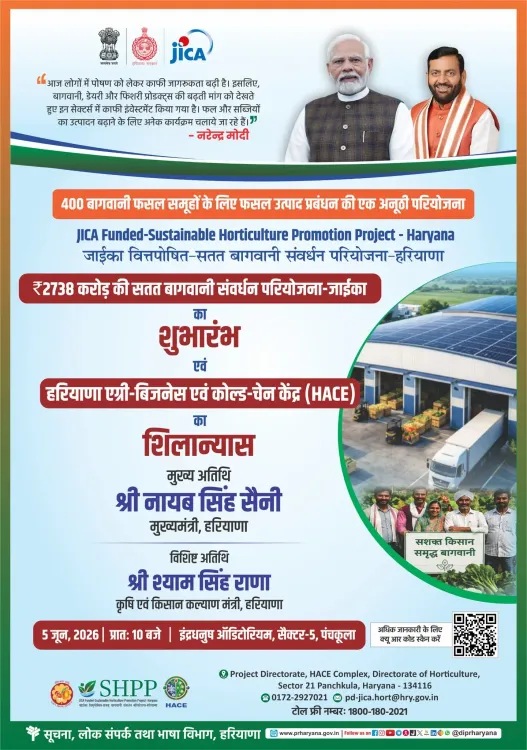
The Chief Minister's Office of Haryana has announced a unique project for crop produce management targeting 400 horticulture crop clusters. The initiative aims to reduce post-harvest losses, strengthen farmer producer groups and improve income for fruit and vegetable growers across the state.
Key Takeaways
The Chief Minister's Office of Haryana announced a unique crop produce management project on June 5, 2026 .
The project targets 400 horticulture crop clusters across Haryana.
It aligns with the central government's 10,000 FPO scheme (2020) and the Horticulture Cluster Development Programme (2021).
Primary beneficiaries are horticulture farmers and farmer producer groups in the state.
The initiative supports Haryana's push to diversify agriculture away from water-intensive wheat-paddy rotation toward higher-value crops.
Rollout guidelines, budget allocations and selection of the 400 groups are yet to be announced.
The Chief Minister's Office of Haryana announced on Friday, June 5, 2026, a unique project aimed at crop produce management for 400 horticulture crop clusters across the state, signalling a significant push to strengthen post-harvest infrastructure for fruit and vegetable growers.
Context
The post, shared by the official Chief Minister's Office of Haryana account, describes the initiative as 'ek anoothi pariyojana' — 'a unique project' — for crop produce management covering 400 horticulture crop groups. The announcement places Haryana among Indian states actively scaling cluster-based approaches to reduce post-harvest losses and improve farmer incomes.
Haryana has a strong agricultural base and has been working in recent years to diversify its farming economy away from the water-intensive wheat-paddy rotation cycle toward higher-value horticulture crops such as fruits and vegetables.
Policy Backdrop
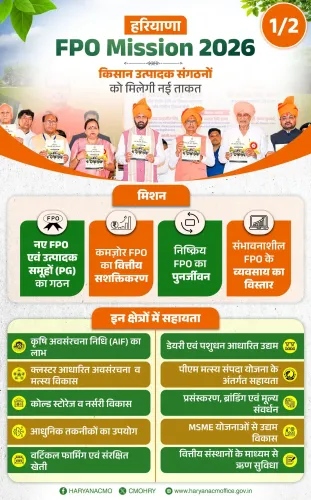
The initiative aligns with two major central policy pillars. The 10,000 Farmer Producer Organisations (FPO) scheme, launched in 2020 under the Union Ministry of Agriculture, aimed to create collective platforms for input purchase, processing and marketing at the grassroots level. Alongside it, the Horticulture Cluster Development Programme, introduced in 2021, was designed to support integrated post-harvest management and value addition in identified horticulture clusters.
Haryana's new project for 400 groups appears to build on this national framework, extending organised produce management to a large number of farmer collectives at the state level. Cluster-based models have been shown to improve bargaining power for small producers and help link them to processing units and export markets.
Stakeholders and Impact
The primary beneficiaries of this project are horticulture farmers and farmer producer groups across Haryana. By targeting 400 crop clusters, the initiative has the potential to reach a substantial number of small and marginal growers who typically face high post-harvest losses due to inadequate storage, handling and market-linkage infrastructure.
Improved produce management at the cluster level can translate into reduced wastage, better price realisation and more stable incomes for participating farmers. Such efforts also serve the broader national goal of doubling farmer incomes through supply-chain and value-chain improvements.
What's Next
Stakeholders and farming communities will be watching for state-level rollout guidelines, budget allocations and the criteria for selecting the 400 horticulture groups to be covered under the project. Any partnerships with private processors, cold-chain operators or export agencies announced in subsequent agriculture policy statements will be critical to the project's long-term success.
If implemented effectively, the initiative could serve as a replicable model for other agrarian states seeking to integrate horticulture farmers into organised value chains and reduce dependence on traditional cereal crops.
Point of View
The government is signalling intent to integrate small growers into organised value chains rather than leaving them exposed to market volatility. The political significance is clear: with farmer welfare remaining a central electoral concern in Haryana, visible horticulture investments serve both developmental and optics goals. The real test, however, will lie in the specifics — funding commitments, group selection transparency and market-linkage partnerships — that are yet to be disclosed.
NationPress
21 Oct 2026
Frequently Asked Questions
What is the Haryana horticulture crop cluster project announced in 2026?
The Chief Minister's Office of Haryana announced a unique crop produce management project for 400 horticulture crop clusters, aimed at reducing post-harvest losses and improving income for fruit and vegetable farmers in the state.
How many farmer groups are covered under Haryana's new horticulture project?
The project covers 400 horticulture crop clusters or farmer producer groups across Haryana.
What is the Horticulture Cluster Development Programme in India?
The Horticulture Cluster Development Programme was introduced by the central government in 2021 to support integrated post-harvest management and value addition in identified horticulture clusters across India.
How does Haryana's horticulture project help farmers?
By organising farmers into produce management clusters, the project aims to reduce post-harvest losses, improve bargaining power and link small growers to processing units and export markets, ultimately boosting their incomes.
What is the 10,000 FPO scheme and how is it related to Haryana's announcement?
The 10,000 Farmer Producer Organisations scheme was launched by the central government in 2020 to promote collective farming, input purchase and marketing. Haryana's cluster project builds on this framework by targeting 400 organised horticulture groups.