Haryana CM dedicates 9 projects worth ₹75 cr in Jhajjar
Synopsis
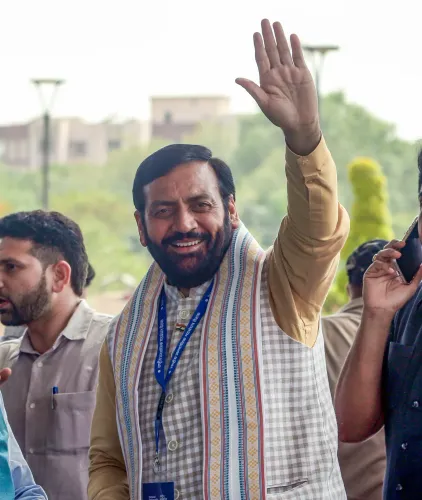
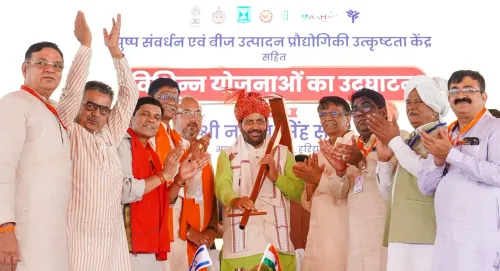
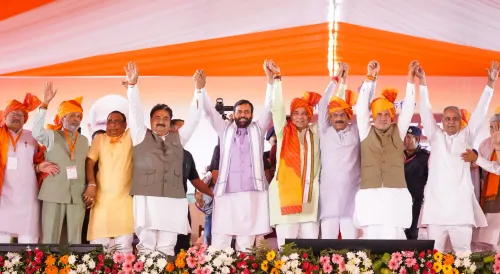
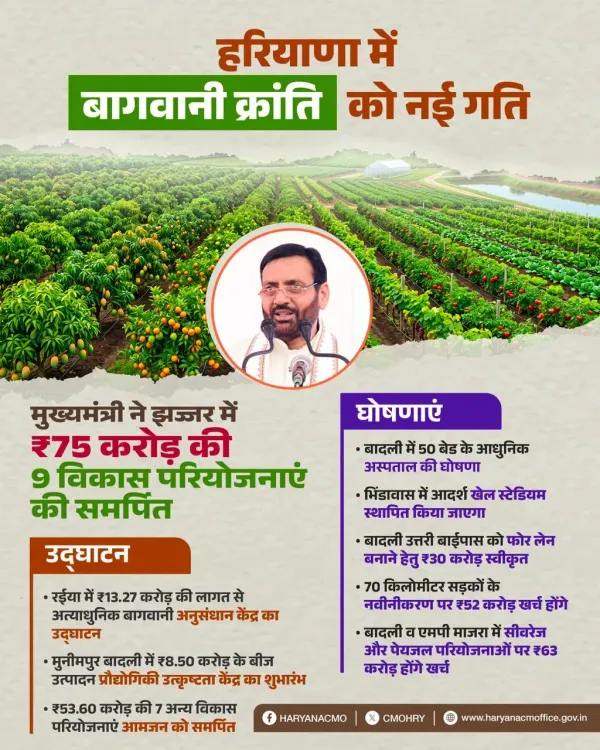
Haryana's Chief Minister dedicated nine development projects worth ₹75 crore in Jhajjar on 17 June 2026, framing the investments as fresh momentum for the state's horticulture revolution and announcing additional measures for the region.
Key Takeaways
Nine development projects worth a combined ₹75 crore were dedicated in Jhajjar district on 17 June 2026 .
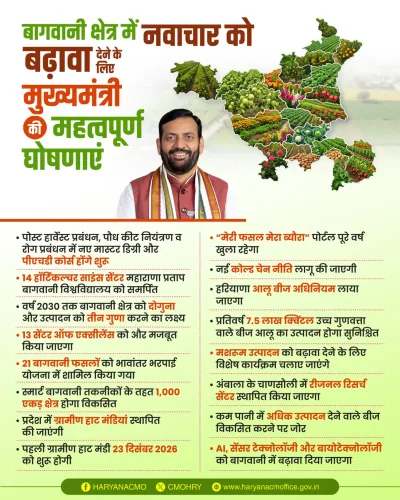
The event was officially described as giving 'new momentum to the horticulture revolution in Haryana.' Several additional announcements for the Jhajjar region were made at the same event, details of which are awaited.
Jhajjar's proximity to Delhi makes it a strategically important zone for high-value horticultural produce.
The investment continues Haryana's long-running policy of shifting farmers away from water-intensive paddy and wheat cultivation.
Physical delivery of all nine projects is expected to be tracked over the next 12-18 months .
The Chief Minister's Office of Haryana announced on Wednesday, 17 June 2026 that the Chief Minister dedicated nine development projects worth ₹75 crore in Jhajjar district, describing the initiative as a new push for a 'horticulture revolution' in the state. Several additional announcements for the region were also made during the event.
Context
The official post from the Chief Minister's Office read: 'हरियाणा में बागवानी क्रांति को नई गति' ('New momentum for the horticulture revolution in Haryana'), signalling that the Jhajjar event was framed as a milestone in the state's ongoing push to transform its agricultural economy. The dedication of nine projects in a single district in a single sitting underlines the scale of infrastructure investment being channelled into horticulture-linked development.
Jhajjar, located adjacent to Delhi, has an established agricultural base and has been identified as a priority zone for crop diversification given its proximity to urban markets and its historically water-intensive farming patterns.
Policy Backdrop
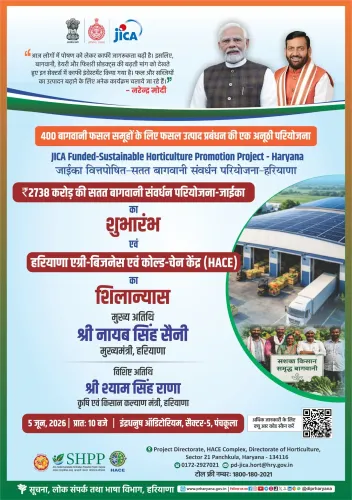
Haryana's interest in horticulture as an alternative to the wheat-paddy rotation dates to its participation in the National Horticulture Mission from 2005 onward. Successive state governments have run crop-diversification pilots through the Horticulture Department of Haryana, offering subsidies, cold-chain infrastructure and farmer training to shift acreage toward fruits, vegetables and flowers.
The strategic rationale is twofold: reducing the severe groundwater depletion caused by paddy cultivation, and raising per-hectare income for farmers. District-level project dedications — linking capital spending directly to market-oriented farming clusters — have become the preferred delivery mechanism for these goals.
Stakeholders and Impact
The primary beneficiaries of the ₹75 crore package are horticulture farmers and rural households in Jhajjar district. Infrastructure investments of this kind typically cover facilities such as nurseries, pack-houses, irrigation networks and farmer service centres, though the precise nature of each of the nine projects was not detailed in the official post.
For farmers currently locked into water-intensive paddy cultivation, state-backed infrastructure lowers the entry cost of switching to higher-value crops. The proximity of Jhajjar to Delhi's wholesale and retail markets adds a logistical advantage that can translate into better price realisation.
What's Next
Attention will now turn to the physical completion and operational status of the nine projects, with analysts typically tracking a 12-to-18-month window for ground-level delivery after such dedications. The 'several announcements' referenced in the official post — whose specifics were not disclosed — may carry budget allocations or cluster-level targets that become clearer in subsequent state agriculture policy reviews.
If Jhajjar's horticulture push delivers measurable output gains, it could serve as a template for scaling similar project clusters to other districts in Haryana, deepening the state's structural shift away from the wheat-paddy monoculture that has long strained its water table.
Frequently Asked Questions
What are the nine development projects dedicated in Jhajjar by the Haryana CM?
The Chief Minister's Office announced nine development projects worth ₹75 crore in Jhajjar on 17 June 2026, but the specific nature of each project was not detailed in the official statement.
What is the horticulture revolution in Haryana?
Haryana's horticulture revolution refers to the state's sustained push to shift farmers away from water-intensive wheat and paddy cultivation toward fruits, vegetables and flowers, supported by subsidies, cold-chain infrastructure and training programmes dating back to the National Horticulture Mission of 2005.
Why is Jhajjar important for Haryana's horticulture plans?
Jhajjar is adjacent to Delhi, giving farmers direct access to large urban markets, and has an established agricultural base that makes it well-suited for crop diversification pilots and infrastructure investment.
How does horticulture development help Haryana farmers?
Switching to horticulture crops can raise per-hectare income compared with paddy and wheat, while also reducing groundwater consumption — a critical concern in Haryana where the water table has been declining steadily.
What announcements were made at the Jhajjar event?
Beyond the dedication of nine projects worth ₹75 crore, the Chief Minister made several additional announcements for the Jhajjar region; their specifics had not been disclosed in the official post at the time of publication.