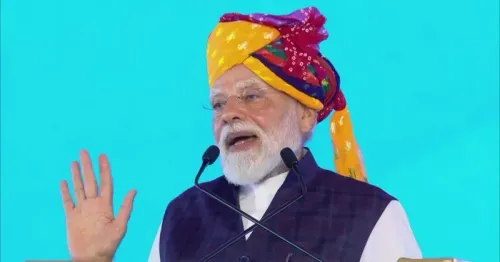
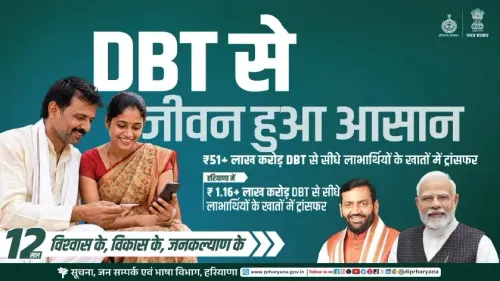
PM Modi Launches ₹14,721 Cr Projects in Haryana
Synopsis
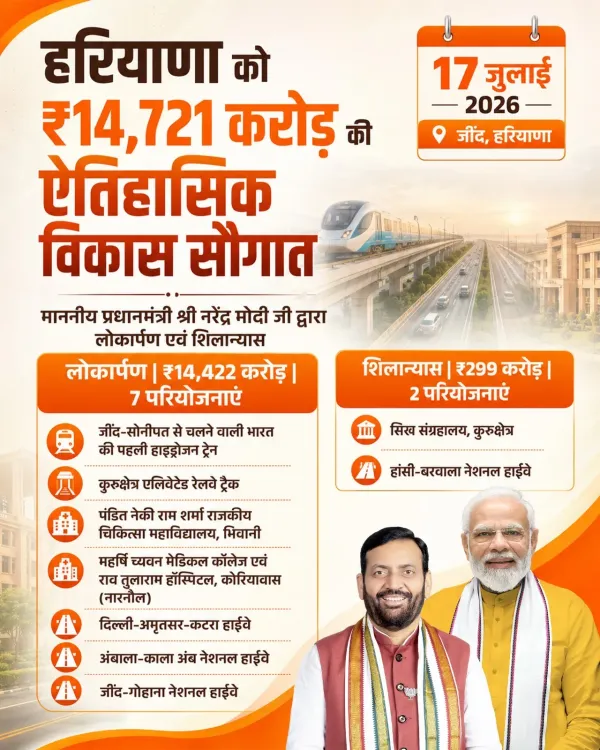
Prime Minister Narendra Modi inaugurated and laid the foundation for development projects worth ₹14,721 crore in Haryana on 17 July 2026. The package covers green transport, modern infrastructure, improved connectivity and quality healthcare, advancing the Viksit Bharat agenda.
Key Takeaways
₹14,721 crore worth of development projects were inaugurated and foundation-stoned by PM Narendra Modi in Haryana on 17 July 2026 .
The package covers four broad domains: green transport , modern infrastructure , improved connectivity , and quality healthcare services .
The Chief Minister's Office described the event as 'another historic step toward a developed Haryana' ( Viksit Haryana ).
The projects align with the National Infrastructure Pipeline launched in 2019 and the broader Viksit Bharat national development goal.
Detailed project-wise breakdowns and progress timelines are expected in subsequent state and central budget documents.
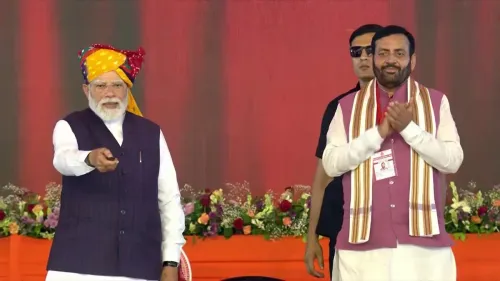
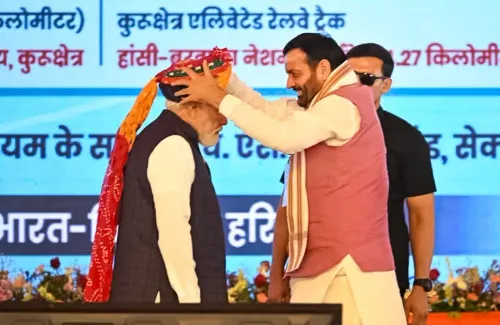
The Chief Minister's Office of Haryana announced on Friday, 17 July 2026 that Prime Minister Narendra Modi inaugurated and laid the foundation stones for development projects worth ₹14,721 crore in the state, describing the event as a historic step toward a developed Haryana.
The official post read: 'विकसित हरियाणा की ओर एक और ऐतिहासिक कदम' ('Another historic step toward a developed Haryana'), adding that the projects would give 'new direction and new momentum' to the state's growth. The package spans green transport, modern infrastructure, improved connectivity, and quality healthcare services, which the CMO said would further strengthen the resolve of a Viksit Bharat (Developed India).
Context
Haryana, a northern state bordering the national capital, has been a recurring site of central government infrastructure drives since 2014. Its proximity to Delhi and its role in multimodal connectivity corridors linking the National Capital Region (NCR) to the rest of north India make it a strategic focus for bundled project announcements. The ₹14,721 crore package announced on 17 July 2026 follows a pattern of coordinated central-state investment events that combine road, transport, and health components under a single high-profile launch.
Policy Backdrop
The projects align with the National Infrastructure Pipeline, launched in 2019, which coordinates central and state spending across roads, rail, health, and urban services. The emphasis on green transport in this package reflects a national-level priority that has appeared in successive multi-state infrastructure rounds. Modern healthcare infrastructure has similarly been bundled into such announcements as the Centre seeks to address gaps in public health access alongside connectivity upgrades.
Haryana has featured in multiple rounds of such coordinated pushes, with investments targeting both urban agglomerations near Delhi and districts further from the capital. The inclusion of quality healthcare services in this round signals an intent to address social infrastructure alongside physical connectivity.
Stakeholders and Impact
The primary beneficiaries include Haryana's residents who rely on state transport networks, healthcare users across districts, and daily commuters who depend on road and transit links to the NCR. Green transport components, if implemented, could reduce vehicular emissions in one of India's most pollution-affected regions. Improved connectivity is also expected to benefit the state's industrial and logistics sectors, which are closely tied to the broader Delhi-NCR economic zone.
The ₹14,721 crore outlay, spread across multiple project categories, represents a significant injection into the state's public infrastructure. Detailed project-wise allocations and timelines are expected to emerge through subsequent state and central budget disclosures.
What's Next
Project-wise breakdowns and physical progress benchmarks will be closely watched in upcoming state budget documents and central ministry reports. The announcements are likely to feed into the broader Viksit Bharat narrative ahead of future electoral and policy cycles. Civil society groups and urban planners in Haryana will track whether green transport commitments translate into procurement and operational timelines on the ground.
Point of View
721 crore package fits a well-established template of high-visibility central project launches in electorally and strategically significant states, where bundling roads, health and green transport under one event maximises political and administrative optics. Haryana's NCR adjacency makes it a natural showcase for the Viksit Bharat narrative, signalling to urban and peri-urban voters that infrastructure dividends are arriving. The explicit inclusion of green transport is noteworthy, suggesting the Centre is beginning to embed climate-linked infrastructure into its standard state-level playbook rather than treating it as a niche add-on. Whether the announced outlay translates into contracted, time-bound projects will be the real test of this announcement's substantive weight.
NationPress
16 Oct 2026
Frequently Asked Questions
What projects did PM Modi launch in Haryana on 17 July 2026?
PM Modi inaugurated and laid the foundation stones for development projects worth ₹14,721 crore in Haryana on 17 July 2026, covering green transport, modern infrastructure, improved connectivity and quality healthcare services.
What is the total value of the Haryana development projects announced in July 2026?
The total value of the projects inaugurated and foundation-stoned by PM Modi in Haryana is ₹14,721 crore.
What does Viksit Haryana mean and how does it relate to these projects?
'Viksit Haryana' means 'Developed Haryana' and is the state-level expression of the national Viksit Bharat goal; the ₹14,721 crore project launch is being positioned as a major step toward achieving that vision.
What is green transport and why is it included in Haryana's infrastructure package?
Green transport refers to low-emission or clean-energy mobility solutions such as electric buses and sustainable transit systems; its inclusion reflects national priorities to reduce pollution, particularly significant given Haryana's proximity to the high-pollution NCR.
When will the detailed breakup of Haryana's ₹14,721 crore projects be available?
Detailed project-wise allocations and progress timelines are expected to be disclosed through subsequent state and central government budget documents and ministry reports.