How is Haryana CM Seeking Economic Cooperation from 21 African Nations?
Synopsis
In a landmark meeting held in Surajkund, Haryana CM Nayab Singh Saini initiated discussions with 21 African diplomats to forge a new economic partnership. This collaboration aims to explore opportunities in agriculture, technology, and trade, promising mutual benefits for both regions.
Key Takeaways
New economic collaboration between Haryana and 21 African nations.
Focus on agriculture and technology for mutual growth.
Haryana's Department of Foreign Cooperation to enhance international ties.
Significant bilateral trade of $90-100 billion between India and Africa.
Opportunities in renewable energy and skill development .
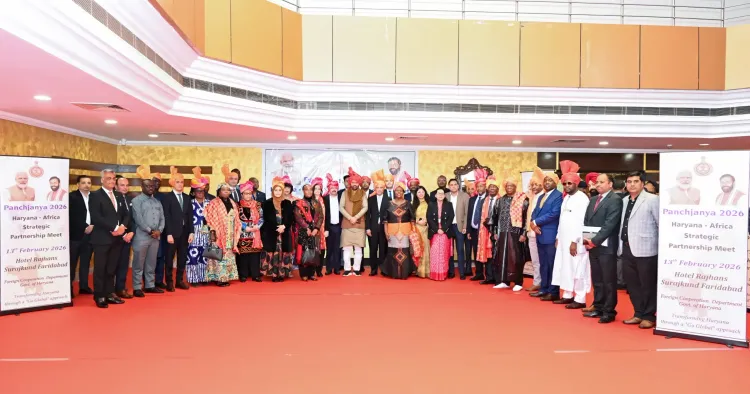
Faridabad, Feb 13 (NationPress) From the sacred and culturally vibrant land of Surajkund, Haryana's Chief Minister Nayab Singh Saini announced the dawn of a new era in India-Africa relations. On Friday, he engaged in discussions with Ambassadors and High Commissioners from 21 African nations focused on economic collaboration.
During the Haryana-Africa Strategic Partnership Meeting held in Surajkund, the officials explored the potential for collaboration between Haryana and various African nations in sectors such as industry, trade, investment, and technology, as stated by the state government.
In his remarks, CM Saini emphasized that the Surajkund International Crafts Mela serves as a global platform for showcasing folk traditions, handicrafts, and creativity, which bolster cultural ties and economic cooperation.
He further articulated that the foundation of India-Africa relations is based on equality, mutual respect, and shared development.
In alignment with Prime Minister Narendra Modi's vision, Haryana aims to foster long-lasting and robust relationships with African countries.
Haryana is the pioneering state to establish a dedicated Department of Foreign Cooperation to enhance international ties, he noted.
The Chief Minister highlighted Haryana's rapid emergence as a vital hub in agriculture, manufacturing, MSMEs, food processing, and automobile components.
Thanks to its connectivity with the National Capital Region, the state offers exceptional logistical advantages, paving the way for extensive multi-sectoral cooperation with African nations.
Pointing out agriculture as a crucial area for collaboration, he mentioned Haryana's expertise in irrigation management, crop diversification, and post-harvest management which can enhance food security in African nations.
He also discussed potential joint farming initiatives, training programs, and technical collaborations with countries like Kenya, Tanzania, Uganda, Ethiopia, and Rwanda.
“Agreements established with the Tanzania Investment Centre and other agricultural entities will facilitate trade, investment, and agricultural cooperation,” he added.
CM Saini identified significant opportunities for collaboration in sectors such as automobiles, healthcare, IT, construction, and skill development.
He described renewable energy, water conservation, and green development as collective moral obligations, asserting that collaborative efforts in solar energy, water management, and environmental sustainability are vital for future generations.
Haryana's Industry and Commerce Minister Rao Narbir Singh remarked that this presents a valuable opportunity to enhance trade relations between India and Africa.
In recent years, bilateral trade between India and Africa has surged to nearly $90-100 billion, signifying a strong economic partnership.
He noted that India primarily imports crude oil, gold, coal, fertilizers, and minerals from Africa, while exporting petroleum products, pharmaceuticals, automobiles, and engineering goods.
This trade is not only limited to physical goods but is also growing in sectors like education, healthcare, IT, and capacity building.
Point of View
It is crucial to acknowledge the strategic significance of Haryana's outreach to African nations. This initiative not only enhances bilateral relations but also paves the way for economic growth in both regions. The emphasis on mutual cooperation in various sectors underscores India's commitment to strengthening international ties.
NationPress
17 Sept 2026
Frequently Asked Questions
What is the significance of Haryana's meeting with African diplomats?
This meeting marks a new era in India-Africa relations, focusing on economic cooperation in sectors like agriculture, trade, and technology.
How does this collaboration benefit Haryana?
Haryana aims to enhance its economic growth by tapping into African markets and sharing expertise in various sectors.
What sectors are highlighted for cooperation?
Key sectors include agriculture, healthcare, IT, and renewable energy, among others.
What agreements were mentioned?
Agreements with the Tanzania Investment Centre and other agricultural bodies were discussed to promote trade and cooperation.
How significant is the bilateral trade between India and Africa?
Bilateral trade has reached nearly $90-100 billion, highlighting the strong economic partnership between the two regions.