Haryana tops national criminal law dashboard with 95.28 score
Synopsis
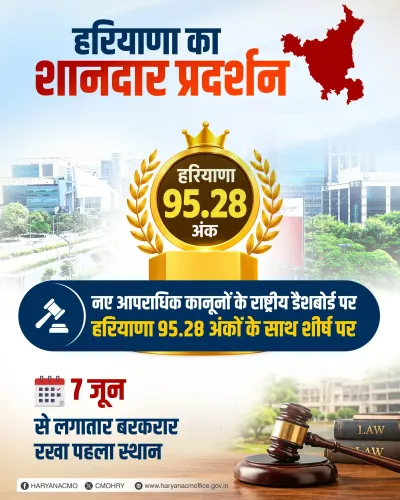
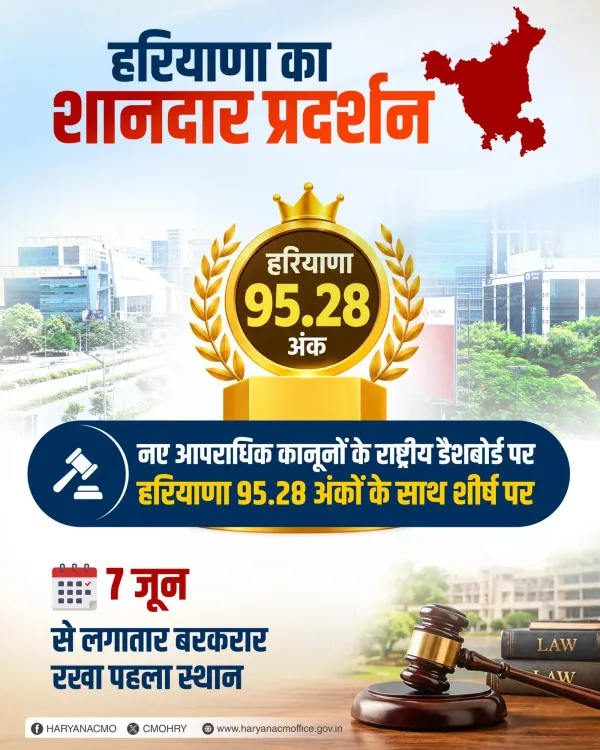
Haryana has topped India's national dashboard for new criminal law implementation with a score of 95.28, holding the first position continuously since 7 June 2026, according to the state's Chief Minister's Office. The ranking tracks BNS, BNSS, and BSA compliance across all states.
Key Takeaways
Haryana leads India's national dashboard for new criminal law implementation with a score of 95.28 points .
The state has held the top position continuously since 7 June 2026 — a streak of over four months.
The dashboard tracks compliance with the Bharatiya Nyaya Sanhita (BNS) , Bharatiya Nagarik Suraksha Sanhita (BNSS) , and Bharatiya Sakshya Adhiniyam (BSA) , which replaced the IPC, CrPC, and Evidence Act from 1 July 2024 .
The ranking system creates competitive federalism in policing, making state-level implementation performance publicly visible in near-real time.
The announcement was made by the Chief Minister's Office of Haryana on 17 October 2026 .
A single number — 95.28 — has placed Haryana at the summit of India's national performance dashboard for the new criminal laws, and the state has held that position without interruption since 7 June 2026. The Chief Minister's Office of Haryana announced the achievement on 17 October 2026, calling it a 'shानदार प्रदर्शन' (shandar pradarshan) — a stellar performance.
What the dashboard actually measures
The ranking tracks state-level implementation of India's three landmark new criminal laws: the Bharatiya Nyaya Sanhita (BNS), the Bharatiya Nagarik Suraksha Sanhita (BNSS), and the Bharatiya Sakshya Adhiniyam (BSA). Parliament passed all three in December 2023; they came into force on 1 July 2024, replacing the colonial-era Indian Penal Code, Code of Criminal Procedure, and Indian Evidence Act — statutes that had governed Indian courts for over 150 years.
Central ministries rolled out the national dashboard to create a visible, real-time scorecard of how effectively each state's police force and district judiciary are absorbing the new framework — from filing e-FIRs under BNS sections to adopting technology-enabled evidence procedures under the BSA. The rankings feed directly into competitive federalism: states can see exactly where they stand against each other, and the pressure to perform is public.
Haryana's unbroken run at the top
Haryana has positioned itself as an early and aggressive adopter of the reforms. The state's 95.28-point score — out of a presumed 100-point scale — reflects consistent compliance across the metrics the dashboard tracks, including case registration, digital workflow integration, and adherence to the new procedural timelines mandated by the BNSS. Crucially, the top rank has not been a one-week flash: the CMO's post confirms it has been sustained continuously since 7 June 2026, a run of over four months.
For a state whose police force and courts handle one of the country's denser caseloads — given Haryana's proximity to the National Capital Region and its rapid urbanisation — holding that position is a logistical as much as a policy achievement. It signals that training programmes, case-management software upgrades, and supervisory oversight have been calibrated to the new statutes, not merely acknowledged on paper.
Why inter-state rankings reshape policing politics
National dashboards of this kind do something older inspection regimes could not: they make underperformance visible and politically costly in near-real time. States that slip in the rankings face questions in their own legislatures; states that lead gain a governance credential the ruling party can carry into the next electoral cycle. Haryana's sustained top rank hands the state government a concrete, data-backed talking point at a moment when criminal justice reform remains one of the central government's signature domestic achievements.
The next dashboard update will test whether Haryana can extend its streak — and which states are closing the gap. The real story is not just the score; it is whether the numbers on the dashboard translate into faster justice for ordinary citizens walking into a police station or a district court.
Point of View
Turning what could have been a slow bureaucratic transition into a visible political contest. For the ruling dispensation in both Chandigarh and New Delhi, a score of 95.28 sustained over four months provides a rare, quantifiable proof-point for a reform package that was politically contentious at the time of passage. The harder question — whether high dashboard scores correlate with faster, fairer outcomes for citizens in police stations and district courts — remains the test that data alone cannot yet answer.
NationPress
17 Oct 2026
Frequently Asked Questions
What is the national dashboard for new criminal laws in India?
It is a central government monitoring tool that ranks states on how effectively they are implementing the three new criminal laws — the Bharatiya Nyaya Sanhita, Bharatiya Nagarik Suraksha Sanhita, and Bharatiya Sakshya Adhiniyam — which replaced the IPC, CrPC, and Evidence Act from 1 July 2024.
What score did Haryana get on the new criminal laws dashboard?
Haryana scored 95.28 points on the national dashboard for new criminal law implementation, placing it at the top position among all Indian states.
Since when has Haryana been ranked first on the criminal law dashboard?
According to the Chief Minister's Office of Haryana, the state has held the top rank continuously since 7 June 2026.
What are the new criminal laws BNS, BNSS, and BSA?
The Bharatiya Nyaya Sanhita (BNS), Bharatiya Nagarik Suraksha Sanhita (BNSS), and Bharatiya Sakshya Adhiniyam (BSA) are three laws passed by Parliament in December 2023 and effective from 1 July 2024, replacing the colonial-era Indian Penal Code, Code of Criminal Procedure, and Indian Evidence Act respectively.
Why does the new criminal laws dashboard ranking matter for states?
The rankings create public accountability and competitive pressure among states to implement the new criminal laws effectively, covering areas like digital case registration, procedural compliance, and technology adoption in police and judicial workflows.