Why Did the HC Stay the CAT Order for IAS Officer Amrapali Kata’s Allotment to Telangana?
Synopsis
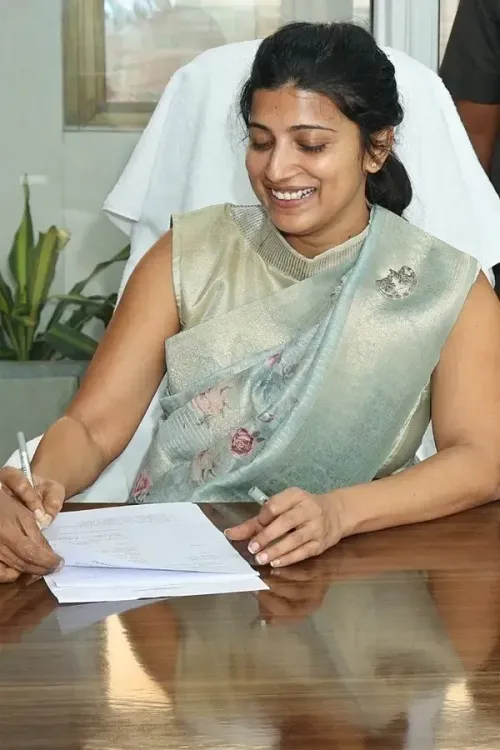
The Telangana High Court has intervened in a significant ruling regarding IAS officer Amrapali Kata, staying the Central Administrative Tribunal's order that assigned her to the Telangana cadre. This case highlights critical issues related to bureaucratic allocation and discrimination within administrative guidelines.
Key Takeaways
The Telangana High Court has stayed the CAT's order on IAS officer Amrapali Kata's allocation.
The DoPT's practices are under scrutiny due to perceived discriminatory actions.
The case emphasizes the importance of consistent application of bureaucratic guidelines.
Significant implications for other IAS officers seeking cadre allocations.
Calls for transparency in administrative processes.
Hyderabad, Dec 8 (NationPress) - The Telangana High Court has placed a stay on the Central Administrative Tribunal (CAT) order that assigned IAS officer Amrapali Kata to the Telangana cadre on Monday. This decision came in response to a petition filed by the Department of Personnel and Training (DoPT), contesting the CAT's ruling.
The court instructed the counsel for the IAS officer to submit a counter and postponed the hearing for six weeks.
In June 2025, the Hyderabad branch of CAT had granted a petition from the 2010-batch IAS officer, directing the authorities to allocate her to the Telangana cadre.
The CAT criticized the government for its selective application of the Pratyush Sinha Committee guidelines, labeling such inconsistency as discriminatory.
Currently, Kata is serving as the Managing Director of the Andhra Pradesh Tourism Development Corporation. She approached the tribunal after the Union government denied her request to be assigned to the Telangana cadre last year.
The CAT observed that the guidelines established by the Pratyush Sinha Committee were strictly enforced in some cases but were arbitrarily relaxed for others without sufficient justification. They concluded that this selective approach constituted discrimination and validated Kata's claims.
The tribunal noted that authorities had failed to explain why her request was denied while others were accommodated, thus allowing her petition and instructing the government to initiate her cadre transfer to Telangana.
Kata was among four IAS officers, including Ronald Rose, Vani Prasad, and Karuna Vakati, directed by the DoPT in October of the previous year to commence duties in Andhra Pradesh.
Initially, the High Court dismissed any orders regarding these duties. During the hearings concerning the DoPT's directive, CAT instructed the officers to comply with the DoPT's orders.
On October 10, 2024, the DoPT issued directives relieving five IAS officials (including one currently based in Andhra Pradesh) from their existing roles to join their respective cadres.
The DoPT rejected claims from eight All India Service (AIS) officers seeking allocation to the Telangana cadre.
A total of five IAS officers and three Indian Police Service (IPS) officers had their requests denied.
These officers were originally assigned to the Andhra Pradesh cadre following the bifurcation of the state in 2014 but sought a reallocation to the Telangana cadre.
The DoPT's decision was influenced by recommendations from a single-member committee led by former DoPT Secretary Deepak Khandekar, tasked with reviewing the final allocation of AIS officers.
After the bifurcation of united Andhra Pradesh, the union government reallocated IAS and IPS officers serving in the undivided state to the remaining state of Andhra Pradesh and the newly formed Telangana.
Several officers contested their reallocations and approached the CAT, which ruled in their favor. The DoPT then challenged these CAT rulings in the High Court.
The Telangana High Court, on January 3, 2024, mandated a reconsideration of the AIS officers' cases for final allocation based on the guidelines established from the Pratyush Sinha committee recommendations between Telangana and Andhra Pradesh.
Following the High Court's directive, the DoPT formed the Khandekar committee in March 2024 to reassess the final allocation.
Point of View
We are committed to providing fair and unbiased reporting. The recent stay by the Telangana High Court on the CAT's decision regarding IAS officer Amrapali Kata’s allocation underscores the complexities involved in bureaucratic appointments. This case not only reflects the ongoing challenges faced by AIS officers but also highlights the need for transparent and consistent application of administrative guidelines.
NationPress
17 Sept 2026