Himachal CM Demands Assurance on BBMB Dues Before Dams Progress
Synopsis
Himachal Pradesh's Chief Minister Sukhvinder Sukhu has put the Kishau and Renuka dam projects on hold until neighboring states commit to paying the long-overdue dues of the BBMB. This statement highlights the state’s fight for its fair share.
Key Takeaways
Himachal Pradesh halts dam projects pending financial assurance from neighboring states.
The state emphasizes ecological significance of the Himalayas .
Agreements signed to enhance cultivation of medicinal plants .
1.2 million saplings to be distributed in ten years.
Focus on sustainable agricultural practices in the region.
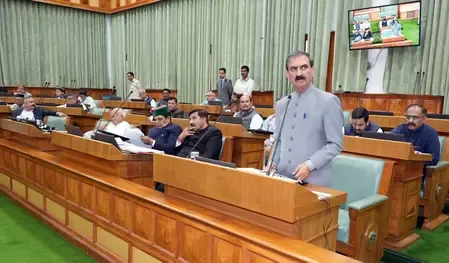
Shimla, Feb 24 (NationPress) The Chief Minister of Himachal Pradesh, Sukhvinder Sukhu, announced on Tuesday that the state government will halt the development of the Kishau and Renuka dam hydropower projects until neighboring states provide a solid commitment to resolve the long-standing dues owed to the Bhakra Beas Management Board (BBMB).
At the unveiling of the report titled ‘Scientific Assessment of Tackling Non-CO2 Emissions: Pathways for Himachal Pradesh,’ he remarked, “There have been some positive developments regarding this matter.”
He emphasized that Himachal Pradesh represents more than just a geographical location; it embodies the very essence of the Himalayas.
“The glaciers, rivers, forests, and mountains shape our identity and support millions beyond our borders. Any disruption to the Himalayas could lead to dire consequences, not just for our state but for the entire country,” he stated, asserting that “the state is advocating for its rightful compensation.”
During this event, the government finalized two memoranda of understanding aimed at enhancing the cultivation and preservation of medicinal plants.
According to the agreement, the company will supply 1.2 million saplings over a decade, distributing 120,000 saplings annually (10,000 of each species) to farmers across the state, aligned with ecological suitability.
In the lower and mid-hill areas, species such as amla, harad, bahera, kakadshingi, and lodhra will be provided in Una, Bilaspur, Hamirpur, Kangra, Sirmaur, and the lower regions of Shimla.
For mid- to high-altitude regions, species like jatamansi, kutaki, sugandhbala (herbs), padam kasht (tree), and pushkarmool (herb) will be given to farmers in Kullu, Chamba, Mandi, upper Shimla, and Kinnaur districts. Alpine species like atich and vish (herbs) will also be offered to farmers in the higher elevations of Kinnaur, Lahaul-Spiti, and Chamba districts.
Under the second agreement, the company will promote the cultivation, preservation, and value chain development of selected medicinal plants in Solan district over a five-year period.
Six species, including turmeric (Curcuma longa), ashwagandha (Withania somnifera), shatavari (Asparagus racemosus), tulsi (Ocimum sanctum), chirayita (Swertia chirayita), and Himalayan gentian (Gentiana kurroo), are set to be cultivated.
Point of View
The Chief Minister's stance reflects a critical intersection of environmental responsibility and inter-state cooperation. The decision to hold off on major hydropower projects underscores the vital need for financial accountability among states sharing resources.
NationPress
3 Oct 2026
Frequently Asked Questions
What are the Kishau and Renuka dam projects?
The Kishau and Renuka dams are proposed hydropower projects in Himachal Pradesh aimed at generating energy and managing water resources.
What are the BBMB arrears?
BBMB arrears refer to the long-standing dues that neighboring states owe to the Bhakra Beas Management Board for water and power resources.
Why is the Chief Minister concerned about the Himalayas?
The Chief Minister emphasized that the Himalayas are crucial for the ecological and cultural identity of Himachal Pradesh, and any disruption could have severe consequences for the state and the country.
What is the purpose of the memoranda of understanding signed?
The memoranda aim to promote the cultivation and conservation of medicinal plants in Himachal Pradesh, enhancing local agriculture and ecological sustainability.
Which medicinal plants are being promoted?
The initiative includes the cultivation of turmeric, ashwagandha, shatavari, tulsi, chirayita, and Himalayan gentian among others.