CM Himanta praises daughter Avantika's tribute to Saketpuri
Synopsis
Assam CM Himanta Biswa Sarma praised daughter Avantika's description of Saketpuri on X, saying India's cultural heritage will remain unshakeable if youth stay rooted in Sanatan traditions. The post, tagged to BJP leader Harish Dwivedi, reflects a broader party emphasis on civilisational continuity.
Key Takeaways
Himanta Biswa Sarma publicly praised his daughter Avantika for her 'beautiful description' of Saketpuri on 18 October 2026 .
He stated that no power can weaken India's cultural heritage if the younger generation stays rooted in Sanatan culture .
The post was shared in response to BJP leader Harish Dwivedi (@HarishD_BJP) , indicating an ongoing conversation within party circles.
Saketpuri is associated with the ancient Hindu name for Ayodhya , a site of major civilisational significance in current political and cultural discourse.
The message fits a BJP pattern of senior leaders publicly endorsing Sanatan traditions — here given extra resonance through a personal family moment.
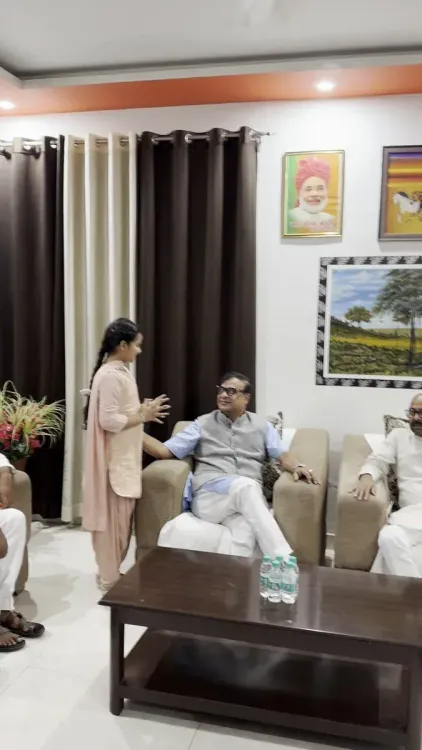
A father's pride and a politician's conviction arrived in the same breath on Sunday evening. Assam Chief Minister Himanta Biswa Sarma took to X on 18 October 2026 to celebrate his daughter Avantika's vivid description of Saketpuri, turning a personal moment into a larger statement about cultural continuity and civilisational resilience.
Sharing the post in reply to @HarishD_BJP — a handle associated with BJP leader Harish Dwivedi — CM Sarma wrote: 'Beti Avantika ne Saketpuri ka itna sundar varnan kiya hai' ('Daughter Avantika has described Saketpuri so beautifully'). He added that if the next generation continues to embrace Sanatan culture and stays rooted in its origins in this way, no power will be able to weaken India's cultural heritage and civilisational values.
Saketpuri and the Sanatan thread
Saketpuri is a name rooted in the ancient Hindu tradition — 'Saketa' being one of the earliest recorded names for Ayodhya, the sacred city on the Sarayu river. A young person offering a richly detailed account of such a site carries symbolic weight in the current cultural moment, where the reinvigoration of classical pilgrimage and heritage spaces has become a visible political and social project.
For CM Sarma, the occasion doubled as a reflection on intergenerational responsibility. His message was direct: cultural heritage does not defend itself — it survives through the choices of the young.
BJP's civilisational messaging and where Sarma fits in
Senior BJP leaders regularly invoke Sanatan dharma and civilisational continuity in public communication, but the framing here is notably personal. Rather than a policy announcement or a rally address, this is a chief minister amplifying his own daughter's cultural engagement — lending the message an intimacy that formal party statements rarely carry.
As convenor of the North-East Democratic Alliance (NEDA), Sarma occupies a bridge role between the BJP's national agenda and the culturally diverse northeast. Statements that foreground India's Sanatan heritage from that perch carry a particular resonance — projecting a civilisational common ground across a region known for its plurality of traditions.
The post's tag to Harish Dwivedi also signals that this was not a solitary reflection but part of an ongoing conversation within BJP circles about heritage, youth, and cultural education.
If the next generation keeps finding beauty in ancient places, the argument goes, the heritage defends itself — one description at a time.
Point of View
Sarma signals that the Sanatan agenda is not merely electoral posturing but a lived, intergenerational commitment. Coming from the NEDA convenor, the statement also carries a quiet federating function: projecting a shared Hindu civilisational identity as a unifying thread across the culturally heterogeneous northeast. Watch for whether this translates into formal cultural-education or heritage-tourism initiatives in Assam.
NationPress
18 Oct 2026
Frequently Asked Questions
What did Himanta Biswa Sarma post about his daughter Avantika?
CM Himanta Biswa Sarma praised his daughter Avantika for her description of Saketpuri, saying it was beautiful and that such connection to Sanatan culture would keep India's civilisational values strong.
Who is Harish Dwivedi tagged in Himanta's post?
Harish Dwivedi is a BJP leader; CM Sarma tagged his handle @HarishD_BJP, indicating the post was part of a conversation within BJP circles about heritage and youth.
Why does CM Sarma emphasise Sanatan culture?
As a senior BJP leader and NEDA convenor, Sarma regularly advocates for preserving India's Sanatan cultural heritage and civilisational values — a consistent theme in BJP's public messaging.
What is NEDA and what is Himanta Biswa Sarma's role in it?
NEDA, the North-East Democratic Alliance, is a BJP-led political coalition of northeast Indian parties. Himanta Biswa Sarma serves as its convenor, making him a key figure in the region's political landscape.