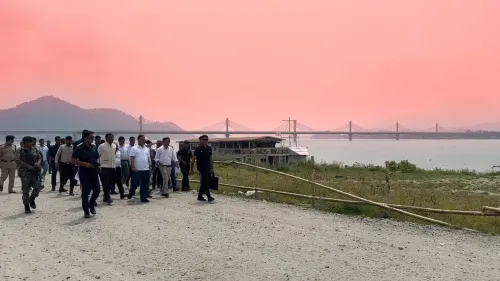
CM Himanta flags 1,500-year-old artefacts found in Hailakandi
Synopsis
Assam Chief Minister Himanta Biswa Sarma has spotlighted approximately 1,500-year-old archaeological artefacts unearthed in Hailakandi, framing them as fresh proof of Assam's ancient Sanatan and Shakti-worship traditions — a discovery timed just before Navratri.
Key Takeaways
Archaeological remains estimated to be approximately 1,500 years old have been found in Hailakandi district , southern Assam.
Assam Chief Minister Himanta Biswa Sarma shared the discovery on 3 October 2026 , days before Navratri .
Sarma linked the find to Assam's ancient Sanatan civilisation and deep-rooted Shakti-worship tradition .
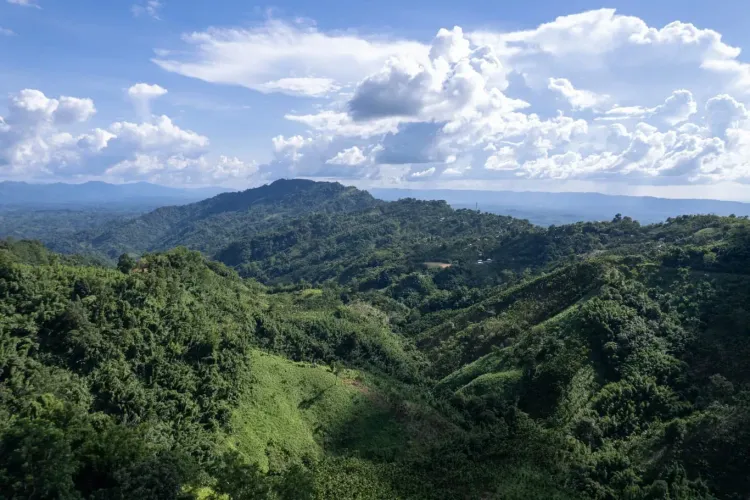
Hailakandi is part of the Barak Valley , a region that borders Bangladesh and Mizoram and has historically received less archaeological spotlight than the Brahmaputra Valley.
The announcement aligns with the Assam government's broader effort to document and promote pre-medieval and early medieval heritage across the state.
Formal archaeological classification and excavation details have not yet been released publicly.
Just days before Navratri, a discovery in the Barak Valley has offered a striking window into Assam's ancient past. Assam Chief Minister Himanta Biswa Sarma on Saturday, 3 October 2026, drew attention to archaeological remains approximately 1,500 years old unearthed in Hailakandi district, calling them fresh evidence of the region's deep-rooted Sanatan civilisation and Shakti-worship traditions.
In his post, the Chief Minister wrote: 'The land of Assam still preserves within itself its ancient Sanatan civilisation and the profound tradition of Shakti-worship. The nearly 1,500-year-old archaeological remains found in Hailakandi are yet another glimpse of this rich heritage. This discovery, emerging just before the auspicious occasion of Navratri, also reminds us of our resolve to protect our roots and spiritual heritage.'
What was found in Hailakandi
Hailakandi, a district in southern Assam bordering Bangladesh and Mizoram, is part of the Barak Valley — a region with a distinct cultural and linguistic identity from the Brahmaputra Valley. The recovery of artefacts dated to roughly the 5th–6th century CE places them in an era when early medieval kingdoms were consolidating across the subcontinent and goddess-worship traditions were being formally enshrined in temple architecture and iconography.
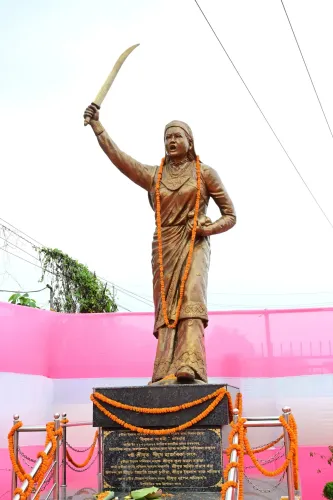
Sarma's post was accompanied by four images, which appear to show the recovered remains, though detailed archaeological provenance — the excavating agency, the precise site, and the classification of the objects — has not been officially specified in publicly available statements at this time.
Navratri timing and the Shakti-worship connection
The Chief Minister's framing is deliberate: Navratri, the nine-night festival dedicated to Goddess Durga and her forms, is one of the most widely observed occasions in Assam. The state is home to the Kamakhya Temple in Guwahati — one of the most revered Shakti Peethas in the country — making goddess-worship a central thread in Assam's religio-cultural identity for well over a millennium.
Sarma explicitly links the Hailakandi find to this living tradition, framing it not merely as an academic curiosity but as a call to 'protect our roots and spiritual heritage.' The timing of the announcement, on the eve of Navratri, amplifies that resonance.
Heritage conservation as political and cultural priority
The Assam government has in recent years signalled a sustained interest in documenting and promoting the state's pre-Islamic and early medieval heritage. References to Pragjyotishpura — the ancient name for the Kamakhya region — and to the Koch and Ahom kingdoms have featured prominently in official messaging. The Hailakandi announcement fits within that broader pattern: using verified archaeological finds to reinforce a narrative of civilisational continuity.
For a district like Hailakandi, which has a significant minority population and has historically attracted less archaeological attention than the Brahmaputra Valley, a high-profile find of this vintage carries additional significance — signalling that the state's ancient heritage extends across its full geographic breadth.
The real measure of this discovery will come when archaeologists publish formal findings. Until then, the 1,500-year-old stones of Hailakandi speak loudest in Sarma's framing — as a pre-Navratri reminder that Assam's spiritual past runs far deeper than living memory.
Point of View
500-year-old archaeological find to the approaching Navratri, he reinforces a well-established BJP governance narrative that frames archaeological heritage as evidence of civilisational continuity. The choice of Hailakandi — a southern Assam district with a large Muslim minority — is also notable: it extends the 'ancient Shakti-worship' narrative beyond the usual Brahmaputra-centric framing, signalling that the state's Hindu antiquity covers its full geography. Without formal excavation reports, however, the political framing currently outruns the verifiable archaeological detail, and experts will watch for what peer-reviewed findings eventually confirm.
NationPress
3 Oct 2026
Frequently Asked Questions
What was found in Hailakandi, Assam?
Archaeological remains estimated to be approximately 1,500 years old — dating to roughly the 5th–6th century CE — were discovered in Hailakandi district in southern Assam. Chief Minister Himanta Biswa Sarma described them as evidence of the region's ancient Sanatan civilisation and Shakti-worship traditions.
Where is Hailakandi district in Assam?
Hailakandi is a district in the Barak Valley region of southern Assam, bordering Bangladesh to the south and Mizoram to the east. It is geographically and culturally distinct from the more prominent Brahmaputra Valley.
Why did Himanta Biswa Sarma link this discovery to Navratri?
Sarma connected the find to Navratri because the festival celebrates goddess worship — a tradition he says the Hailakandi remains help trace back over 1,500 years. Assam is home to the Kamakhya Temple, one of India's most important Shakti Peethas, making Shakti worship central to the state's identity.
Who is conducting the excavation at Hailakandi?
The excavating agency and full technical details of the Hailakandi site have not been specified in publicly available statements at this time. Formal archaeological reports are yet to be released.
What is the significance of 1,500-year-old artefacts in Assam?
Remains from roughly the 5th–6th century CE place the find in the early medieval period, when goddess-worship traditions and temple culture were being codified across the subcontinent. In Assam's context, such finds support historical claims of a continuous civilisational presence predating later medieval dynasties.