CM Himanta Congratulates Assam Artistes on Sangeet Natak Akademi Awards
Synopsis
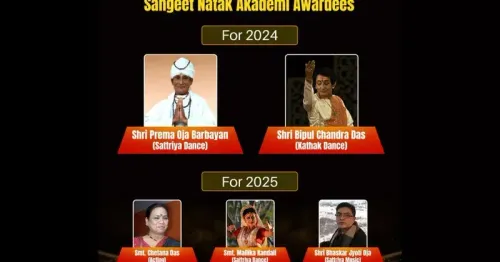
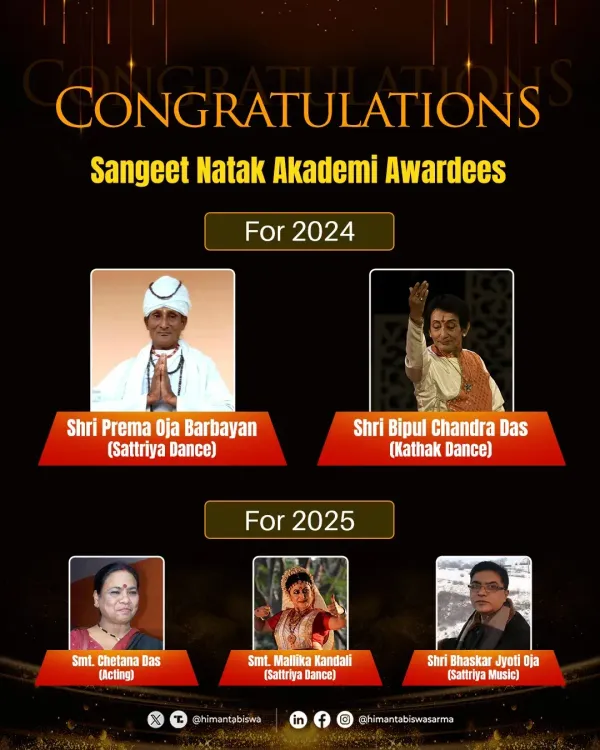
Assam Chief Minister Himanta Biswa Sarma congratulated state artistes honoured with the Sangeet Natak Akademi Awards and Ustad Bismillah Khan Yuva Puraskar, pledging continued state commitment to Sattriya, folk traditions, theatre, and music alongside Assam's development drive.
Key Takeaways
CM Himanta Biswa Sarma publicly congratulated Assam artistes receiving Sangeet Natak Akademi Awards and the Ustad Bismillah Khan Yuva Puraskar on June 11, 2026 .
The Ustad Bismillah Khan Yuva Puraskar is specifically for young performing artists under the age of 40 .
The Sangeet Natak Akademi was established in 1952 and is India's national apex body for music, dance, and drama.
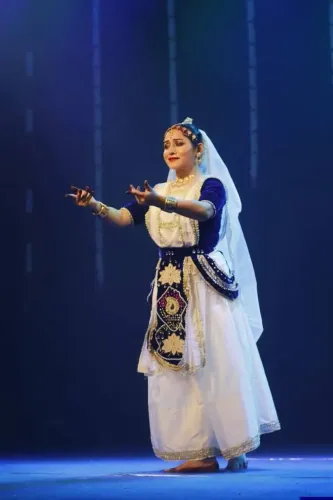
Sattriya was recognised as a classical dance form by the Sangeet Natak Akademi in 2000 , prompting sustained state-level promotion in Assam .
The CM linked cultural preservation of virasat — heritage in Sattriya, folk traditions, theatre, and music — directly to Assam's broader development agenda.
Budget allocations for Sattriya academies and folk festivals will be a key indicator of how this stated commitment materialises in policy.
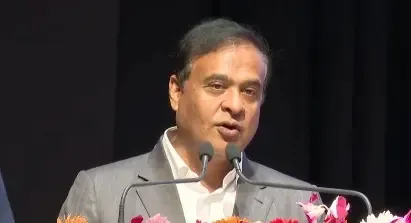
Assam Chief Minister Himanta Biswa Sarma on Thursday, June 11, 2026, congratulated artistes from the state who were honoured with the Sangeet Natak Akademi Awards and the Ustad Bismillah Khan Yuva Puraskar, reaffirming his government's commitment to preserving the state's performing arts heritage alongside its development agenda.
Context
In his post, CM Sarma wrote: 'As we accelerate Assam's development journey, we remain equally committed to preserving and promoting our rich virasat [heritage] of Sattriya, folk traditions, theatre and music, for our cultural roots define who we are.' The message signals that cultural patronage remains a deliberate policy strand of the current state administration, not a peripheral concern.
The Sangeet Natak Akademi, established in 1952, is India's apex body for music, dance, and drama. Its annual awards are among the country's most prestigious recognitions for performing artists, while the Ustad Bismillah Khan Yuva Puraskar specifically honours young practitioners below the age of 40.
Policy Backdrop
Sattriya, the classical dance form rooted in the sattras (Vaishnavite monasteries) of Assam, was formally recognised by the Sangeet Natak Akademi as one of India's classical dance forms in 2000. That recognition triggered a sustained push at the state level to institutionalise its teaching, documentation, and performance.
Successive administrations in Assam, and more broadly across BJP-led governments in the Northeast, have framed cultural preservation as a parallel track to infrastructure investment and economic growth — a dual mandate that CM Sarma has consistently articulated during his tenure.
Stakeholders and Impact
The immediate beneficiaries are the Assam-based artistes who received the national honours — practitioners of Sattriya, folk music, theatre, and allied performing arts traditions. Recognition at the national level typically elevates an artist's access to grants, festival invitations, and institutional support.
Broader stakeholders include the state's network of sattras, folk festival organisers, and cultural academies that look to the chief minister's public endorsements as signals of continued budgetary and policy support. The Northeast Democratic Alliance (NEDA), which CM Sarma convenes, has also used cultural commonality as a soft-diplomacy tool among the region's diverse states.
What's Next
Observers will watch Assam's upcoming state budget allocations for performing arts institutions, Sattriya academies, and folk festivals as a concrete measure of how the government's stated cultural commitment translates into spending. Participation of the newly honoured awardees in national and international cultural events organised under state patronage will also be a marker to track.
The chief minister's statement, timed to a high-profile national award cycle, is likely to reinforce calls from cultural organisations in the state for expanded institutional infrastructure — including dedicated performance spaces and artist welfare schemes — as Assam positions itself as a hub for Northeast India's performing arts.
Point of View
Folk traditions, and the concept of virasat in the same breath as the state's development journey, the administration signals that indigenous arts are not a soft afterthought but a political asset in a state with deep ethno-cultural sensitivities. This framing has been a consistent feature of BJP governance across the Northeast, where cultural authenticity often carries as much electoral weight as infrastructure delivery. The test, as always, will be whether the rhetoric is matched by budget lines in the next state financial cycle.
NationPress
23 Sept 2026
Frequently Asked Questions
What are the Sangeet Natak Akademi Awards?
The Sangeet Natak Akademi Awards are India's highest national recognition for performing artists in music, dance, and drama, conferred annually by the Sangeet Natak Akademi, which was established in 1952.
What is the Ustad Bismillah Khan Yuva Puraskar?
The Ustad Bismillah Khan Yuva Puraskar is an annual award given by the Sangeet Natak Akademi to young performing artists below the age of 40, recognising emerging talent in India's classical and folk arts.
What is Sattriya dance and why is it significant for Assam?
Sattriya is a classical dance form originating in the Vaishnavite monasteries, known as sattras, of Assam. It was formally recognised as one of India's classical dance forms by the Sangeet Natak Akademi in 2000, making it a point of cultural pride and a focus of state-level promotion in Assam.
Why did Himanta Biswa Sarma congratulate Assam artistes?
Assam Chief Minister Himanta Biswa Sarma congratulated Assam-based artistes who were honoured with the Sangeet Natak Akademi Awards and the Ustad Bismillah Khan Yuva Puraskar, using the occasion to reaffirm his government's commitment to preserving the state's performing arts heritage.
How does Assam's government support cultural heritage?
The Assam government, under CM Himanta Biswa Sarma, has framed cultural preservation — covering Sattriya, folk traditions, theatre, and music — as a parallel priority alongside economic development, with state budget allocations for cultural academies and folk festivals serving as key instruments.