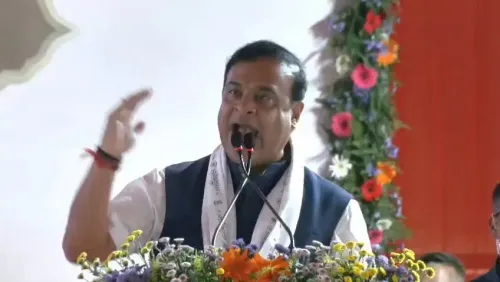
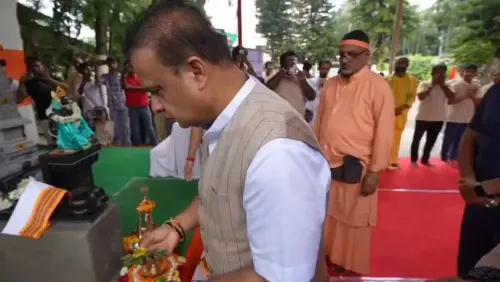
CM Himanta fires at Opposition over Ram Mandir, Shiv Tandav
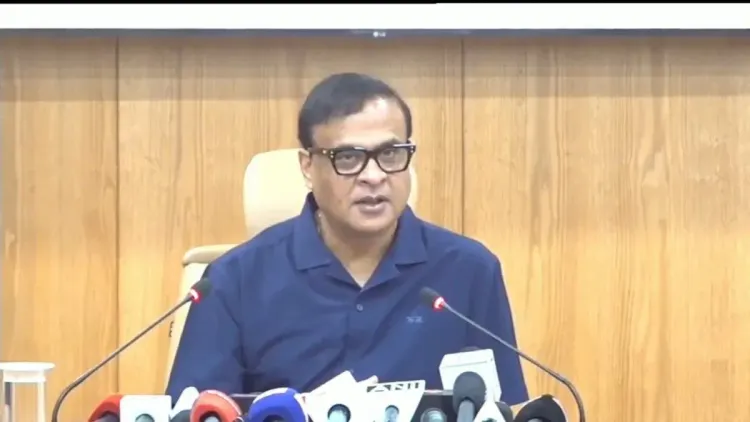
Synopsis
Assam CM Himanta Biswa Sarma targeted unnamed Opposition leaders on 12 October 2026, saying those who lack the courage to visit Ayodhya's Ram Mandir have no standing to invoke Shiv Tandav — branding it peak hypocrisy.
Key Takeaways
Assam CM Himanta Biswa Sarma posted a sharp political attack on X on 12 October 2026 .
He accused unnamed opponents of hypocrisy for invoking 'Shiv Tandav' while allegedly avoiding a visit to the Ram Mandir in Ayodhya .
The post was written in Hindi and included the English word 'Hypocrisy,' maximising its reach across audiences.
No individual or party was named — a deliberate rhetorical choice that broadens the charge.
The Ram Mandir, consecrated in January 2024 , has become a recurring BJP benchmark for judging the Opposition's stance on Hindu traditions.
A sharp political barb — delivered in eleven words of Hindi — landed with considerable force on Monday evening. Assam Chief Minister Himanta Biswa Sarma took to X on 12 October 2026 to call out what he described as rank hypocrisy among political opponents who invoke Lord Shiva's Tandav yet, in his telling, lack the courage to visit the Ram Mandir in Ayodhya.
Posting in Hindi, the BJP leader and North-East Democratic Alliance (NEDA) convenor wrote: 'जिनमें राम मंदिर जाने की हिम्मत नहीं है, वे शिव तांडव की बात कर रहे हैं।' — 'Those who do not have the courage to visit the Ram Mandir are talking about Shiv Tandav' — before adding a cutting rhetorical sign-off: 'Hypocrisy, too, has a limit!'
The coded charge: Ram Mandir, Shiv Tandav, and political symbolism
The Ram Mandir in Ayodhya has functioned as one of the BJP's most potent cultural and electoral touchstones since its consecration in January 2024. Visits to — or conspicuous absences from — the temple have become a litmus test that BJP leaders regularly deploy against Opposition figures, framing non-attendance as either appeasement politics or performative secularism.
Sarma does not name his targets, but the reference to 'Shiv Tandav' carries its own political memory. The phrase has periodically resurfaced in public discourse — most famously in the context of politicians and activists who have recited or invoked the ancient Sanskrit hymn during high-profile controversies, drawing accusations from BJP quarters of selective religious enthusiasm. The implicit charge: praising one Hindu tradition while distancing from another is not secularism — it is calculation.
Sarma's pattern: short posts, long echoes
The Assam Chief Minister is one of the most combative voices in the BJP's north-east leadership and has made a habit of landing precisely aimed one-liners on social media that ignite national debate well beyond his home state. This post follows that template — brief, punchy, and designed to force the Opposition either to explain their position on Ayodhya or absorb the jibe in silence.
Whether the remark is aimed at Congress, INDIA bloc partners, or a specific state-level rival is left deliberately ambiguous — an old political technique that lets every critic recognise themselves while denying any single target the dignity of a named rebuttal.
With Ayodhya still drawing millions of pilgrims annually and the temple's political symbolism showing no signs of fading, Sarma's eleven words are a reminder that in Indian politics, a visit — or the lack of one — can still be worth a thousand speeches.
Point of View
He engineers a situation where any denial functions as an implicit admission. The Shiv Tandav reference adds a second layer: it suggests the Opposition selectively deploys Hindu iconography for political cover while rejecting its institutional expression at Ayodhya. Ahead of any state election cycle, such messaging is designed to consolidate Hindu consolidation sentiment without requiring a single policy debate.
NationPress
12 Oct 2026
Frequently Asked Questions
What did Himanta Biswa Sarma say about Ram Mandir and Shiv Tandav?
On 12 October 2026, Sarma posted in Hindi that those who do not have the courage to visit the Ram Mandir in Ayodhya have no standing to speak about Shiv Tandav, calling it the height of hypocrisy.
Who is Himanta Biswa Sarma targeting in his post?
Sarma did not name any individual or party, leaving the target deliberately ambiguous — a common political technique that lets opponents self-identify while denying them a direct rebuttal.
Why is visiting the Ram Mandir politically significant in India?
Since its consecration in January 2024, the Ram Mandir in Ayodhya has become a cultural and political touchstone. BJP leaders frequently use visits — or absences — as a marker of Opposition leaders' stance on Hindu traditions.
What is the Shiv Tandav controversy in Indian politics?
The ancient Sanskrit hymn 'Shiv Tandav Stotram' has periodically featured in political controversies, with BJP leaders accusing Opposition figures of invoking it selectively for optics while rejecting other expressions of Hindu religious identity.
What is Himanta Biswa Sarma's political role beyond Assam?
Besides serving as Chief Minister of Assam, Sarma is the convenor of the North-East Democratic Alliance (NEDA), making him a key BJP strategist for the entire north-eastern region.