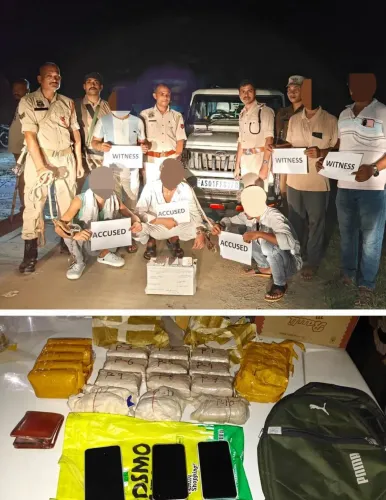
CM Himanta's anti-drug blitz: 700 hotspots raided, 47 absconders caught

Synopsis
Assam CM Himanta Biswa Sarma declared 700 drug hotspots raided and 47 absconders apprehended under the Nasha Mukt Bharat Abhiyan, framing the operation as a full-chain strike from street-level dealers to kingpins.
Key Takeaways
700 drug hotspots were raided in the latest Assam enforcement push under the Nasha Mukt Bharat Abhiyan.
47 absconders — individuals with pending arrest warrants — were tracked down and apprehended.
CM Himanta Biswa Sarma framed the operation as targeting the full supply chain, 'from the street corner to the kingpin.' The Nasha Mukt Bharat Abhiyan was launched by the central government in August 2020 , targeting 272 high-risk districts nationwide.
Assam and the wider Northeast are identified as high-pressure corridors in India's narcotics trafficking map.
The campaign combines police enforcement with de-addiction and community awareness tracks.
Seven hundred drug hotspots raided. 47 absconders hunted down. In a single enforcement push under the Nasha Mukt Bharat Abhiyan, Assam Chief Minister Himanta Biswa Sarma announced on Thursday, October 22 that the state's anti-narcotics machinery has moved from street-level dealers all the way up to the kingpins — and the chain is being broken, link by link.
The 'Inspector Vijay' invocation — and what it signals
Sarma opened his post with a cultural reference that lands hard for a certain generation: 'Inspector Vijay would be proud.' The allusion to the archetypal Hindi-film cop-hero is deliberate — it frames Assam's police force as the protagonist in a morality story, one where the system actually wins. The rhetorical flourish is not accidental; it is a signal to citizens and, equally, to officers on the ground that the political leadership is watching and celebrating results.
The numbers he cited are concrete and operational: 700 hotspots raided and 47 absconders — people who had evaded earlier arrest warrants — tracked down and apprehended. The twin metrics matter because they target both the geography of the trade (the hotspot) and the human network that sustains it (the absconder).
Nasha Mukt Bharat Abhiyan — the national frame behind the Assam push
The hashtag #NashaMuktBharatAbhiyan tethers Thursday's announcement to a programme that the central government launched in August 2020 under the Ministry of Social Justice and Empowerment. Designed to target 272 high-risk districts across India, the Abhiyan combines three tracks: enforcement raids and supply-chain disruption, de-addiction treatment and rehabilitation, and school and community-level awareness drives aimed at youth and women.
Assam sits squarely in the programme's crosshairs. The Northeast has long been identified as a pressure point — a corridor through which narcotics move before fanning out into the rest of the country. Under the Abhiyan framework, BJP-governed states in the region have leaned heavily on the supply-chain disruption track: district-level raids, fugitive tracking, and public reporting of outcomes.
Street corner to kingpin — the full-chain doctrine
The most pointed phrase in Sarma's post is also the most strategic: 'From the street corner to the kingpin, every link of the chain is being broken.' It is a direct repudiation of enforcement approaches that historically netted only low-level carriers while leaving the organising network intact. By naming both ends of the supply chain in the same breath, the Chief Minister is asserting a full-spectrum doctrine — and putting the wider network on notice.
Whether that doctrine is being delivered in full will become clearer in the Social Justice Ministry's quarterly district-level Abhiyan performance reports, and in any forthcoming Assam-specific narcotics control legislation that may follow this operational phase.
For now, the scoreboard reads 700 hotspots and 47 absconders — and a Chief Minister who is very publicly keeping count.
Point of View
Sustained supply-chain disruption carries strategic weight beyond law and order, given the region's role as a transit corridor. The real test will be whether operational numbers translate into durable dismantling of networks — or reset after each announced crackdown.
NationPress
22 Oct 2026
Frequently Asked Questions
What is the Nasha Mukt Bharat Abhiyan?
The Nasha Mukt Bharat Abhiyan is a national anti-drug campaign launched in August 2020 by the Ministry of Social Justice and Empowerment, targeting 272 high-risk districts through a combination of enforcement raids, de-addiction treatment, and community awareness programmes.
How many drug hotspots were raided in Assam?
Assam CM Himanta Biswa Sarma announced that 700 drug hotspots were raided as part of the latest enforcement push under the Nasha Mukt Bharat Abhiyan.
Who are the 47 absconders arrested in Assam?
The 47 absconders referred to in CM Sarma's post are individuals who had outstanding arrest warrants in drug-related cases and had been evading law enforcement; they were tracked down and apprehended in this operation.
Why is Assam a focus area for anti-drug operations in India?
Assam and the broader Northeast region have been identified as a significant narcotics transit corridor, making them high-priority zones under the national Abhiyan framework for supply-chain disruption.
Who is Himanta Biswa Sarma?
Himanta Biswa Sarma is the Chief Minister of Assam, a senior BJP leader, and the convenor of the North-East Democratic Alliance (NEDA), a coalition of BJP-aligned parties in the northeastern states.