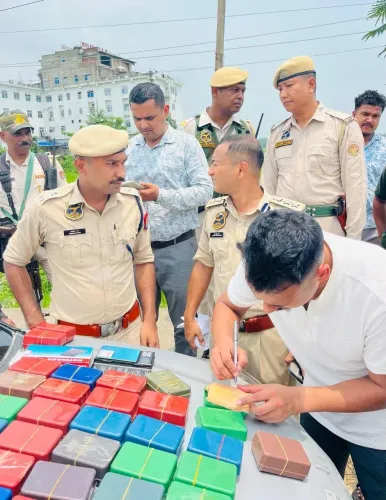
Amit Shah praises Assam CM Himanta for drug crackdown
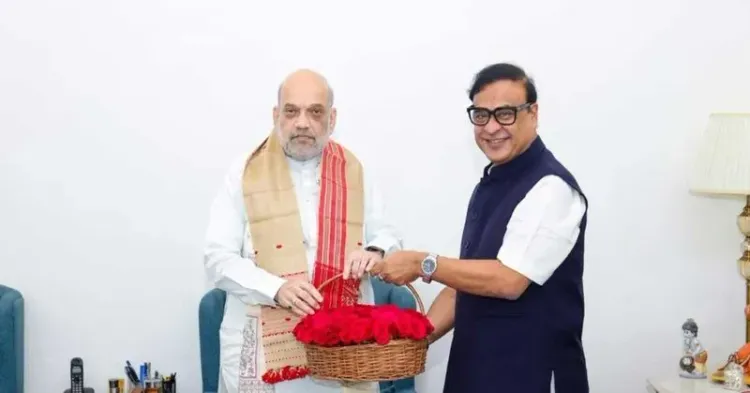
Synopsis
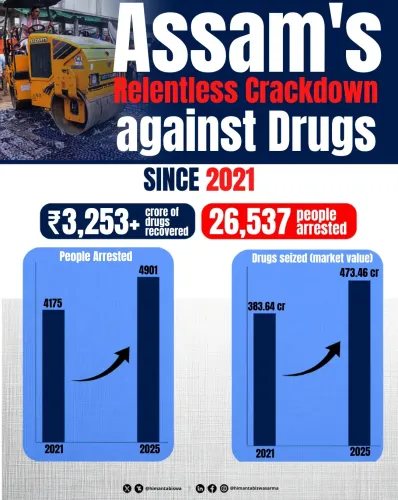
Union Home Minister Amit Shah publicly commended Assam CM Himanta Biswa Sarma and Assam Police for a sustained anti-drug drive yielding 945 arrests, 547 cases, and narcotics seizures worth over ₹182 crore — federal recognition of a northeastern state on the Golden Triangle transit corridor.
Key Takeaways
Union Home Minister Amit Shah publicly praised Assam CM Dr Himanta Biswa Sarma and Assam Police for their anti-narcotics operations.
The crackdown resulted in 945 arrests across 547 registered cases .
Narcotics seizures in the operations are valued at over ₹182 crore .
Assam sits on transit routes linked to the Golden Triangle , making drug enforcement a structural state priority.
Operations are conducted under the Narcotic Drugs and Psychotropic Substances (NDPS) Act framework, supported by Ministry of Home Affairs coordination.
Conviction rates in the 547 cases and potential joint operations with the Narcotics Control Bureau are the next key benchmarks to watch.
Nearly a thousand arrests, over half a thousand cases, and narcotics hauls worth more than ₹182 crore — Assam's sustained war on drug networks has earned a direct salute from the country's top law-enforcement authority. Union Home Minister Amit Shah publicly commended Assam Chief Minister Dr Himanta Biswa Sarma and Assam Police on Thursday, October 22, 2026, for their relentless crackdown on drug trafficking networks operating in and through the state.
The numbers behind the praise
The figures Shah cited are striking in scale: 945 arrests across 547 registered cases, accompanied by narcotics seizures valued at over ₹182 crore. The Chief Minister's Office of Assam shared the Home Minister's endorsement on X, framing it as federal recognition of a state-driven enforcement push. The commendation signals that the Centre views Assam's approach as a template worth noting in the northeast's broader counter-narcotics landscape.
Why Assam sits at the front line
Assam's geography places it squarely on transit corridors linked to the Golden Triangle — the Myanmar-Laos-Thailand drug-producing belt — making the state a pressure point for heroin, synthetic tablets, and precursor chemicals moving westward into India's heartland. The Ministry of Home Affairs has coordinated anti-narcotics operations with northeastern states under the Narcotic Drugs and Psychotropic Substances (NDPS) Act framework for over a decade, but operational intensity has visibly climbed under Chief Minister Sarma's tenure, with Assam Police executing raids that span border districts and urban supply chains alike.
What the Centre's recognition means in practice
When the Home Minister names a state chief minister and his police force by name in a public commendation, it does more than acknowledge past performance — it reaffirms resource alignment and political backing for continued operations. Border communities, long caught between traffickers and enforcement agencies, stand as the most immediate beneficiaries if the crackdown holds. The real test, however, lies ahead: conviction rates in the 547 registered cases will determine whether the arrests translate into durable dismantling of networks, or whether replacements quickly fill the void.
With the Narcotics Control Bureau increasingly active in the northeast and neighbouring states watching Assam's methods closely, the question is no longer whether Assam can arrest — it is whether its courts, prosecutors, and border-sealing coordination can turn seizures into sentences.
Point of View
Federal recognition converts operational numbers into political capital ahead of any assessment of his governance record. The broader arc here is the Centre's evolving playbook of 'name and reward' state compliance on security priorities — a soft-power coordination tool that bypasses formal MHA directives. Whether this translates into structural dismantling of trafficking networks, or remains a headline-driven arrest surge, depends entirely on what happens inside Assam's courtrooms over the next two years.
NationPress
22 Oct 2026
Frequently Asked Questions
How many arrests did Assam Police make in the drug crackdown praised by Amit Shah?
Assam Police made 945 arrests across 547 cases in the anti-narcotics drive that Union Home Minister Amit Shah publicly commended.
What is the value of narcotics seized by Assam Police?
The narcotics seized during Assam's crackdown operations are valued at over ₹182 crore , according to figures cited by the Chief Minister's Office.
Why is Assam a major focus for drug trafficking in India?
Assam lies on transit corridors connected to the Golden Triangle — the Myanmar-Laos-Thailand narcotics belt — making it a key entry point for heroin, synthetic tablets, and precursor chemicals moving into mainland India.
Under which law are drug cases registered in Assam?
Cases are registered under the Narcotic Drugs and Psychotropic Substances (NDPS) Act , the central legislation governing drug offences in India, with the Ministry of Home Affairs coordinating operations with state forces.
What is the next step after the arrests in Assam's drug crackdown?
The critical next benchmark is the conviction rate in the 547 registered cases, and potential expansion of joint operations with the Narcotics Control Bureau or neighbouring states.