SKM at five: How a farmers' platform became a national political force
Synopsis
The Samyukta Kisan Morcha forced the Centre to repeal three farm laws in 2021 — one of modern India's rarest legislative reversals. Five years on, it has morphed into something larger and more contested: a national political force targeting the BJP-RSS framework, with electoral reforms and civil rights on its agenda alongside unresolved agricultural demands. The identity question is now existential.
Key Takeaways
The Samyukta Kisan Morcha (SKM) was formed during the 2020–2021 protests against the Centre's three farm laws.
Its landmark achievement: the Centre repealed the three farm laws in November 2021 after sustained public agitation.
Core unresolved demand: statutory MSP at C2+50 per cent above comprehensive cultivation cost, per the M.S.
Swaminathan Commission formula.
The SKM now also demands withdrawal of four Labour Codes , the Electricity Privatisation Bill , expansion of MGNREGA , and electoral reforms.
Critics argue the political expansion risks diluting the platform's agricultural focus while core farm demands remain unmet.
Supporters contend that farming concerns are inseparable from wider questions of democracy, labour rights, and economic policy.
The Samyukta Kisan Morcha (SKM), born during the 2020–2021 agitation against the Centre's three farm laws, has evolved well beyond its agrarian origins — transforming from a focused farmers' campaign into a broad-based political mobilisation directed against the Bharatiya Janata Party (BJP)-led government. What began as an umbrella platform coordinating farmers' unions across India now devotes significant organisational energy to electoral reforms, labour rights, civil liberties, and opposition politics.
A landmark victory that reshaped the movement
The SKM's most consequential moment came in November 2021, when the Centre announced the repeal of the three farm laws after a year-long sustained agitation — a rare instance of a major piece of legislation being withdrawn under public pressure. The repeal handed the coalition enormous political and moral capital, cementing its status as one of the most influential mass movements in contemporary India.
Since that victory, the platform has witnessed several internal fissures and organisational erosions. Yet it retains a formidable national presence with reach across multiple states, and continues to press a wide-ranging set of demands that have expanded considerably since 2021.
Core agricultural demands still unresolved
At the heart of the SKM's unfinished agrarian agenda is the demand for a statutory guarantee of Minimum Support Price (MSP) based on the formula recommended by the National Commission on Farmers, chaired by agricultural scientist M.S. Swaminathan. Specifically, the coalition seeks MSP fixed at 50 per cent above the comprehensive cost of cultivation — known as the C2+50 per cent formula.
The C2 cost is the broadest measure of production expenditure, encompassing paid-out expenses on seeds, fertilisers, pesticides, hired labour, and irrigation (A2), the imputed value of family labour (FL), as well as the rental value of owned land and interest on owned capital. Farmer organisations argue that only C2+50 per cent delivers a fair return to cultivators. The government, however, has typically calculated MSP using the narrower A2+FL benchmark — and this difference lies at the centre of the ongoing MSP debate.
Beyond MSP, the SKM also demands a comprehensive farm loan waiver, withdrawal of the four Labour Codes and the Electricity Privatisation Bill, restoration and expansion of the Mahatma Gandhi National Rural Employment Guarantee Act (MGNREGA), and mobilisation against free trade agreements that, according to the platform, undermine agricultural incomes.
The political expansion: Electoral reforms and civil rights
Critics argue that while these agricultural demands remain unresolved, the SKM's organisational focus has shifted increasingly toward campaigns that move beyond farming. The evidence is visible in the platform's own recent resolutions and protest programmes.
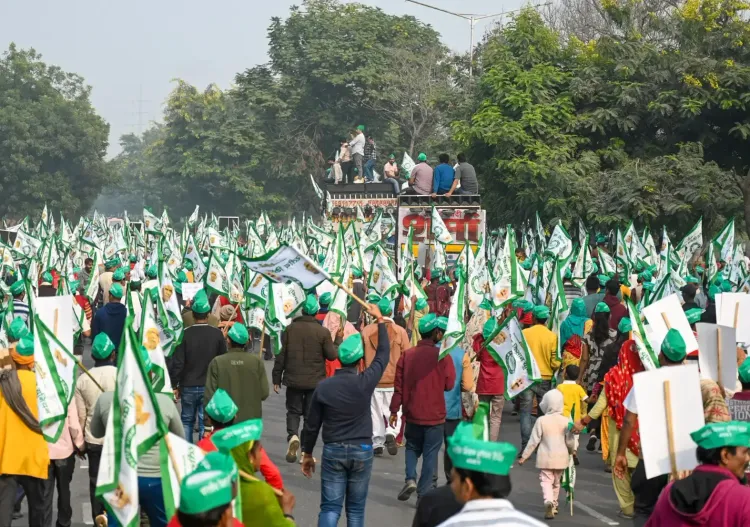
Earlier this year, at a national convention, the SKM explicitly called for rallying people against what it described as the 'BJP-RSS-led' ruling framework, linking farmers' concerns to labour rights, trade agreements, privatisation, and broader economic policy. The coalition participated in nationwide 'Jail Bharo' actions alongside trade unions, bringing together farmers, workers, and students under a wider anti-government agenda.
The platform has also pursued electoral reforms and backed amendments to the law governing the appointment of Election Commissioners. More recently, the SKM decided to join demonstrations alongside student and youth protesters, accusing authorities of undermining democratic rights — a mobilisation that carries few direct links to farm-sector distress.
Supporters versus critics: Two readings of the same movement
Supporters of the SKM's expanding scope contend that the broadening is a logical and necessary evolution. Their argument: farming communities cannot isolate their struggles from decisions affecting trade policy, electoral integrity, federalism, and public institutions. In this reading, a movement for farmers' welfare must also be a movement for democratic accountability.
Critics, however, contend that this trajectory risks diluting the platform's original focus at precisely the moment when core agricultural demands — statutory MSP, loan relief, labour code withdrawal — remain unfulfilled. From their perspective, every mobilisation dedicated to electoral controversies or civil rights causes represents organisational energy diverted from the pressing economic problems confronting farmers.
What the SKM's evolution means going forward
The central question confronting the SKM today is whether it can remain credibly rooted in farmers' concerns while simultaneously participating in broader political battles. An organisation born from the agrarian anxieties of 2020 has now elevated itself into a national political force with an ideological identity that extends well beyond the farm gate. Whether that expansion strengthens or strains its original mandate will likely define its relevance in the years ahead.
Point of View
The coalition now risks trading its most potent asset, moral clarity, for the messier terrain of electoral politics. Core agricultural demands like statutory MSP remain undelivered years after the protests ended, yet the SKM's bandwidth is visibly stretched across labour codes, election commissioner appointments, and student protests. The harder question mainstream coverage sidesteps is whether this expansion is strategic consolidation or organisational drift — and whether India's farming communities, whose economic distress is acute and structural, are best served by a movement that is increasingly indistinguishable from broader opposition politics.
NationPress
23 Oct 2026
Frequently Asked Questions
What is the Samyukta Kisan Morcha (SKM)?
The Samyukta Kisan Morcha (SKM) is an umbrella platform of farmers' organisations and unions that was formed during the 2020–2021 protests against the Centre's three farm laws. It led the year-long agitation and achieved a landmark victory in November 2021 when the Centre repealed the laws.
What is the SKM's demand on Minimum Support Price (MSP)?
The SKM demands a statutory guarantee of MSP based on the C2+50 per cent formula recommended by the National Commission on Farmers chaired by M.S. Swaminathan — meaning MSP set at 50 per cent above the comprehensive cost of cultivation. The government has typically calculated MSP using the narrower A2+FL benchmark, and this gap is the heart of the ongoing MSP dispute.
How has the SKM evolved beyond its original farm law focus?
Since the 2021 repeal, the SKM has expanded its agenda to include withdrawal of four Labour Codes, the Electricity Privatisation Bill, expansion of MGNREGA, opposition to free trade agreements, electoral reforms, and support for student and youth protests. At a recent convention, it explicitly called for mobilisation against what it described as the 'BJP-RSS-led' ruling framework.
What do critics say about the SKM's political expansion?
Critics argue that broadening into electoral controversies and civil rights campaigns risks diluting the movement's original agricultural focus at a time when core farm demands — statutory MSP, loan waivers, labour protections — remain unmet. They contend that organisational energy directed at political battles is energy taken away from unresolved economic problems facing farmers.
What is the significance of the C2 versus A2+FL cost debate?
C2 is the broadest measure of production cost, covering paid-out expenses, imputed family labour, rental value of owned land, and interest on owned capital, while A2+FL covers only paid-out expenses and imputed family labour. Farmers' unions argue that only C2+50 per cent provides a truly remunerative return, whereas the government's A2+FL-based MSP underestimates true cultivation costs.