Shivraj hits 'Regime Change Gang' after ABVP, BJP poll wins
Synopsis
Agriculture Minister Shivraj Singh Chouhan mocked opposition forces as a 'Regime Change Gang' on 18 October 2026, citing ABVP wins at Punjab and Delhi universities, 13 Odisha campuses, Gujarat civic polls, and by-elections in Assam, Bengal and Puducherry as proof the public mood defies their narrative.
Key Takeaways
Shivraj Singh Chouhan coined the term 'Regime Change Gang' on 18 October 2026 to describe opposition forces he accuses of manufacturing anti-BJP narratives.
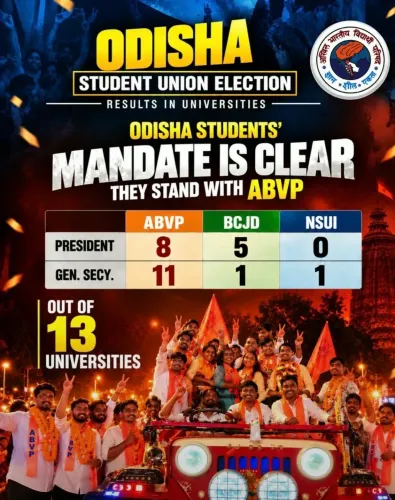
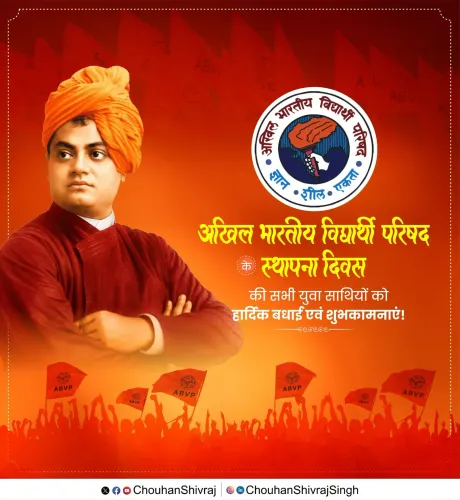
ABVP victories at Punjab University , Delhi University , and 13 universities in Odisha were cited as evidence of BJP/RSS-aligned youth dominance.
Results from Gujarat municipal elections and by-elections in Assam, Bengal, and Puducherry were also included in Chouhan's list of wins.
Chouhan used the colloquial Hindi idiom 'daal nahin gal rahi' to ridicule what he called the opposition's repeated electoral failures.
The minister hinted at a follow-up post the next day explaining why the opposition 'keeps failing' — deliberately extending the news cycle.
Citing student-union and local-body wins to project national momentum is a BJP messaging strategy in use since 2014 .
Every time ballot boxes close, a question gets louder — and Union Agriculture Minister Shivraj Singh Chouhan posed it bluntly on Sunday, 18 October 2026: why does the opposition's script keep failing before the verdict of the people? In a sharp post on X, the senior BJP leader coined a pointed label — 'Regime Change Gang' (regime change gang) — for what he described as forces that conspire, spread falsehoods, and manufacture narratives, only to watch their dreams burst 'like soap bubbles' against the public's mandate.
The wins Chouhan is counting
Chouhan's post lists a specific cluster of recent results as his evidence: ABVP victories at Punjab University and Delhi University, wins across 13 universities in Odisha, results in Gujarat municipal body elections, and by-election outcomes in Assam, Bengal, and Puducherry. Taken together, he argues, they reveal a clear gap — 'जनता का मूड कुछ और है, और रिजीम चेंज गैंग की स्क्रिप्ट कुछ और' ('the public's mood is something else, and the regime-change gang's script is something else entirely').
ABVP — the Akhil Bharatiya Vidyarthi Parishad — is the RSS-affiliated student organisation that has contested university elections as a proxy barometer of youth sentiment since long before the BJP's national resurgence in 2014. Wins at marquee campuses like Delhi University, where the student union result is watched nationally, carry symbolic weight well beyond the college corridors.
The 'daal nahin gal rahi' question
Chouhan closes with a vernacular jab drawn from everyday Hindi: 'भैया, भारत में तुम्हारी दाल गल क्यों नहीं रही?' — roughly, 'Brother, why can't you get your way in India?' It is a colloquial idiom for persistent failure despite effort, and Chouhan wields it to mock what he frames as serial miscalculations by the opposition. He adds a teaser: if introspection does not yield the answer, he will explain it himself the following day.
That deliberate cliff-hanger is itself a messaging tactic — it extends the news cycle, invites speculation, and keeps the political conversation centred on BJP's narrative of electoral invincibility across geographies and demographics: 'गाँव हो या शहर, युवा हों या आम नागरिक' ('village or city, youth or ordinary citizen').
A pattern older than the post
Ruling-party leaders have routinely cited student union and local body results to rebut opposition claims of eroding popularity — a playbook that has run consistently since 2014. The framing serves a dual purpose: it energises the party's own cadre while signalling to swing voters that momentum remains firmly in one direction. By stringing together campus, municipal, and by-election wins into a single post, Chouhan is doing exactly that — converting a scatter of local contests into a single national story of mandate renewal.
Whether the next round of state assembly by-elections and university polls confirms or complicates that story, the minister has already set the terms of the argument — and promised chapter two tomorrow.
Point of View
Civic, and by-election wins under a single punchy label, he turns a collection of localised results into a unified proof-of-mandate narrative ahead of what is expected to be a busy by-election season. The 'Regime Change Gang' coinage is designed to stick — it frames the opposition not as a legitimate democratic challenger but as a conspiratorial fringe, a framing the BJP has found electorally useful since 2019. The teaser about explaining opposition failures 'tomorrow' is a deliberate engagement device, keeping BJP's version of the story dominant for at least another news cycle. Analysts will watch whether the promised follow-up post escalates the rhetoric or pivots to a more substantive policy contrast.
NationPress
18 Oct 2026
Frequently Asked Questions
Who is the 'Regime Change Gang' Shivraj Singh Chouhan is referring to?
Chouhan does not name specific individuals or parties. He uses 'Regime Change Gang' as a collective label for opposition forces he accuses of plotting power transfers through conspiracies, misinformation, and manufactured political narratives rather than democratic means.
Where did ABVP win elections that Chouhan mentioned?
Chouhan cited ABVP victories at Punjab University (Chandigarh), Delhi University , and 13 universities in Odisha as part of a broader sweep of recent results he presented as evidence of BJP and RSS-aligned popularity.
What does 'daal nahin gal rahi' mean in Chouhan's post?
'Daal nahin gal rahi' is a common Hindi idiom meaning someone's plans or efforts are consistently failing to yield results. Chouhan used it to mock the opposition's inability to translate its anti-BJP campaigns into electoral wins.
What by-election results did Shivraj Singh Chouhan reference?
Chouhan referenced by-election outcomes in Assam , West Bengal , and Puducherry as part of the string of results he argues reflect public support for the ruling dispensation.
Why does BJP often highlight ABVP student union wins?
Student union results at major universities like Delhi University are seen as a barometer of youth political sentiment. BJP and its affiliated organisations have highlighted ABVP victories consistently since 2014 to demonstrate organisational strength among younger voters and counter opposition claims of declining support.