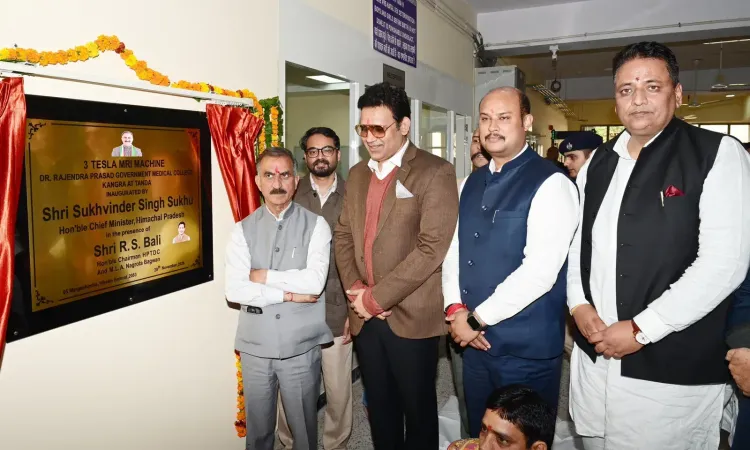
HP CM inaugurates 3 Tesla MRI at Tanda Medical College
Synopsis
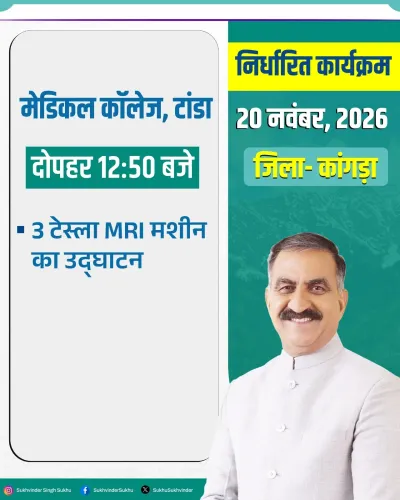
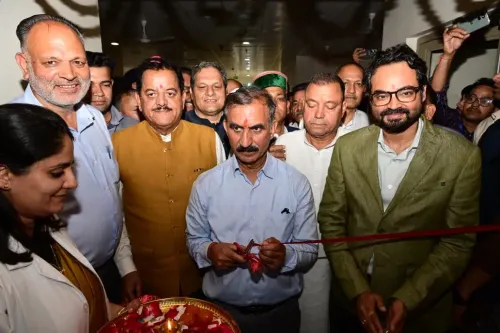
The Himachal Pradesh Chief Minister's Office inaugurated a 3 Tesla MRI machine at Dr. RPGMC Tanda on 20 November 2026, bringing high-field diagnostic imaging to Kangra district's public health system and offering relief to poor families who earlier had to travel long distances for advanced scans.
Key Takeaways
A 3 Tesla MRI machine was inaugurated at Dr.
Rajendra Prasad Government Medical College, Tanda on 20 November 2026 .
The facility serves residents of Tanda and Kangra district , eliminating the need to travel to distant cities for high-resolution imaging.
The Chief Minister's Office specifically highlighted relief for poor and needy families , who faced prohibitive costs at private centres.
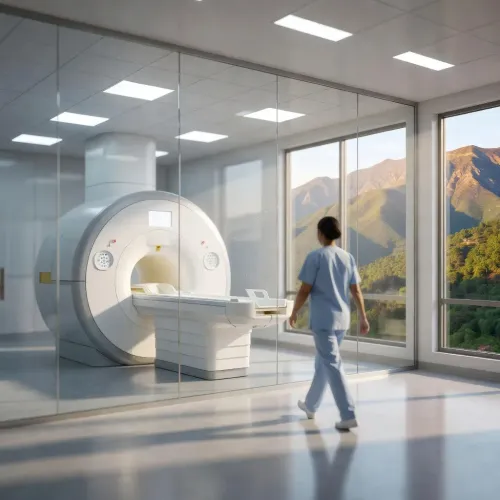
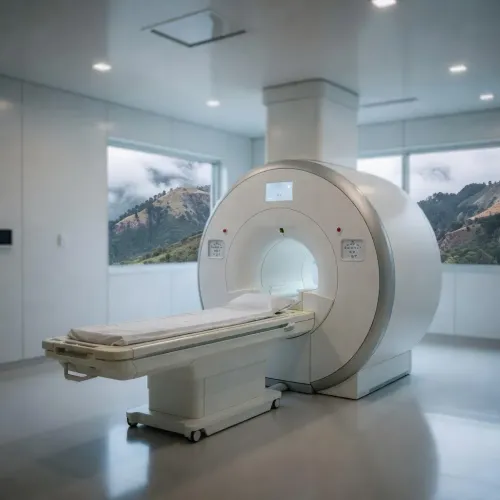
A 3T scanner delivers twice the magnetic field strength of standard 1.5T hospital MRI units, enabling sharper and faster diagnostic imaging.
RPGMC Tanda functions as the apex tertiary-care and medical education institution for the Kangra valley, amplifying the scanner's impact across the region.
The post signals a broader healthcare infrastructure rollout across Himachal Pradesh, though specifics of future projects were not detailed.
A mountain district long dependent on distant city hospitals just got a diagnostic upgrade that changes the calculus for thousands of families. The Chief Minister's Office of Himachal Pradesh announced on Friday, 20 November 2026, that a 3 Tesla MRI machine has been inaugurated at Dr. Rajendra Prasad Government Medical College (Dr. RPGMC), Tanda — bringing one of medicine's most powerful imaging tools to Kangra district for the first time within the public health system.
What a 3 Tesla scanner means for Kangra's patients
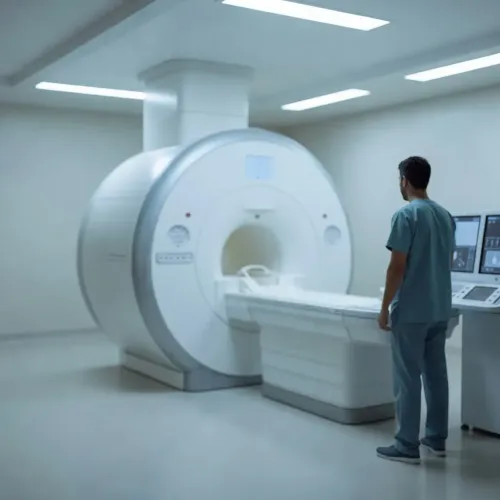
Not all MRI machines are equal. A 3 Tesla (3T) scanner operates at twice the magnetic field strength of the more common 1.5 Tesla units found in most district hospitals — producing sharper images, faster scans, and clearer reads on neurological, cardiac, and musculoskeletal conditions. For patients in Kangra and Tanda who previously had to travel to Chandigarh or Shimla for high-resolution imaging, the nearest 3T machine just moved into their own backyard.
The Chief Minister's Office, in its post, underlined the equity dimension directly: 'khāskar garib aur zarūratmand parivāron ke liye yah baṛī rāhat hai' — 'especially for poor and needy families, this is great relief.' That framing matters. MRI scans at private facilities can cost anywhere between ₹5,000 and ₹15,000 per scan; government access removes that barrier entirely for patients covered under state and central health schemes.
Dr. RPGMC Tanda's role in Himachal's health network
Dr. Rajendra Prasad Government Medical College in Tanda is Himachal Pradesh's principal tertiary-care institution for the entire Kangra valley — a region that accounts for the state's largest population. The college doubles as a teaching hospital, meaning the new 3T machine will also sharpen the diagnostic training of medical students and residents rotating through radiology. Infrastructure here cascades outward: better imaging at the apex referral centre reduces unnecessary patient transfers and eases the load on over-burdened wards.
Across India, state governments have steadily pushed high-field MRI scanners from private metro hospitals into government medical colleges — part of a broader effort to close the diagnostic gap between cities and states like Himachal Pradesh, where mountainous terrain makes every kilometre of travel exponentially harder for the sick. This inauguration follows that pattern, with Himachal now joining the cohort of states that have positioned 3T capability at their regional medical anchors.
The bigger promise embedded in the post
The Chief Minister's Office's message was notably incomplete — the original post trails off mid-sentence with the words 'hamārā prayās hai ki Himāchal ke...' ('our effort is that Himachal's...'), suggesting a broader healthcare commitment was articulated beyond what the platform's character limit captured. The intent, however, reads clearly: this single inauguration is positioned as one node in a wider infrastructure rollout, not a one-off gesture. What comes next — whether similar equipment reaches Mandi, Hamirpur, or Kullu — will reveal whether the ambition matches the momentum.
For now, the message from Tanda is concrete and consequential. A 3 Tesla MRI machine in a government hospital is not a ribbon-cutting abstraction — it is a scan that a stroke patient gets within hours instead of days, a tumour spotted earlier, a diagnosis that does not bankrupt a family in the hills.
Point of View
Addressing the chronic under-investment in imaging infrastructure outside metros. The equity framing the Chief Minister's Office chose — centering poor families, not just clinical capability — aligns with the political calculus of welfare-led governance that hill-state governments have leaned on. If the state follows through with similar upgrades in other districts, it could meaningfully reduce diagnostic out-of-pocket expenditure, one of the leading drivers of household debt in rural Himachal. The half-finished sentence in the original post, hinting at a larger promise, is itself a signal worth watching.
NationPress
20 Nov 2026
Frequently Asked Questions
What is a 3 Tesla MRI machine and why is it significant?
A 3 Tesla MRI machine uses a magnetic field twice as strong as the standard 1.5 Tesla units, producing sharper images and enabling faster, more accurate diagnosis of neurological, cardiac, and other conditions. Its installation at a government hospital makes this advanced imaging available free or at subsidised cost to patients.
Where is Dr. RPGMC Tanda located?
Dr. Rajendra Prasad Government Medical College (Dr. RPGMC) is located in Tanda, in the Kangra district of Himachal Pradesh. It is the principal tertiary-care government hospital for the Kangra valley region.
Who will benefit from the new MRI machine at Tanda?
Residents of Tanda and Kangra district will benefit, particularly poor and needy families who previously had to travel to distant cities and pay high charges at private hospitals for advanced MRI scans.
When was the 3 Tesla MRI inaugurated at Tanda Medical College?
The 3 Tesla MRI machine was inaugurated at Dr. RPGMC Tanda on Friday, 20 November 2026, as announced by the Chief Minister's Office of Himachal Pradesh.
Is Himachal Pradesh expanding medical infrastructure in other districts too?
The Chief Minister's Office post suggested a broader commitment to healthcare infrastructure across Himachal Pradesh, though specific projects for other districts have not been officially detailed yet.