HP CM Office Hails Kishau Dam Milestone, Backs New Panchayat Reps

Synopsis
The Chief Minister's Office of Himachal Pradesh announced a significant achievement in the Kishau Dam Project on the Tons River and expressed confidence in newly elected panchayat representatives to lead model village governance with honesty and transparency.
Key Takeaways
The Chief Minister's Office of Himachal Pradesh posted on June 18, 2026 about two major developments: panchayat governance and the Kishau Dam Project.
The state government expressed confidence in newly elected panchayat representatives to build model panchayats with honesty, transparency and sensitivity.
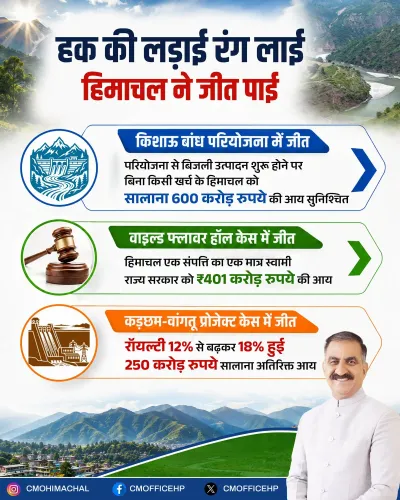
The Kishau Dam Project , a joint project of Himachal Pradesh and Uttarakhand on the Tons River , recorded a 'significant achievement' as per the official announcement.
The Kishau project is designed to generate hydroelectric power and support irrigation across the Yamuna basin.
India's 73rd Constitutional Amendment (1992) forms the legal backbone for panchayati raj institutions whose newly elected members are being addressed by the state.
Further details on the specific Kishau milestone and capacity-building plans for new panchayat members are awaited from the state government.
The Chief Minister's Office of Himachal Pradesh, on Thursday, June 18, 2026, posted a message on X expressing confidence in newly elected panchayat representatives and announcing a significant achievement in the Kishau Dam Project, a major inter-state hydropower and irrigation initiative on the Tons River.
The post, shared from the official @CMOFFICEHP handle, stated in Hindi: 'पूर्ण विश्वास है कि नवनिर्वाचित प्रतिनिधि ईमानदारी, पारदर्शिता और संवेदनशीलता के साथ जनसेवा को प्राथमिकता देते हुए आदर्श पंचायतों के निर्माण में अग्रणी भूमिका निभाएँगे।' ['We have full confidence that the newly elected representatives will play a leading role in building model panchayats, prioritising public service with honesty, transparency and sensitivity.']
Context
The statement comes in the backdrop of recently concluded panchayat elections in Himachal Pradesh, following which a fresh cohort of grassroots representatives has assumed office. The Chief Minister's Office used the occasion to underline the state government's expectations from local bodies, emphasising values of transparency and accountability in the delivery of rural services. Panchayati Raj Institutions remain the primary vehicle for decentralised governance across India's hill states, and their effective functioning is seen as critical to last-mile delivery of welfare schemes.Policy Backdrop
India's 73rd Constitutional Amendment of 1992 established the constitutional framework for elected panchayati raj institutions, mandating regular elections and devolution of powers to village-level bodies. Himachal Pradesh has, in successive administrations, combined capacity-building of elected local bodies with large-scale infrastructure investment — a dual approach that reflects the development template adopted by Himalayan hill states since the early 2000s. On the infrastructure front, the Kishau Dam Project, a joint undertaking of Himachal Pradesh and Uttarakhand on the Tons River — a tributary of the Yamuna — is designed to generate hydroelectric power and support irrigation across the Yamuna basin. The project has been in planning and clearance stages for several years, making any forward movement a notable development for both states.Stakeholders and Impact
The twin announcements carry implications for two distinct sets of stakeholders. Newly elected panchayat members across Himachal Pradesh are being called upon to function as frontline administrators, responsible for rural development planning and basic service delivery in their respective gram panchayats. For residents of the Yamuna basin — spanning communities in both Himachal Pradesh and Uttarakhand — the Kishau Dam Project holds the promise of improved water availability for irrigation and an addition to the region's hydroelectric capacity. Inter-state water infrastructure projects of this scale require sustained coordination between state governments, central agencies, and affected communities, making each milestone significant.What's Next
The state government's reference to a 'significant achievement' in the Kishau Dam Project is expected to be elaborated through official communications detailing the specific milestone — whether a statutory clearance, funding release, or construction progress. Observers will also watch for structured capacity-building programmes for the newly elected panchayat representatives, which have historically been rolled out by the state in the weeks following local body elections. Both tracks — grassroots governance and Himalayan infrastructure — are likely to remain central to Himachal Pradesh's policy agenda in the months ahead.Point of View
Suggesting the state is keen to set a governance benchmark early in the new local bodies' tenure. The Kishau Dam announcement, even without specifics, is politically significant — progress on a long-pending inter-state project is a credibility marker for any state government. Taken together, the post fits a well-established pattern among hill-state governments of linking decentralised democracy with large infrastructure ambition to shore up both rural and urban support bases.
NationPress
17 Sept 2026
Frequently Asked Questions
What is the Kishau Dam Project and which states are involved?
The Kishau Dam Project is a multipurpose hydroelectric and irrigation project on the Tons River, a tributary of the Yamuna, being developed jointly by Himachal Pradesh and Uttarakhand. It is intended to generate hydroelectric power and improve water availability for irrigation across the Yamuna basin.
What did the Himachal Pradesh Chief Minister's Office announce on June 18, 2026?
The Chief Minister's Office of Himachal Pradesh announced a significant achievement in the Kishau Dam Project and expressed confidence in newly elected panchayat representatives to prioritise public service with honesty, transparency and sensitivity.
What are panchayati raj institutions and why do they matter in Himachal Pradesh?
Panchayati raj institutions are elected local self-government bodies at the village level, established under India's 73rd Constitutional Amendment of 1992. In Himachal Pradesh, they are the primary mechanism for decentralised rural governance, responsible for development planning and delivery of basic services.
What is the significance of the Kishau Dam for the Yamuna basin?
The Kishau Dam is expected to add to the hydroelectric capacity of the Himalayan region and support irrigation for communities in the Yamuna basin spanning Himachal Pradesh and Uttarakhand, addressing both energy security and agricultural water needs.
What should newly elected panchayat members in Himachal Pradesh focus on according to the state government?
According to the Chief Minister's Office, newly elected panchayat representatives should prioritise public service with honesty, transparency and sensitivity, and play a leading role in building model panchayats across the state.