HP CM Office Pays Tribute to India's First Voter Shyam Saran Negi
Synopsis
The Chief Minister's Office of Himachal Pradesh paid tribute on 1 July 2026 to Shyam Saran Negi of Kalpa, Kinnaur, who cast the first ballot in independent India during the 1951 general elections, calling his life an inspiration for democratic participation.
Key Takeaways
Shyam Saran Negi of Kalpa, Kinnaur is recognised as the first voter of independent India, having voted on 25 October 1951 .
The Himachal Pradesh Chief Minister's Office issued a formal tribute on his birth anniversary on 1 July 2026 .
The CM Office stated that democracy 'flourishes only through the participation of aware, dutiful, and active citizens.' Negi's historic vote was made possible by a mobile polling party that reached Kinnaur early due to anticipated harsh winter conditions.
Kinnaur , a tribal district bordering Tibet, has since become a symbol of democratic inclusion in India's remote Himalayan regions.
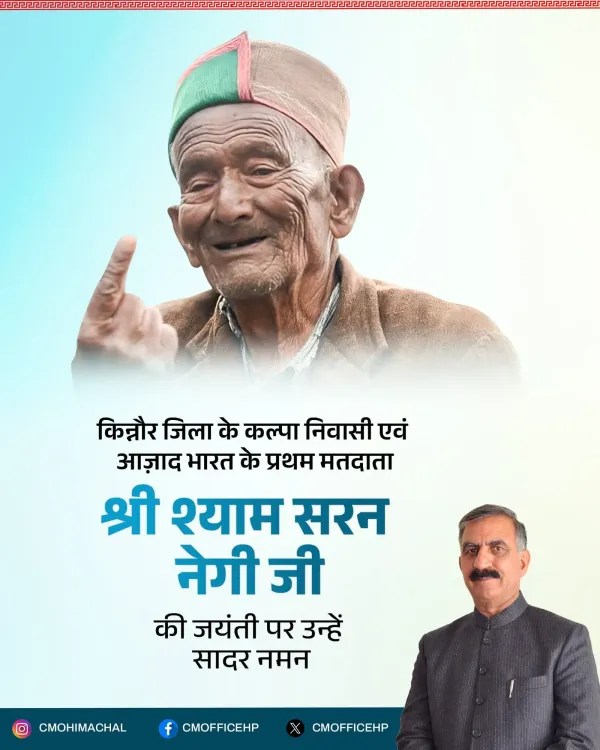
The Chief Minister's Office of Himachal Pradesh on Wednesday, 1 July 2026 paid tribute to Shyam Saran Negi, a resident of Kalpa in Kinnaur district and widely recognised as the first voter of independent India, on the occasion of his birth anniversary.
The official post, written in Hindi, offered a respectful salute to Negi — 'सादर नमन' (respectful salutation) — and noted that his life stands as an inspiration demonstrating that 'democracy flourishes only through the participation of aware, dutiful, and active citizens.'
Context
Shyam Saran Negi cast his ballot on 25 October 1951, during India's first general elections of 1951–52, making him the first person to vote in independent India. A mobile polling party had reached the remote Himalayan terrain of Kinnaur ahead of schedule due to harsh winter conditions, enabling Negi to vote before polling began elsewhere in the country.
Kalpa, a small village nestled in the Kinnaur district of Himachal Pradesh, thus became the site of one of the earliest polling stations in free India's democratic experiment — a distinction that has made Negi a living symbol of universal adult franchise.
Policy Backdrop
India's first general elections established universal adult franchise across an extraordinarily diverse terrain, from coastal plains to high Himalayan valleys. The decision to send mobile polling parties to remote tribal areas like Kinnaur was a deliberate act of democratic inclusion by the nascent republic, ensuring that geography would not be a barrier to citizenship rights.
State governments across India have periodically issued tributes to early voters and election pioneers as part of a broader national practice of commemorating the 1951–52 elections. Such observances serve to reinforce the legitimacy of democratic institutions and highlight the role of citizens in remote regions in building the republic.
Stakeholders and Impact
The tribute carries particular resonance for tribal communities and remote voters across Himachal Pradesh, for whom Negi's story represents the constitutional promise that every citizen's vote carries equal weight regardless of geography or social background. Kinnaur, a tribal district bordering Tibet, has historically faced infrastructural challenges that make voter participation especially meaningful.
Election awareness programmes in states like Himachal Pradesh frequently invoke Negi's legacy to encourage first-time voters and to underscore civic duty. His story has been used in school curricula and voter-awareness campaigns to connect younger generations to the founding democratic moment of 1951.
What's Next
State education departments and the election commission are expected to continue marking anniversaries of the 1951 vote through targeted voter-awareness drives, particularly in districts like Kinnaur ahead of future assembly elections. Tributes like this one from the Chief Minister's Office signal an ongoing institutional commitment to celebrating grassroots democratic participation as a core value of the Himachal Pradesh government's public messaging.
Point of View
Connecting a tribal Himalayan constituency to the republic's founding moment. By framing Negi's life as proof that democracy thrives on active citizenship, the CM Office subtly reinforces voter mobilisation messaging ahead of future electoral cycles. The tribute also signals the state's intent to position Kinnaur's tribal identity as a point of democratic pride rather than peripheral marginality. In a broader national pattern, such gestures serve to anchor civic education in lived, local history rather than abstract constitutional text.
NationPress
1 Jul 2026
Frequently Asked Questions
Who is Shyam Saran Negi and why is he famous?
Shyam Saran Negi is a resident of Kalpa village in Kinnaur district, Himachal Pradesh, recognised as the first voter of independent India. He cast his ballot on 25 October 1951 during India's first general elections, when a mobile polling party reached Kinnaur early due to the region's harsh winter conditions.
When did Shyam Saran Negi first vote?
Shyam Saran Negi voted on 25 October 1951, during India's first general elections of 1951–52, making him the first person to exercise the franchise in independent India.
Where is Kalpa located?
Kalpa is a village in Kinnaur district, Himachal Pradesh, situated in the high Himalayan region bordering Tibet. It was the site of one of the earliest polling stations in India's first general elections.
Why did the Himachal Pradesh CM Office pay tribute to Shyam Saran Negi?
The Chief Minister's Office of Himachal Pradesh paid tribute to Shyam Saran Negi on his birth anniversary on 1 July 2026, honouring him as India's first voter and citing his life as an inspiration for democratic participation and civic duty.
What is the significance of India's 1951 general elections?
India's 1951–52 general elections were the first in the country after independence, establishing universal adult franchise. Mobile polling parties were deployed to remote areas like Kinnaur in Himachal Pradesh to ensure that geography did not prevent citizens from voting.