HP CM Office pays tribute to Nehru on his birth anniversary
Synopsis
The Chief Minister's Office of Himachal Pradesh marked Nehru Jayanti on 14 November 2026 with a tribute citing the founding of IITs, AIIMS, dams and steel plants as cornerstones of Nehru's nation-building vision, while also acknowledging Devbhoomi Himachal's bond with the late Prime Minister.
Key Takeaways
The Chief Minister's Office of Himachal Pradesh posted a formal tribute to Pandit Jawaharlal Nehru on his birth anniversary, 14 November 2026 .
The tribute specifically cited the IITs, AIIMS, major dams and public-sector steel plants as pillars of Nehru's modernisation programme.
Nehru served as India's first Prime Minister from 1947 to 1964 and initiated the Five-Year Planning framework.
The first IIT was established at Kharagpur in 1951 and AIIMS New Delhi in 1956 under his tenure.
14 November is observed as Children's Day across India in honour of Nehru's affinity for children.
The post referenced Devbhoomi Himachal Pradesh's own connection to Nehru's legacy of nation-building.
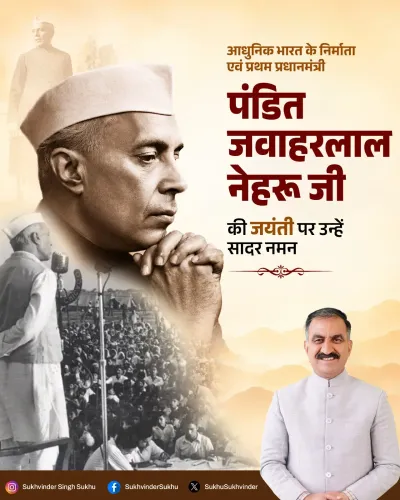
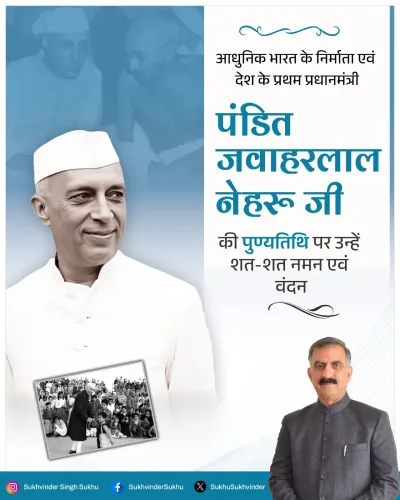
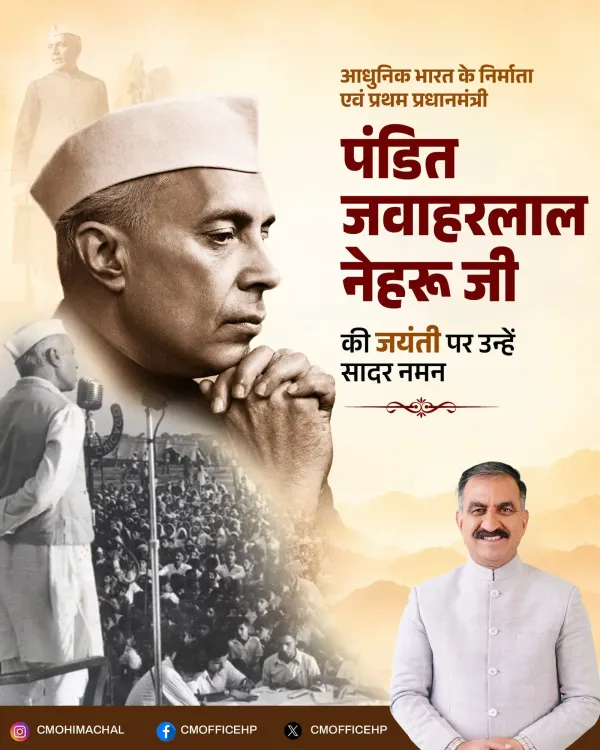
On the birth anniversary of India's first Prime Minister, the Chief Minister's Office of Himachal Pradesh on Saturday, 14 November 2026 offered a formal tribute to Pandit Jawaharlal Nehru — honouring the leader who steered a newly independent nation into the modern age, institution by institution, dam by dam.
The post, shared on Nehru Jayanti, saluted Nehru as 'aadhunik Bharat ke nirmata' — the architect of modern India — and drew a vivid arc from the IITs to AIIMS, from hydroelectric dams to public-sector steel plants. 'He ushered India into a new era of modernity and laid the strong foundation of nation-building,' the message read, before turning to Himachal Pradesh's own bond with the late Prime Minister.
From Kharagpur to New Delhi: the institutions Nehru built
The tribute's specific references carry real weight. Nehru's government established the first Indian Institute of Technology at Kharagpur in 1951 and the All India Institute of Medical Sciences in New Delhi in 1956 — twin pillars of scientific and health infrastructure that still define the country's elite education landscape. The great river dams and steel plants of the First and Second Five-Year Plans were Nehru's other monuments: he called them 'the new temples of modern India.'
That framing — temples of the modern state — was deliberate. Nehru governed from 1947 to 1964, shaping not just policy but the philosophical architecture of a secular, industrialising republic at a moment when the choices made were irreversible.
Devbhoomi's remembrance of Pandit Ji
The post from Himachal Pradesh's Chief Minister's Office also gestured toward the state's particular connection to Nehru — though the text trails off, the reference to 'Devbhoomi Himachal' signals a pride of place in that shared national memory. The hill state, carved out as a full-fledged entity in the post-independence reorganisation, was itself a product of the era Nehru shaped.
14 November doubles as Children's Day across India, observed on Nehru's birthday in recognition of his affection for children — a detail that makes the annual observance one of the most widely marked on the government calendar, with state administrations from Shimla to Chennai issuing tributes in near-unison.
Seventy-two years after his peak in office, the institutions Nehru seeded remain the country's most competitive — and the debate about his legacy, never quite settled, makes each Jayanti a small reckoning with the choices that made modern India.
Point of View
AIIMS, steel plants — as a counter to revisionist critiques of the Nehruvian era. The specificity of the references (from IITs to dams) is deliberate political shorthand: each institution is both a historical fact and a rhetorical riposte. With Children's Day providing a softer, non-partisan frame, such tributes allow state administrations to participate in national commemoration while quietly staking out ideological ground on who built modern India.
NationPress
14 Nov 2026
Frequently Asked Questions
Why is 14 November celebrated as Children's Day in India?
14 November is observed as Children's Day (Bal Diwas) in India to mark the birth anniversary of Pandit Jawaharlal Nehru, who was famously fond of children and was affectionately called Chacha Nehru by them. India began observing the date as Children's Day after his death in 1964.
What institutions did Jawaharlal Nehru establish during his tenure?
During his tenure as Prime Minister from 1947 to 1964 , Nehru's government established key institutions including the Indian Institutes of Technology (the first at Kharagpur in 1951), the All India Institute of Medical Sciences in New Delhi (1956), major hydroelectric dams, and public-sector steel plants under the Five-Year Plans.
What did the Himachal Pradesh CM Office post on Nehru Jayanti 2026?
The Chief Minister's Office of Himachal Pradesh posted a tribute on 14 November 2026 honouring Nehru as the 'architect of modern India,' specifically citing the IITs, AIIMS, dams and steel plants as the foundations of his nation-building legacy, and referencing Himachal Pradesh's own connection to that legacy.
What is Nehru Jayanti and when is it observed?
Nehru Jayanti is the birth anniversary of Pandit Jawaharlal Nehru, India's first Prime Minister, observed every year on 14 November . It is simultaneously celebrated as Children's Day across the country.
What is Devbhoomi Himachal Pradesh?
Devbhoomi — meaning 'Land of the Gods' — is a popular epithet for Himachal Pradesh , the northern Indian hill state known for its temples, Himalayan landscape and spiritual heritage. State government communications frequently use the term as a point of regional pride.