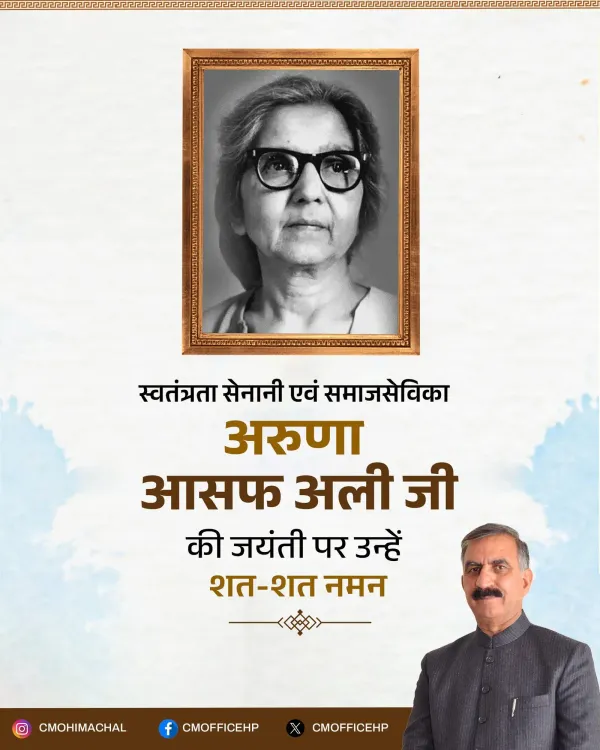
HP CM Office Pays Tribute to Aruna Asaf Ali on Birth Anniversary
Synopsis
The Chief Minister's Office of Himachal Pradesh paid tribute to Aruna Asaf Ali on her birth anniversary, honouring her iconic 1942 flag hoisting at Gowalia Tank Maidan, Mumbai — an act that galvanised the Quit India Movement and defined her legacy as a fearless freedom fighter and social worker.
Key Takeaways
The Chief Minister's Office of Himachal Pradesh posted an official tribute to Aruna Asaf Ali on 16 July 2026 , her birth anniversary.
The post honoured her as a pioneering leader of the Quit India Movement , freedom fighter, and social worker.
Aruna Asaf Ali hoisted the Congress flag at Gowalia Tank Maidan, Mumbai on 9 August 1942 , defying British colonial authorities after top Congress leaders were arrested.
The maidan has since been renamed August Kranti Maidan in memory of the 1942 events.
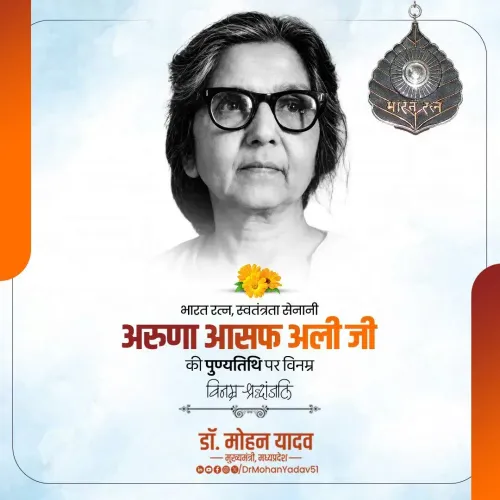
Aruna Asaf Ali was awarded the Bharat Ratna posthumously in 1997 , India's highest civilian honour.
Such tributes form part of a broader national pattern institutionalised under the Azadi Ka Amrit Mahotsav framework launched in 2021 .
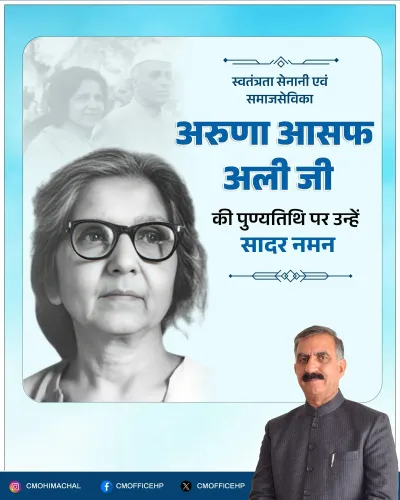
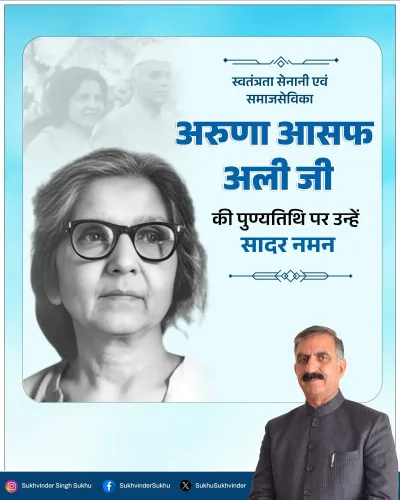
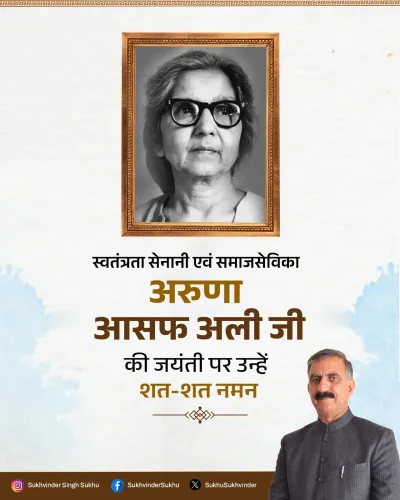
The Chief Minister's Office of Himachal Pradesh on Thursday, 16 July 2026 paid tribute to freedom fighter and Quit India Movement leader Aruna Asaf Ali on her birth anniversary, honouring her legacy through an official post on X.
The post, written in Hindi, offered respectful salutations — 'saadar naman' (respectful salute) — to Aruna Asaf Ali, describing her as a pioneering leader of the Quit India Movement, a freedom fighter, and a social worker. It highlighted her act of hoisting the Congress flag at Gowalia Tank Maidan, Mumbai, as an act that 'infused new consciousness into the independence movement.'
Context
Aruna Asaf Ali is remembered as one of the most courageous figures of India's independence struggle. On 9 August 1942, when British authorities arrested top Congress leaders including Mahatma Gandhi, Aruna Asaf Ali stepped forward and hoisted the Indian National Congress flag at Gowalia Tank Maidan in Mumbai, defying colonial rule in a moment that became iconic.
The act was a direct response to the Quit India resolution passed by the Indian National Congress the previous day, demanding an immediate end to British colonial rule. The maidan has since been renamed August Kranti Maidan — the Ground of the August Revolution — in memory of those events.
Policy Backdrop
Official tributes to independence-era figures have become a structured part of Indian governance, particularly since the Government of India launched the Azadi Ka Amrit Mahotsav in 2021 to mark 75 years of independence. The initiative institutionalised nationwide commemorations of freedom fighters on birth and death anniversaries across central and state governments.
Chief ministers' offices across India routinely use social media to issue such tributes, linking state administration with the broader narrative of the freedom struggle and reinforcing national identity through the legacies of independence-era leaders.
Stakeholders and Impact
The tribute is directed at a broad public audience — citizens, students, and those engaged with India's independence history. Aruna Asaf Ali's story holds particular resonance for younger generations as a symbol of civilian courage and women's participation in the freedom struggle.
Her contributions extended beyond 1942: she remained active in public life post-independence, serving in civic roles and receiving the Bharat Ratna, India's highest civilian honour, posthumously in 1997. The Himachal Pradesh government's acknowledgement keeps her memory alive in the public consciousness of a state with its own rich freedom-struggle history.
What's Next
State governments, schools, and cultural organisations across India are expected to mark Aruna Asaf Ali's birth anniversary with events, lectures, and educational programmes. In Himachal Pradesh, commemorations around 15 August — Independence Day — may incorporate tributes to figures such as Aruna Asaf Ali as part of broader freedom-struggle observances.
The consistent pattern of such official tributes suggests that anniversaries of major independence-era figures will continue to anchor state-level public messaging, reinforcing the connection between contemporary governance and the values of the national movement.
Point of View
Linking the current administration to the moral authority of the independence movement. The choice to highlight her flag hoisting at Gowalia Tank Maidan — rather than her later civic career — underscores how governments tend to foreground acts of defiance and sacrifice when invoking freedom fighters. This fits a broader post-2021 pattern under the Azadi Ka Amrit Mahotsav framework, where state governments have systematically used social media to anchor their public identity to independence-era narratives. For Himachal Pradesh, such messaging also serves to remind citizens of a shared national heritage that transcends regional politics.
NationPress
15 Oct 2026
Frequently Asked Questions
Who was Aruna Asaf Ali?
Aruna Asaf Ali was a prominent Indian freedom fighter, social worker, and leader of the Quit India Movement of 1942. She is best known for hoisting the Indian National Congress flag at Gowalia Tank Maidan in Mumbai on 9 August 1942, defying British colonial authorities. She was awarded the Bharat Ratna posthumously in 1997.
Why is Aruna Asaf Ali famous for the Quit India Movement?
Aruna Asaf Ali gained iconic status in the Quit India Movement after she hoisted the Congress flag at Gowalia Tank Maidan, Mumbai, on 9 August 1942, when British authorities had arrested most top Congress leaders. Her act of defiance symbolised civilian resistance and inspired the broader independence movement.
What is Gowalia Tank Maidan and why is it significant?
Gowalia Tank Maidan is a ground in Mumbai, now known as August Kranti Maidan, where the Indian National Congress publicly launched the Quit India Movement in August 1942. It was here that Aruna Asaf Ali hoisted the Congress flag, making it a landmark site in India's freedom struggle.
Why did the Himachal Pradesh CM Office pay tribute to Aruna Asaf Ali?
The Himachal Pradesh Chief Minister's Office paid tribute to Aruna Asaf Ali on her birth anniversary on 16 July 2026, honouring her contributions as a freedom fighter and social worker. Such official tributes to independence-era figures are a standard practice among Indian state governments, particularly since the launch of Azadi Ka Amrit Mahotsav in 2021.
What is the Azadi Ka Amrit Mahotsav?
Azadi Ka Amrit Mahotsav is an initiative launched by the Government of India in 2021 to celebrate 75 years of independence. It institutionalised nationwide commemorations of freedom fighters on birth and death anniversaries, encouraging central and state governments to publicly honour independence-era leaders.