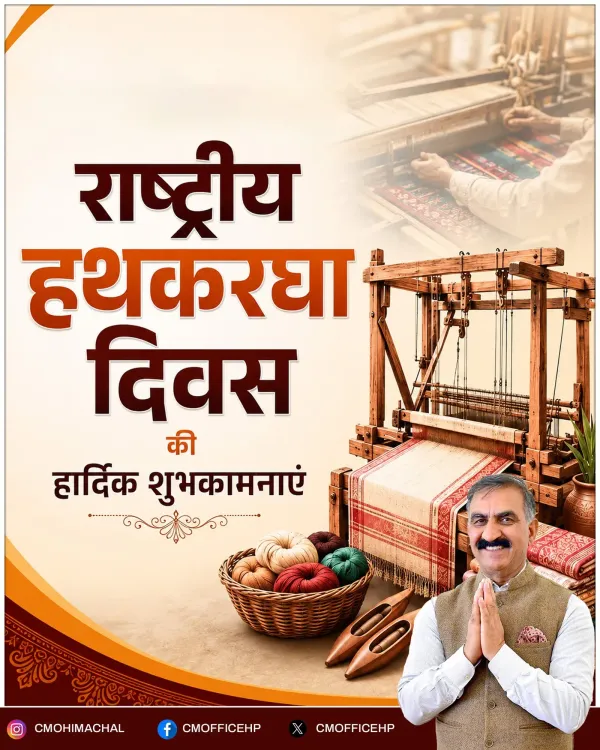
HP CM Office Marks National Handloom Day, Salutes State Weavers
Synopsis
On National Handloom Day 2026, the Chief Minister's Office of Himachal Pradesh celebrated the state's rich weaving heritage — from Kullu shawls to Kinnauri textiles — honouring artisans who sustain these traditions as symbols of self-reliance and cultural identity.
Key Takeaways
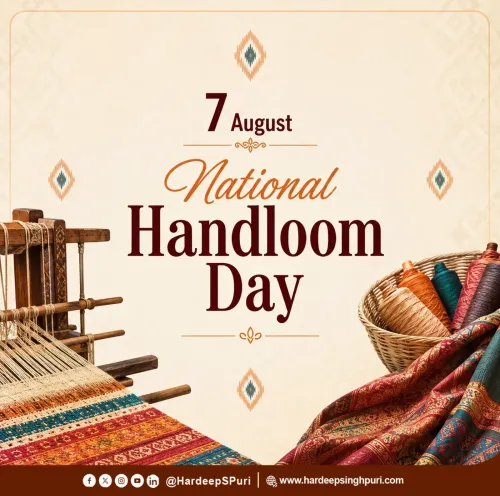
National Handloom Day is observed on 7 August every year, instituted by the Government of India in 2015 to honour weavers and promote indigenous textiles.
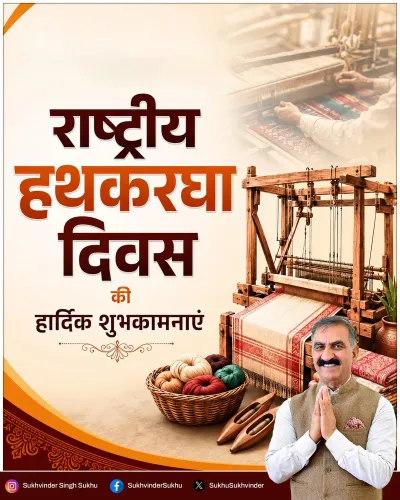
The Chief Minister's Office of Himachal Pradesh extended greetings, calling handloom a symbol of indigenous products, self-reliance, and local culture.
Himachal Pradesh's handloom heritage includes celebrated crafts such as Kullu shawls , Kinnauri weaves , and hand-knotted carpets .
The date commemorates the Swadeshi Movement launched on 7 August 1905 , linking handloom to India's broader narrative of self-reliance.
Artisan welfare and market access for Himachal weavers have historically been supported through both central and state government schemes.
Every year on 7 August, India pauses to honour the hands that weave its heritage — and this year the Chief Minister's Office of Himachal Pradesh used National Handloom Day 2026 to spotlight the state's living craft traditions and the artisans who keep them alive.
The office extended greetings for the occasion, calling handloom a symbol of 'swadeshi utpaad, aatmanirbharta aur sthaniya sanskriti' — indigenous products, self-reliance, and local culture. It described Himachal Pradesh's handloom tradition as an inseparable part of the state's cultural identity, and saluted its artisans for preserving and renewing that legacy through skill and dedication.
Why 7 August Matters for India's Weavers
The date is not arbitrary. National Handloom Day was instituted by the Government of India in 2015 to coincide with the anniversary of the Swadeshi Movement launched on 7 August 1905 — the mass mobilisation that made homespun cloth a symbol of resistance and self-reliance. The connection is deliberate: handloom as heritage, but also as economic backbone.
Across India, the day prompts state governments to reaffirm their commitment to artisan welfare and market access for weavers. Himachal Pradesh's message fits that pattern — warm in tone, rooted in cultural pride, and framed around the national vocabulary of aatmanirbharta (self-reliance).
Kullu Shawls, Kinnauri Weaves and a Living Tradition
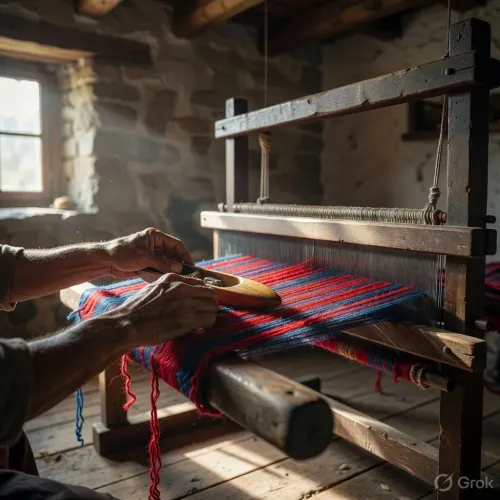
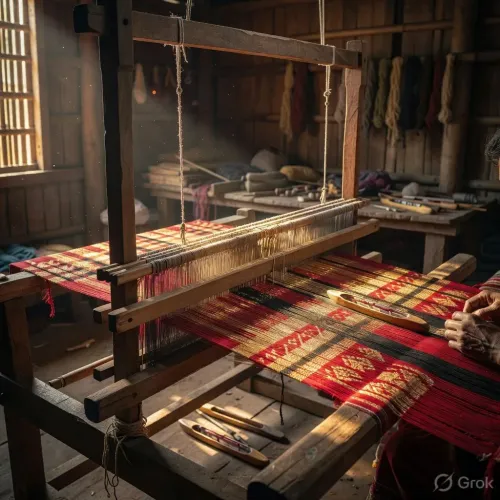
Himachal Pradesh carries one of northern India's richest handloom legacies. Kullu shawls, Kinnauri weaves, and hand-knotted carpets from the region are recognised across the country for their geometric patterns, natural dyes, and mountain-sourced wool. These are not museum pieces — they are active livelihoods for thousands of artisan families spread across the state's highland valleys.
State and central schemes have historically channelled support toward these weavers through training, equipment subsidies, and linkages to national handloom expos and buyer-seller meets. The CM Office's message reinforces that the sector remains a priority in the state's cultural and economic narrative.
Point of View
Which depends significantly on artisan-based rural livelihoods, such messaging also carries an implicit economic argument: cultural pride and market demand for handloom products are two sides of the same coin. The CM Office's statement signals continuity in this framing, though the real test remains whether rhetorical support translates into budget allocations and market linkages for weavers in the coming fiscal cycle.
NationPress
21 Sept 2026
Frequently Asked Questions
When is National Handloom Day celebrated in India?
National Handloom Day is celebrated on 7 August every year. The Government of India instituted it in 2015 to coincide with the anniversary of the Swadeshi Movement launched on 7 August 1905.
Why is National Handloom Day observed on 7 August?
The date marks the launch of the Swadeshi Movement on 7 August 1905 , which made homespun and indigenous cloth a symbol of self-reliance and national identity — values the day continues to celebrate.
What handloom traditions is Himachal Pradesh known for?
Himachal Pradesh is known for Kullu shawls , Kinnauri weaves , and hand-knotted carpets , crafted by artisan communities across the state's highland valleys using natural fibres and traditional techniques.
What did the Himachal Pradesh CM Office say on Handloom Day 2026?
The Chief Minister's Office of Himachal Pradesh extended greetings, describing handloom as a symbol of indigenous products, self-reliance, and local culture, and praised the state's artisans for preserving and renewing this heritage.
How does the government support handloom weavers in Himachal Pradesh?
Himachal Pradesh's handloom sector has historically received support through both central and state government schemes focused on artisan training, equipment subsidies, and linkages to national handloom expos and buyer-seller meets.