HP CM Office: Tourism-Driven Revenue Push, 18% GST on Hotels

Synopsis
The Himachal Pradesh CM Office on 16 November 2026 signalled a push to grow tourism as a revenue lever, citing the 18% GST on hotels — split equally between Centre and state — and referencing a ₹4,000 crore VAT-excise figure as a fiscal benchmark.
Key Takeaways
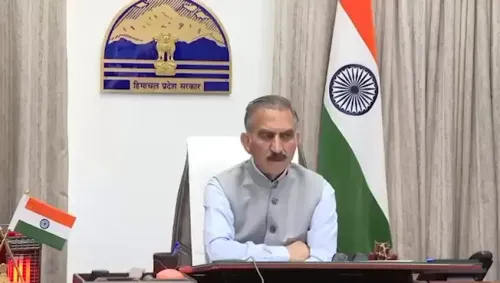
The Himachal Pradesh CM Office posted on 16 November 2026 about plans to promote hotels and tourism as a state revenue strategy.
Hotel accommodation in India attracts 18% GST — 9% to the Centre and 9% to the state — making tourism growth directly linked to state fiscal receipts.
The post references ₹4,000 crore from VAT and excise as a revenue figure, though the full context of the sentence was truncated.
GST replaced VAT and excise duties across India when it was implemented in July 2017 , consolidating the indirect tax framework.
Himachal Pradesh's major tourist destinations — Shimla, Manali, Kullu — make hospitality one of the state's most significant economic sectors.
Any concrete follow-up — budget allocations, hotel-sector incentives, or GST administration changes — will determine whether this signals a formal policy push.
Himachal Pradesh is betting on tourism as its next big fiscal engine — and the numbers make clear why. The Chief Minister's Office of Himachal Pradesh posted on Monday, 16 November 2026, outlining the state government's intent to strengthen the hospitality sector as a direct lever for boosting state revenue, pointing to the 18% GST structure on hotel stays and allied services as a key mechanism in that strategy.
The post, in Hindi, states: 'hum hotel aur paryatan ko badhawa dena chahte hain' ('we want to promote hotels and tourism'). It goes on to explain the GST split — 9% to the Central government and 9% to the state — before flagging that the government's effort is to 'strengthen tourism and increase the state's revenue,' and references a figure of ₹4,000 crore sourced from VAT and excise, though the full sentence was cut off in the post.Why GST's 50-50 Split Matters for a Hill State
When India rolled out the Goods and Services Tax in July 2017, it replaced a web of central and state levies — including VAT and excise duties — with a unified framework. For hotel accommodation and hospitality services, the rate settled at 18%. For a tourism-dependent hill state like Himachal Pradesh, that split is not an abstract accounting detail. Every additional guest night booked in Shimla or Manali translates directly into state revenue through the State GST (SGST) share. Scale the tourist base up, and the fiscal dividend scales with it.
Himachal Pradesh's economy leans heavily on its mountain landscape, with the hospitality sector among the largest employers in districts like Kullu, Lahaul-Spiti, and Kinnaur. The state's challenge has long been a narrow revenue base — limited industrial activity, terrain constraints on agriculture — which makes tourism's GST contribution structurally significant rather than incidental.
The ₹4,000 Crore Reference and What Comes Next
The post's truncated reference to ₹4,000 crore from VAT and excise points to legacy revenue streams that pre-date GST consolidation. While the full context of that figure remains incomplete from the post alone, the framing signals the government is benchmarking tourism-linked fiscal ambitions against a substantial baseline — and believes the sector has headroom to grow beyond it.
The immediate question for Himachal Pradesh is execution: whether the push to 'strengthen tourism' translates into concrete incentives for hotel operators, infrastructure investment, or promotional campaigns that lift occupancy rates sustainably. Any follow-up proposals — in the next state budget or in GST administration policy — will reveal how much of this is strategic intent versus a broader fiscal roadmap already in motion.
For a state carved from mountain terrain and perennial visitor demand, the arithmetic is straightforward: more tourists mean more hotel nights, more hotel nights mean more SGST, and more SGST means greater fiscal space. The only variable is how aggressively Himachal Pradesh moves to close that loop.
Point of View
The CM Office is signalling that tourism promotion is not merely a cultural or economic-development goal — it is a budgetary imperative. The ₹4,000 crore reference, even truncated, suggests the government is calibrating its ambitions against a known legacy revenue baseline, which could indicate a target-setting exercise ahead of the next budget cycle. How the state balances promotional incentives for hotel operators against the revenue it derives from that same sector's GST liability will be the central tension to watch.
NationPress
16 Nov 2026
Frequently Asked Questions
What is the GST rate on hotels in Himachal Pradesh?
Hotel accommodation and related services in India, including Himachal Pradesh, attract an 18% GST — split equally as 9% Central GST and 9% State GST .
Why is Himachal Pradesh focusing on tourism to increase revenue?
Himachal Pradesh has a narrow industrial base and relies heavily on hospitality and tourism. Every additional tourist generates State GST receipts for the government, making tourism growth a direct fiscal strategy.
What was the ₹4,000 crore figure mentioned by the HP CM Office?
The post references ₹4,000 crore in the context of VAT and excise revenue, though the full sentence was cut off. The precise details of this figure have not been independently verified.
When did GST replace VAT and excise in India?
India implemented the Goods and Services Tax (GST) in July 2017 , replacing multiple levies including VAT and excise duties with a unified indirect tax framework.
What are the major tourist destinations in Himachal Pradesh?
Himachal Pradesh's key tourism hubs include Shimla, Manali, Kullu, Dharamshala, Dalhousie , and districts like Lahaul-Spiti and Kinnaur , which collectively drive the state's hospitality economy.