HP CM Office: Local Medical Access to Aid Elderly, Women, Children
Synopsis
The Chief Minister's Office of Himachal Pradesh has highlighted that local-level medical facilities will particularly benefit the elderly, women, and children — groups most burdened by the state's challenging hill terrain and long distances to healthcare centres.
Key Takeaways
The Chief Minister's Office of Himachal Pradesh posted on October 30, 2026 , emphasising local healthcare access.
The statement specifically identifies elderly citizens, women, and children as the primary beneficiaries of localised medical facilities.
Himachal Pradesh's Himalayan terrain makes distance to healthcare a critical challenge for vulnerable populations.
India's National Health Mission (2005) provides the national policy framework supporting decentralised rural health infrastructure.
Decentralised health delivery has been a key focus across Indian states following the COVID-19 pandemic's exposure of over-reliance on district-level hospitals.
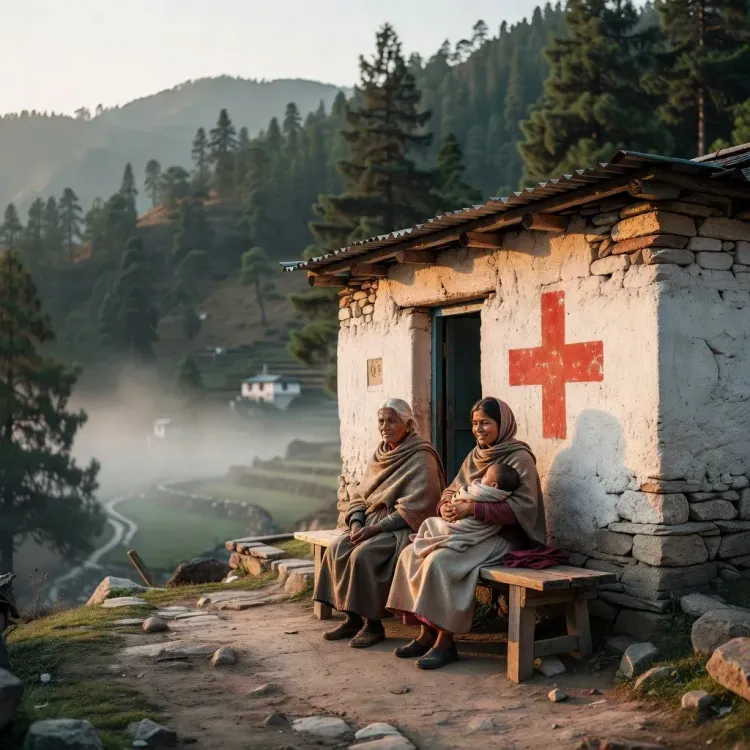
For the elderly person who must navigate a mountain road to reach the nearest clinic, or the mother carrying a sick child through remote hill terrain, distance is not an inconvenience — it is a barrier to survival. The Chief Minister's Office of Himachal Pradesh on Friday, October 30, 2026, underlined precisely this reality, noting that making medical facilities available at the local level will bring significant relief to the state's most vulnerable groups: the elderly, women, and children.
The post stated, 'स्थानीय स्तर पर चिकित्सा सुविधाएं उपलब्ध होने से खासकर बुजुर्गों, महिलाओं और बच्चों को सहूलियत होगी' — 'Making medical facilities available at the local level will particularly ease the burden on the elderly, women, and children.'The hill-state healthcare gap that makes proximity everything
Himachal Pradesh's geography is both its identity and its challenge. Spread across the western Himalayas, the state's rugged terrain means that even a short distance on a map can translate to hours of difficult travel — a calculation that falls hardest on those least able to manage it. Decentralising health services in such a landscape is not a bureaucratic preference; it is a clinical necessity.
India's National Health Mission, launched in 2005, laid the groundwork for strengthening rural and remote healthcare infrastructure across states, including Himachal Pradesh. The mission recognised that primary health centres need to be within reach of the communities they serve — a principle that has only grown more urgent in the years since, particularly after COVID-19 exposed the fragility of overburdened district-level hospitals when local facilities are absent.
Why the elderly, women, and children bear the brunt
The CMO's specific callout of these three groups is not incidental. Older citizens with chronic conditions need regular, low-intensity medical contact — routine checkups and medication management — that is practically impossible when the nearest facility is far away. Women, especially in reproductive health contexts, face compounded risks when maternal care is distant. Children with fevers, infections, and nutritional concerns require swift access that distance routinely denies.
Bringing facilities closer does not merely improve convenience. It shifts the calculus on whether care is sought at all — and in rural hill communities, that difference can determine outcomes.
As Indian states continue to push decentralised health delivery as a post-pandemic structural priority, Himachal Pradesh's articulation of this goal for its most geographically isolated citizens places the human stakes squarely at the centre of the policy conversation.
Point of View
Women, and children fits squarely into a broader national pattern of states repositioning primary healthcare as a proximity problem, not just a resource problem. In hill states especially, decentralisation is a political deliverable with measurable human impact — reducing 'out-of-pocket' travel costs that often deter care-seeking altogether. The framing also signals how state governments are translating National Health Mission objectives into constituent-facing communication, keeping healthcare access visible as an electoral and governance priority. Whether the on-ground infrastructure matches the stated intent will be the defining test.
NationPress
30 Oct 2026
Frequently Asked Questions
What did the Himachal Pradesh CM's Office say about healthcare on October 30, 2026?
The Chief Minister's Office of Himachal Pradesh stated that making medical facilities available at the local level will particularly benefit the elderly, women, and children of the state.
Why is local healthcare access especially important in Himachal Pradesh?
Himachal Pradesh's rugged Himalayan terrain means long and difficult travel to distant facilities, making local clinics critical for vulnerable groups who cannot easily commute for medical care.
Which groups does the HP government say will benefit most from local medical facilities?
The Chief Minister's Office specifically highlighted elderly citizens, women, and children as those who will gain the most relief from healthcare being available at the local level.
What is the National Health Mission and how does it relate to Himachal Pradesh?
The National Health Mission, launched in 2005, aims to strengthen rural and remote healthcare infrastructure across India, including Himachal Pradesh, by expanding primary health centres closer to communities.
How has COVID-19 changed the focus on local healthcare in Indian hill states?
The COVID-19 pandemic exposed the dangers of over-reliance on district-level hospitals, pushing states like Himachal Pradesh to accelerate decentralised, community-level health infrastructure.