HP CM Office Vows to Keep Youth Away From Drug Menace
Synopsis
The Chief Minister's Office of Himachal Pradesh on 17 June 2026 declared protecting youth from drug addiction and keeping families safe a government priority, echoing national anti-narcotics efforts under the Nasha Mukt Bharat Abhiyaan and state-level welfare initiatives.
Key Takeaways
The Chief Minister's Office of Himachal Pradesh posted on 17 June 2026 reaffirming the state government's anti-drug commitment.
The post identifies youth as the foundation of society and drug addiction as a threat to the entire community.
Keeping youth away from drugs and families safe is declared the government's stated priority.
The Nasha Mukt Bharat Abhiyaan , launched nationally in August 2020 , covers 272 vulnerable districts, including areas in Himachal Pradesh.
The NDPS Act amendment of 2014 strengthened both penalties and rehabilitation provisions at the national level.
Upcoming state budget allocations for de-addiction centres and school-based awareness programmes are being closely watched.
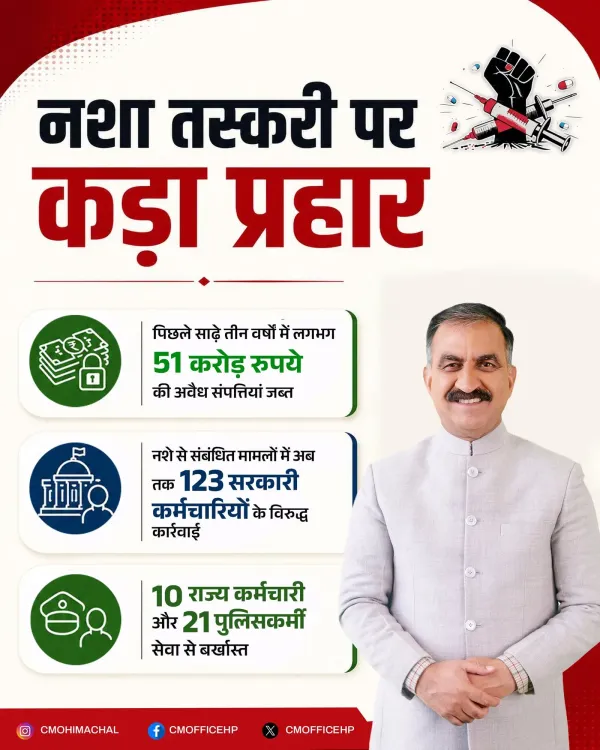
The Chief Minister's Office of Himachal Pradesh on Wednesday, 17 June 2026 reaffirmed the state government's commitment to protecting young people and families from the scourge of substance abuse, calling drug addiction one of the gravest threats to society's future.
The post, shared from the official CMO Himachal Pradesh handle, stated in Hindi: 'किसी भी देश और प्रदेश की नींव उसके युवा होते हैं' — 'The youth are the foundation of any nation and state.' It added that the direction of society and the pace of its future are determined by young people, and that when they fall prey to the evil of addiction, the impact is felt across the entire community. Keeping youth away from drugs and families safe, the post declared, is 'our government's priority.'
Context
Himachal Pradesh, a northern hill state, has in recent years reported rising concerns over substance abuse — particularly among youth in border and semi-urban districts. The state has been running awareness drives and de-addiction initiatives alongside central government schemes. The CMO's post signals that the political leadership views this as a front-line welfare priority, not merely a law-enforcement matter.
The statement comes against the backdrop of broader national conversations about narcotics penetration in smaller towns and rural areas, with hill states like Himachal Pradesh seen as increasingly vulnerable transit and consumption zones.
Policy Backdrop
At the national level, the Nasha Mukt Bharat Abhiyaan — launched in August 2020 — identified 272 vulnerable districts across India for targeted anti-drug outreach, counselling, and rehabilitation. Several districts in Himachal Pradesh were included in this list, making the state a focus area for both central and state-level intervention.
The Narcotic Drugs and Psychotropic Substances Act, amended in 2014, strengthened penalties for trafficking while also introducing improved provisions for the rehabilitation of addicts — reflecting a dual approach of enforcement and welfare. Himachal Pradesh has sought to align its state programmes with this dual framework, expanding counselling infrastructure and community outreach alongside enforcement.
Indian states have increasingly integrated central anti-narcotics schemes with local programmes targeting educational institutions and families. The CMO's statement reinforces this pattern of preventive messaging as a social-sector priority.
Stakeholders and Impact
The primary stakeholders identified in the government's messaging are youth and families — the two groups most directly affected by substance abuse at the community level. By framing drug prevention as a family-safety issue, the government is broadening its appeal beyond enforcement agencies to include parents, teachers, and community leaders as partners in the effort.
For young people in Himachal Pradesh, expanded access to counselling and de-addiction facilities can be transformative — particularly in areas where mental health and rehabilitation services remain sparse. Families in affected districts stand to benefit from both awareness campaigns and institutional support structures.
What's Next
Observers will watch for concrete follow-through in the form of state budget allocations for new de-addiction centres, school-based awareness mandates, and any legislative proposals for stricter local enforcement. The CMO's public reaffirmation of this priority could signal forthcoming policy announcements in the next assembly session or budget cycle.
For Himachal Pradesh, sustaining momentum on drug prevention will require moving from messaging to measurable outcomes — tracking enrolments in rehabilitation programmes, reductions in first-time drug use among school-age youth, and community-level awareness penetration across vulnerable districts.
Point of View
Which broadens its resonance with voters across demographics. It also signals alignment with the central government's Nasha Mukt Bharat Abhiyaan, reinforcing cooperative federalism optics on a sensitive social issue. For Himachal Pradesh, where youth outmigration and unemployment intersect with rising substance abuse concerns, such messaging carries both policy and electoral weight. The real test will be whether this public commitment translates into measurable budget outlays and institutional expansion in the months ahead.
NationPress
16 Sept 2026
Frequently Asked Questions
What is the Himachal Pradesh government's policy on drug prevention for youth?
The Chief Minister's Office of Himachal Pradesh has declared keeping youth away from drugs and protecting families a top government priority, aligning with both state-level de-addiction initiatives and the national Nasha Mukt Bharat Abhiyaan.
What is the Nasha Mukt Bharat Abhiyaan and does it cover Himachal Pradesh?
The Nasha Mukt Bharat Abhiyaan is a national programme launched in August 2020 targeting 272 vulnerable districts with awareness, counselling, and rehabilitation efforts. Several districts in Himachal Pradesh are included in this list.
What did the HP CMO post about drugs on X in June 2026?
On 17 June 2026, the CMO Himachal Pradesh posted in Hindi stating that youth are the foundation of any nation, that drug addiction harms all of society, and that protecting young people and families from substance abuse is the state government's priority.
What laws govern drug enforcement and rehabilitation in India?
The Narcotic Drugs and Psychotropic Substances Act, amended in 2014, governs drug enforcement in India, enhancing penalties for trafficking while also strengthening rehabilitation provisions for those struggling with addiction.
What should one watch for next in HP's anti-drug efforts?
Key developments to watch include state budget allocations for new de-addiction centres in Himachal Pradesh, school-based awareness mandates, and any legislative proposals in upcoming assembly sessions aimed at strengthening local enforcement or outreach.