CM Vijay raises Tamil Nadu govt staff DA to 63% from July 2026
Synopsis
Tamil Nadu Chief Minister Joseph Vijay has announced a Dearness Allowance hike for state government employees and teachers — from 60 percent to 63 percent — effective 1 July 2026, delivering a direct inflation-linked pay boost to the state's entire public-sector workforce.
Key Takeaways
DA raised from 60% to 63% for Tamil Nadu government officials and teachers.
Effective date is 1 July 2026 , meaning eligible employees will receive arrears from that date.
Announcement made by Chief Minister Joseph Vijay via the official CMO Tamil Nadu X account on 31 October 2026 .
The revision follows the standard Indian practice of biannual DA adjustments linked to the All India Consumer Price Index for Industrial Workers .
Both state government officials and teachers are covered under the revised rate.
The next DA revision cycle will depend on fresh inflation index data and government fiscal assessment.
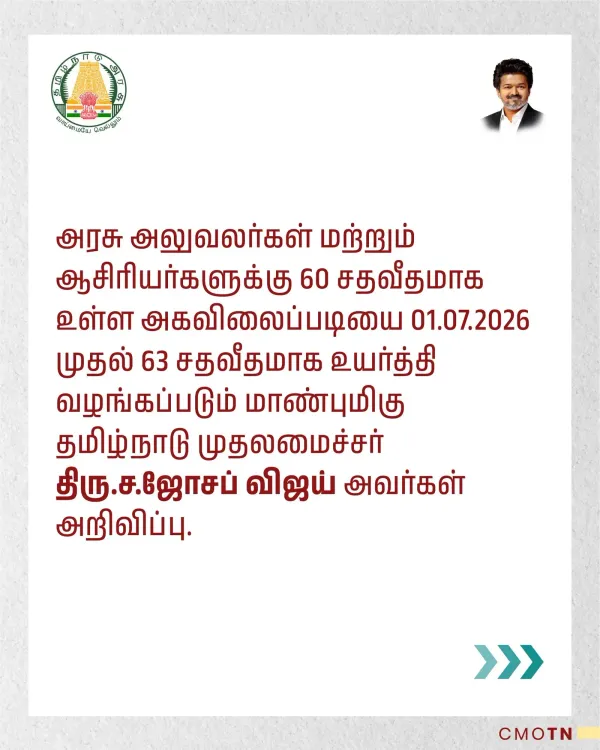
A pay boost is coming for hundreds of thousands of Tamil Nadu government employees and teachers. Chief Minister Joseph Vijay announced on Saturday, 31 October 2026 that the Dearness Allowance (DA) for state government officials and teachers will be raised from 60 percent to 63 percent, effective 1 July 2026 — a three-percentage-point hike that directly shores up the real income of the state's public-sector workforce against inflation.
The announcement, made through the official Chief Minister's Office of Tamil Nadu account on X, was posted in Tamil: the DA currently standing at 60 percent will be revised upward to 63 percent from 1 July 2026, benefiting government servants and teachers across the state.What the 3-point DA hike means in practice
Dearness Allowance is a cost-of-living adjustment paid on top of base salary, recalibrated periodically to track the All India Consumer Price Index for Industrial Workers (AICPI-IW). A move from 60% to 63% means every government employee's DA component rises by three percentage points of their basic pay — translating into a meaningful monthly addition, particularly for those at lower pay-band levels who depend most heavily on allowances to meet everyday expenses.
Indian states typically revise DA rates twice a year — broadly mirroring the central government's schedule — to prevent inflation from silently eroding public-sector salaries. Tamil Nadu has historically maintained a structured approach to these revisions, keeping its rates broadly aligned with central patterns while exercising its own fiscal discretion on timing and quantum.
Vijay's first major pay-structure move for state staff
Chief Minister Joseph Vijay — whose elevation to the state's top executive post marks a notable chapter in Tamil Nadu's political landscape — is signalling early intent to maintain the welfare commitments that state employees and teachers have come to expect from successive governments. The 1 July 2026 effective date means the benefit is backdated, so eligible employees will receive arrears covering the period from that date to the date of formal implementation — a standard feature of such revisions that adds a one-time financial fillip alongside the recurring monthly gain.
The twin beneficiary groups — government officials and teachers — together represent one of the largest organised constituencies in the state. For teachers in particular, who span everything from primary schools to government-aided colleges, this revision carries both economic and symbolic weight.
Eyes on the next revision cycle
With the 63 percent rate now locked in from July 2026, attention will turn to the next scheduled review — typically anchored to fresh AICPI-IW data releases. If inflation indices continue to move, a further revision before the financial year ends remains well within precedent. The government's fiscal managers will need to account for the full-year liability of the revised DA in the state budget, including arrears payouts — a line item that will be closely watched by both employee unions and fiscal analysts.
For Tamil Nadu's public-sector workers, the announcement is a concrete, quantified commitment — not a promise deferred.
Point of View
High in reach, and timed to consolidate goodwill among the organised public-sector workforce early in a Chief Minister's tenure. For CM Joseph Vijay, it signals continuity with Tamil Nadu's tradition of structured employee welfare rather than a sharp policy departure. The three-percentage-point increment is modest but non-trivial in aggregate fiscal terms, and the backdated effective date ensures a visible arrears payout that employees will feel immediately. Longer term, the sustainability of such revisions will depend on whether Tamil Nadu's own-tax revenues keep pace with a growing DA liability — a tension that has quietly constrained state finances across India.
NationPress
1 Nov 2026
Frequently Asked Questions
What is the new Dearness Allowance rate for Tamil Nadu government employees?
The new DA rate is 63 percent of basic pay, up from the previous 60 percent , effective 1 July 2026 .
Who benefits from the Tamil Nadu DA hike announced by CM Joseph Vijay?
All state government officials and teachers in Tamil Nadu are covered under the revised Dearness Allowance rate.
When will the 63% DA be effective for Tamil Nadu employees?
The revised DA of 63 percent is effective from 1 July 2026 , and employees will receive arrears from that date once the revision is formally implemented.
How is Dearness Allowance calculated for government employees in India?
DA is calculated as a percentage of an employee's basic pay and is revised periodically — typically twice a year — based on changes in the All India Consumer Price Index for Industrial Workers (AICPI-IW) to offset inflation.
Will Tamil Nadu government employees get DA arrears with this hike?
Yes. Since the effective date is 1 July 2026 , employees will receive arrears covering the period from that date to the date of actual payment, in line with standard practice for backdated DA revisions.