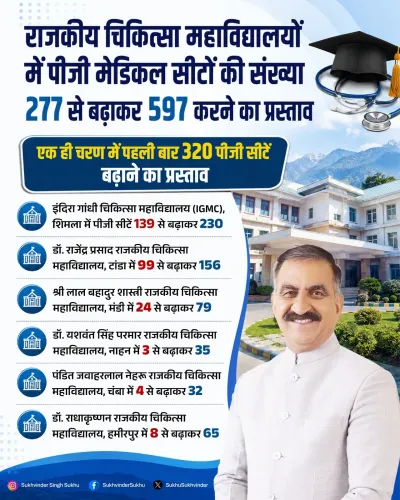
CM Sukhu: HP's PG medical seats jump from 227 to 547
Synopsis
Himachal Pradesh CM Sukhu announces approval of 320 new PG medical seats, more than doubling the state's long-frozen capacity of 227 to 547, while targeting centres of excellence and zero diagnostic waiting times to stop Rs 1,000 crore flowing out of state for healthcare.
Key Takeaways
320 new PG medical seats have been approved in Himachal Pradesh, raising the total from 227 to 547 .
The previous figure of 227 seats had remained unchanged for nearly 40 years .
CM Sukhu aims to develop at least two to three medical colleges as centres of excellence so residents need not seek care outside the state.
Himachal residents currently spend approximately Rs 1,000 crore annually on medical treatment outside the state.
The government is installing advanced equipment and working toward zero waiting time for diagnostics and surgeries.
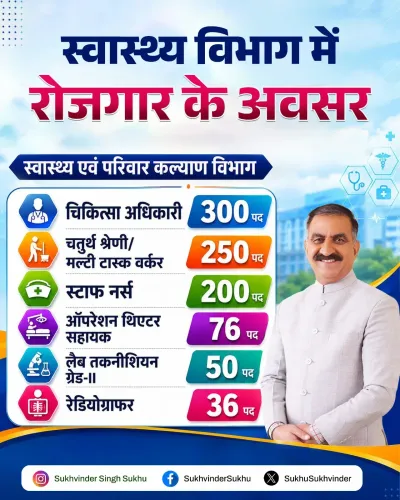
Doctor recruitment and infrastructure strengthening across all medical colleges are stated priorities alongside the seat expansion.
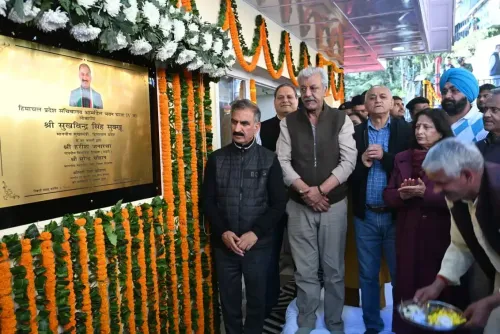
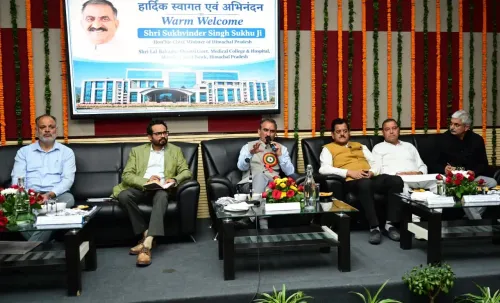
For nearly four decades, Himachal Pradesh sat with the same 227 postgraduate medical seats — a number that quietly told the story of a state watching its patients board buses to Delhi and Chandigarh for specialist care. That number has now changed, sharply. Himachal Pradesh Chief Minister Sukhvinder Singh Sukhu announced on Monday, October 19 that 320 new PG seats have been approved, taking the state's total to 547 — more than doubling the capacity that had been frozen since the mid-1980s.
A forty-year freeze, finally broken
The arithmetic here is striking. 'करीब 40 वर्षों से पीजी की 227 सीटें थीं' — 'For nearly 40 years, there were 227 PG seats,' Sukhu said. The stagnation was not a secret; it was a structural ceiling that limited how many specialists the state could train and, by extension, how many it could retain. With the new 320-seat approval, Himachal Pradesh has in a single move added more postgraduate medical capacity than it built across four decades.
The Chief Minister also pointed to the downstream consequence of that gap: residents currently spend approximately Rs 1,000 crore annually on medical treatment outside the state. That figure, whether read as a healthcare failure or an economic drain, frames the urgency behind the expansion push.
The 'centres of excellence' blueprint
Seat numbers alone do not build specialists. Sukhu's statement flags a parallel ambition: elevating at least two to three medical colleges in the state to the status of centres of excellence, equipped with modern technology and filled-out medical rosters. The explicit goal — that Himachal residents should not have to leave the state for quality treatment — positions this as a retention play as much as a capacity one.
The state is also targeting zero waiting time for diagnostics and surgeries, a benchmark that speaks directly to the friction point that pushes patients outward. Installing advanced equipment and filling doctor vacancies are cited as the twin levers. Himachal's medical infrastructure, anchored by institutions such as Indira Gandhi Medical College, Shimla, has grown incrementally since the 2000s under successive governments, but the scale of this announced expansion is notably larger.
A pattern playing out across India's hill states
Himachal Pradesh is not moving in isolation. Across India's hill and northeastern states, the post-pandemic period has accelerated investment in regional health infrastructure — driven partly by the visibility of patient outflows to metros and partly by central government pushes on specialist doctor supply. The logic is consistent: train more specialists locally, equip local hospitals to handle complex cases, and the money spent on out-of-state referrals begins to recycle within the state economy.
For Sukhu's government, now in its fourth year, delivering on healthcare infrastructure is both a policy commitment and a political one. The rollout of the 320 newly approved seats and the formal designation of excellence centres in upcoming health department notifications will be the real test of whether the announcement translates into changed outcomes for the seven million people of Himachal Pradesh.
A state that spent forty years at 227 seats just moved to 547. The clock — and the patients — are watching.
Point of View
And it lands at a politically telling moment for the Sukhu government heading into its mid-term stretch. By anchoring the move to a concrete Rs 1,000 crore outflow figure, the CM is translating a health-policy decision into an economic-sovereignty argument — a framing that travels well in smaller states conscious of metro dependence. The 'centres of excellence' target, however, will be the harder deliverable: seats on paper require faculty, equipment procurement, and accreditation timelines that routinely outpace announcements. Whether this expansion genuinely reshapes specialist availability in the western Himalayas, or remains an aspirational headline, will depend entirely on the pace of on-ground rollout in the next two to three budget cycles.
NationPress
19 Oct 2026
Frequently Asked Questions
How many PG medical seats does Himachal Pradesh have now?
Himachal Pradesh now has 547 PG medical seats after the approval of 320 new seats , up from 227 that had been in place for nearly 40 years.
Why is Himachal Pradesh expanding postgraduate medical seats?
The expansion aims to train more specialists locally so that residents do not have to travel outside the state for treatment. HP residents currently spend roughly Rs 1,000 crore annually on out-of-state healthcare.
Which medical colleges in Himachal Pradesh will become centres of excellence?
CM Sukhu has stated the goal is to develop at least two to three medical colleges into centres of excellence, but specific institutions have not been named in the announcement. Indira Gandhi Medical College, Shimla is the state's flagship institution.
What is the zero waiting time target in Himachal Pradesh hospitals?
The HP government is working toward zero waiting time for diagnostic tests and surgical procedures at state medical colleges, through installation of advanced equipment and filling of doctor vacancies.
When were the 320 new PG medical seats in HP approved?
CM Sukhu announced the approval of the 320 new PG seats on October 19, 2026 . The precise date of the formal approval order has not been specified in the announcement.