CM Sukhu challenges Jairam on PG medical seats left unfilled
Synopsis
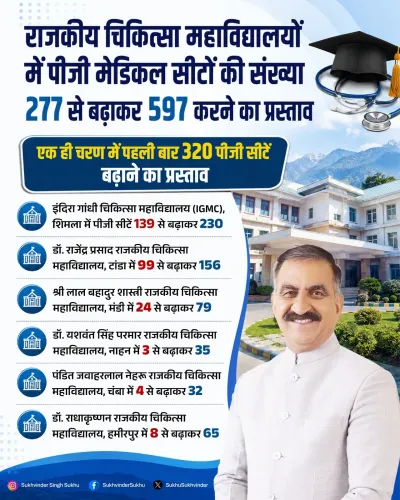
CM Sukhu claims his government expanded Himachal Pradesh PG medical seats from a 40-year-old ceiling of 277 to 320, directly challenging former CM Jairam Thakur to explain why the BJP's five-year tenure left the same seats unfilled.
Key Takeaways
PG seats in Himachal Pradesh government medical colleges were stagnant at 277 for nearly 40 years across multiple governments.
CM Sukhvinder Singh Sukhu says his administration worked to fill 320 seats , a rise of 43 seats or roughly 15.5 percent.
Sukhu says he personally spoke with Union Health Minister J.P.
Nadda to secure central approval for the expanded seats.
The CM directly challenged former CM Jairam Thakur , who governed Himachal from 2017 to 2022 , to explain why his BJP government did not achieve the same expansion.
PG medical seat increases require National Medical Commission approval — a joint state-centre process — making the credit dispute politically significant given BJP's simultaneous control of both levels of government in that period.
For nearly four decades, Himachal Pradesh's government medical colleges sat on the same number of postgraduate seats — a ceiling nobody chose to break. Now Himachal Pradesh Chief Minister Sukhvinder Singh Sukhu is pointing directly at his predecessor and asking a simple, uncomfortable question: if the seats were always possible to expand, why didn't you?
In a post on X on Monday, 26 October 2026, CM Sukhu stated that PG seats in the state's medical colleges had remained stagnant at 277 for close to 40 years. His government, he said, not only worked to fill 320 seats but also personally coordinated with Union Health Minister J.P. Nadda to secure central approval for the expanded intake.
The dig at Jairam's five years in power
The post is a direct counter to BJP leader and former Chief Minister Jairam Thakur, who has been crediting the central government for the seat increase. Sukhu's retort is pointed: credit the Centre if you must, but explain why your own government — which held power in Shimla from 2017 to 2022 — couldn't move the needle on the same seats across five full years.
It is a federalism question wrapped in a political taunt. Medical college PG seats in India require National Medical Commission (NMC) approval — the regulatory body that replaced the Medical Council of India under the NMC Act 2019. State governments propose, the NMC and Union Health Ministry clear. The BJP held both the state government and the union health portfolio simultaneously for much of that window; Thakur's silence on that overlap is precisely what Sukhu is pressing.
Why 277 seats stayed frozen for so long
The 277-seat figure representing nearly four decades of stagnation points to a structural inertia in India's medical education system — a cycle of under-investment, delayed regulatory approvals, and insufficient faculty and infrastructure in state-run colleges. Expanding PG capacity requires not just political will but physical infrastructure, faculty positions, and NMC inspections, all of which take coordinated effort between state and central authorities.
That the count stood unchanged through multiple governments — Congress and BJP alike — makes Sukhu's framing a double-edged argument: it implicitly acknowledges long continuity of the problem while specifically targeting the most recent BJP tenure as the window when reform was most achievable yet absent.
What the seat jump to 320 means for Himachal doctors
Moving from 277 to 320 PG seats is a gain of 43 seats — roughly a 15.5 percent increase in specialist training capacity at state medical colleges. For a hill state where specialist shortages directly affect rural health outcomes, each additional seat represents a potential specialist who may serve in government facilities. The immediate test is whether the National Medical Commission's formal notifications and actual admissions data for the upcoming academic year reflect the numbers Sukhu has cited.
The political battle over who deserves the credit will run through Himachal's election cycle. But the harder, less glamorous question — whether the state has the infrastructure to sustain those seats year after year — is the one that will define the legacy.
Point of View
Where state governments propose and the Centre approves, allowing both sides to claim ownership or assign failure. Sukhu's move is tactically sharp: by invoking the 40-year stagnation, he neutralises BJP's narrative while simultaneously highlighting a governance gap during the Jairam era. The fact that J.P. Nadda — a senior BJP figure from Himachal Pradesh himself — is named as Sukhu's ally in securing approvals complicates the BJP's ability to claim sole credit. The real policy question, whether the physical and faculty infrastructure exists to sustain 320 seats sustainably, will ultimately separate political victory from administrative delivery.
NationPress
26 Oct 2026
Frequently Asked Questions
How many PG medical seats has Himachal Pradesh added under CM Sukhu?
CM Sukhu claims his government moved PG medical seats in state medical colleges from 277 to 320 , an addition of 43 seats, ending nearly four decades of stagnation.
Why is CM Sukhu criticising Jairam Thakur over medical seats?
Sukhu is responding to Jairam Thakur's claim that the seat increase is a credit to the central government, countering that Thakur's BJP government had five years in power ( 2017-2022 ) and did not achieve the same expansion.
What role does J.P. Nadda play in Himachal Pradesh PG medical seat expansion?
CM Sukhu says he personally spoke with Union Health Minister J.P. Nadda to secure central-level approval for increasing PG seats, as National Medical Commission sign-off requires coordination with the Union Health Ministry.
Who approves increases in PG medical college seats in India?
The National Medical Commission (NMC) , established under the NMC Act 2019, is the regulatory body responsible for approving increases in postgraduate medical seats at colleges across India, in coordination with the Union Health Ministry.
Why did PG medical seats in Himachal Pradesh stay at 277 for so long?
The stagnation reflected structural challenges common to state medical colleges — delayed regulatory approvals, infrastructure gaps, and faculty shortfalls — compounded by a lack of coordinated push from successive state governments until the current administration's claimed effort.