CM Sukhu adds 320 PG medical seats across HP colleges
Synopsis
Himachal Pradesh CM Sukhvinder Singh Sukhu announces 320 new postgraduate medical seats across all state government medical colleges simultaneously — a first for the hill state — aiming to retain young doctors and improve specialist availability for residents.
Key Takeaways
320 new PG medical seats are being added across all Himachal Pradesh government medical colleges in a single, simultaneous move.
CM Sukhvinder Singh Sukhu described this as happening 'for the first time' in the state's history.
The goal is dual: giving medical graduates in-state training opportunities and building a pipeline of specialists for Himachal Pradesh residents.
The move aligns with a national push to expand PG medical capacity that accelerated after the National Medical Commission was formed in 2019 .
Hilly terrain and connectivity constraints make specialist retention a particular challenge for Himachal, making in-state PG expansion a strategic priority.
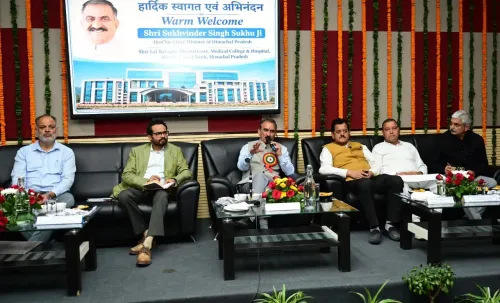
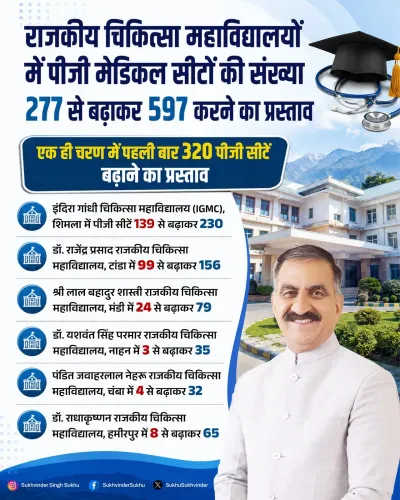
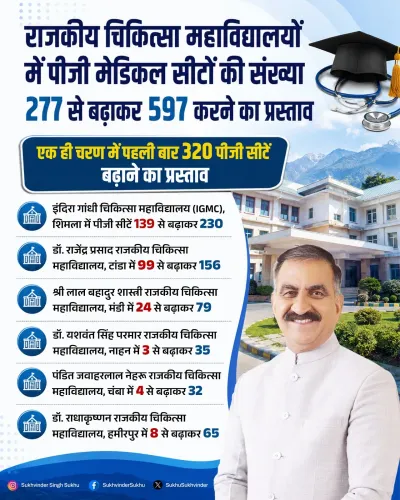
For the first time in Himachal Pradesh's history, every government medical college in the state will simultaneously gain new postgraduate seats — 320 in total — in a single coordinated push that Himachal Pradesh Chief Minister Sukhvinder Singh Sukhu says will reshape both specialist availability and medical education in the hill state.
Announcing the expansion on Monday, 17 August 2026, Sukhu framed the move as a twin commitment: giving Himachal's young medical graduates a reason to train at home rather than migrate to metro cities, and building a generation of capable doctors who will serve state residents. 'पहली बार एक साथ पीजी की 320 नई सीटें बढ़ाई जा रही हैं' — 'for the first time, 320 new PG seats are being added simultaneously' — was the centrepiece of his announcement.
Why 320 seats at once is a significant number
Postgraduate medical seats are the bottleneck between an MBBS degree and a practicing specialist. India has been grappling with this gap since the National Medical Commission was constituted in 2019, which accelerated state-level efforts to expand PG capacity beyond the large teaching hospitals concentrated in major cities. Adding 320 seats across all colleges in one academic move — rather than a trickle of additions college by college — signals a deliberate policy decision rather than routine administrative expansion.
Himachal Pradesh faces a structural challenge that flatland states do not: terrain and connectivity make it harder to attract and retain trained specialists in district hospitals and remote valleys. Expanding in-state PG seats is one of the few levers a state government can pull to keep trained talent closer to where patients actually live.
The national pattern Himachal is joining
Himachal is not acting in isolation. Across India, states from the north-east to the southern peninsula have been racing to add PG medical seats, recognising that rural and semi-urban populations are most hurt by specialist shortages. What distinguishes the Sukhu government's announcement is the simultaneity — all colleges moving together — which typically requires coordinated faculty recruitment and infrastructure readiness across institutions at the same time.
The rollout timeline and how the state plans to staff the new seats — faculty shortages are a common chokepoint in such expansions — will be the practical test of whether the announcement translates into functional classrooms and clinical training slots in the next academic cycle.
For a state whose residents have long had to travel to Chandigarh, Delhi, or beyond for specialist care, 320 more PG seats is not just an education statistic. It is a downstream bet on better healthcare within Himachal's own borders.
Point of View
Institution-by-institution increments — is a deliberate political and administrative signal from the Sukhu government that it is treating healthcare access as a flagship deliverable ahead of future electoral cycles. For the Congress government in Shimla, which has leaned heavily on welfare and public-service messaging, anchoring medical education expansion to both youth opportunity and rural health access is textbook base consolidation. The real test, however, lies in execution: PG seat expansions routinely stall on faculty shortages and infrastructure gaps, and Himachal's difficult terrain amplifies both risks. If the seats are functional by the next academic cycle, it becomes a genuine governance win; if they exist only on paper, the announcement becomes political liability.
NationPress
1 Oct 2026
Frequently Asked Questions
How many new PG medical seats is Himachal Pradesh adding?
320 new postgraduate medical seats are being added simultaneously across all government medical colleges in Himachal Pradesh, as announced by CM Sukhvinder Singh Sukhu on 17 August 2026.
Which medical colleges in Himachal Pradesh are getting new PG seats?
CM Sukhu stated the seats are being added across all government medical colleges in the state simultaneously. The exact college-wise distribution has not been officially detailed yet.
Why is Himachal Pradesh expanding PG medical seats?
The expansion aims to give Himachal's medical graduates in-state postgraduate training opportunities and to build a larger pool of specialists who can serve the state's residents, particularly in areas underserved by specialist doctors.
What is the National Medical Commission and how does it relate to this?
The National Medical Commission , constituted in 2019 , replaced the Medical Council of India and accelerated state-level efforts to expand PG medical education capacity across India to address the country's specialist shortage.
When will the new PG medical seats in Himachal Pradesh be available?
The rollout timeline for the next academic cycle has not been formally announced. Implementation details, including faculty recruitment and infrastructure readiness, are expected to be disclosed as the plan progresses.