HP CM Office Hands Land Pattas to 42 Pong Dam Displaced Families
Synopsis
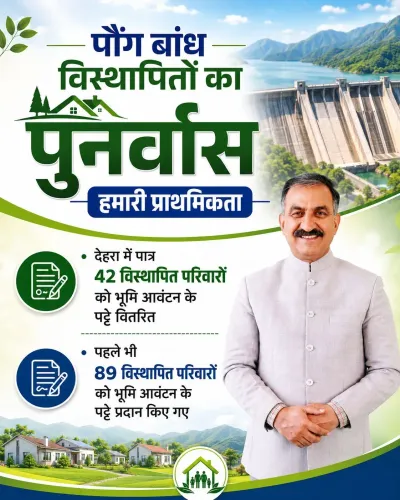
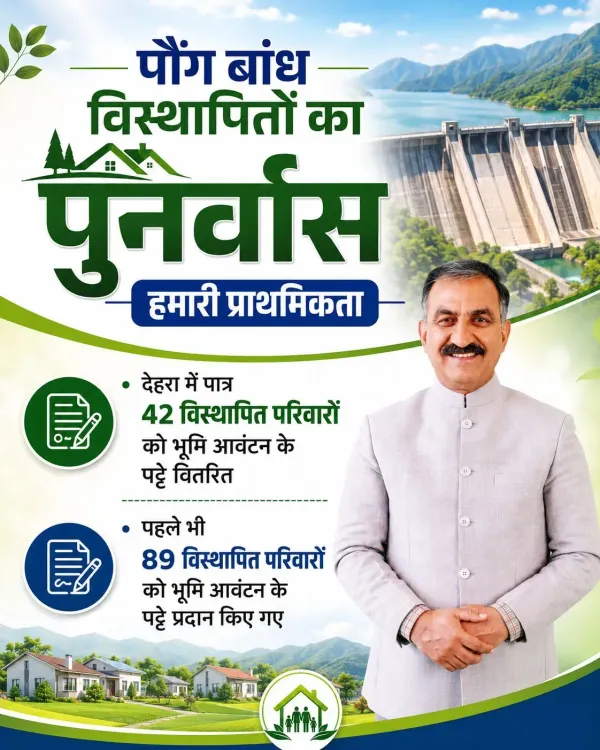
The Himachal Pradesh CM's Office has distributed land-allotment pattas to 42 Pong Dam-displaced families in Dehra constituency, following an earlier allotment to 89 families. The move continues a decades-long rehabilitation process for oustees displaced by the Beas River dam completed in 1974.
Key Takeaways
42 families from Dehra Assembly constituency received land-allotment pattas on 20 July 2026 .
An earlier tranche had already allotted land to 89 displaced families , bringing the cumulative total to at least 131 families .
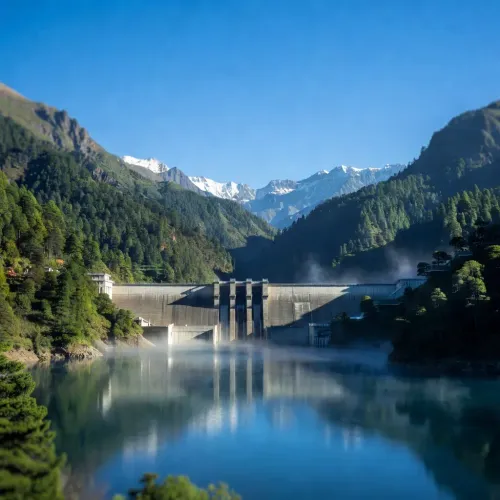
Pong Dam on the Beas River was completed in 1974 , submerging villages and displacing thousands of families in Kangra district .
Rehabilitation through phased patta distribution has been ongoing since the 1980s under successive Himachal Pradesh governments.
The number of Pong Dam oustee families still awaiting allotment in Dehra has not been officially disclosed.
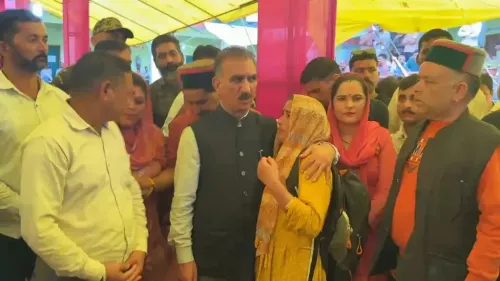
The Chief Minister's Office of Himachal Pradesh announced on Monday, 20 July 2026, that land-allotment pattas have been handed over to 42 displaced families from the Dehra Assembly constituency who lost their homes to the Pong Dam submergence — adding to the 89 families who had already received land allotments in an earlier tranche.
The post, shared in Hindi, noted that these families had endured the pain of separation from their birthplace for years: 'अपनी जन्मभूमि से बिछड़ने का दर्द इन परिवारों ने वर्षों तक सहा है' ('these families have borne the pain of being separated from their homeland for years').
Context
Pong Dam, built on the Beas River in Kangra district, Himachal Pradesh, was completed in 1974. Its reservoir submerged dozens of villages, triggering one of the largest displacement episodes in the state's history. Thousands of families — primarily from Kangra district — were uprooted from agricultural land that had sustained them for generations. The Dehra constituency falls within this affected belt, and its oustee families have pursued land rights through successive state administrations for more than five decades.Policy Backdrop
Rehabilitation of Pong Dam oustees has never been a single event but a phased, decades-long process. The Himachal Pradesh government has periodically distributed pattas — formal land-title deeds — to resolve pending claims since the 1980s. The current allotment follows that lineage: the earlier batch of 89 families had already received land, and the fresh tranche of 42 families represents a further step in clearing the backlog. Large dam projects across India have generated similar protracted rehabilitation demands, where land rights for oustees are settled incrementally, often long after the original displacement.Stakeholders and Impact
For the 42 families receiving pattas in this round, the allotment ends a wait measured in years — in some cases, spanning generations. A formal land title provides legal security of tenure, access to institutional credit, and eligibility for state welfare schemes tied to land ownership. Taken together with the preceding 89 allotments, a total of at least 131 displaced families from Dehra have now received land through the state's rehabilitation programme. Remaining oustee households who have not yet received pattas continue to have a stake in how quickly the government can process and distribute further tranches.What's Next
The Chief Minister's Office has not specified the total number of Pong Dam oustee families still awaiting land allotment in Dehra or across Kangra district. Advocates for displaced communities are likely to press for a clear timeline on further tranches. Any revision to rehabilitation norms — including compensation benchmarks or eligibility criteria — could also become a point of legislative discussion in the Himachal Pradesh Vidhan Sabha. The pace of future allotments will be watched as a measure of the state government's commitment to closing a rehabilitation chapter that has remained open since the 1970s.Point of View
The Chief Minister's Office is framing the move as cumulative progress rather than a one-off act — a signal of administrative momentum ahead of any electoral cycle. The action fits a broader national pattern where dam-affected communities in states like Himachal Pradesh, Madhya Pradesh, and Odisha have used land-rights campaigns to extract incremental concessions from state governments. The key unresolved question — how many families remain in the queue — will determine whether this announcement is seen as a milestone or a footnote in a still-incomplete rehabilitation story.
NationPress
20 Oct 2026
Frequently Asked Questions
Why were families displaced by Pong Dam in Himachal Pradesh?
Pong Dam, built on the Beas River in Kangra district, was completed in 1974, and its reservoir submerged dozens of villages, forcing thousands of families — many from what is now the Dehra Assembly constituency — to relocate and lose their agricultural land.
What is a land patta and why does it matter for displaced families?
A patta is a formal government-issued land-title deed that gives the holder legal ownership rights over a plot of land; for Pong Dam oustees, receiving a patta means security of tenure, access to institutional loans, and eligibility for welfare schemes linked to land ownership.
How many Pong Dam displaced families have received land in Dehra so far?
At least 131 families from Dehra constituency have received land allotments: 89 in a prior tranche and a fresh batch of 42 families announced on 20 July 2026.
How long has the Pong Dam rehabilitation process been going on?
The rehabilitation of Pong Dam oustees has been ongoing since the 1980s, with the Himachal Pradesh government periodically distributing land pattas to affected families over more than four decades.
Are there still Pong Dam oustee families waiting for land allotment?
Yes, the Chief Minister's Office has not disclosed the total number of families still awaiting allotment in Dehra or across Kangra district, and further tranches are expected as the state works through pending rehabilitation claims.