HP CM Office: 30% clean energy revenue to panchayats, 20% for welfare
Synopsis
The Chief Minister's Office of Himachal Pradesh has announced that 30% of income from clean energy projects will go to gram panchayats and 20% to welfare of deprived communities, combining renewable energy expansion with local empowerment and social equity.
Key Takeaways
30% of revenue from clean energy projects in Himachal Pradesh will be allocated to gram panchayats .
20% of the income will be directed toward welfare of deprived and needy sections of society.
The announcement was made by the Chief Minister's Office of Himachal Pradesh on 16 June 2026 .
Himachal Pradesh has a precedent of revenue-sharing from hydropower projects with local bodies dating to the mid-2000s.
The initiative is described as advancing clean energy, local empowerment and social responsibility simultaneously.
Specific projects covered and disbursement mechanisms are yet to be publicly detailed.
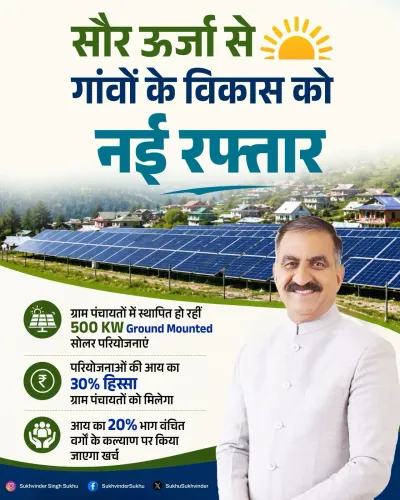
The Chief Minister's Office of Himachal Pradesh announced on Tuesday, 16 June 2026 that revenue generated from clean energy initiatives in the state will be shared with rural local bodies and marginalised communities, outlining a dual-track benefit-sharing model under which 30% of income goes to gram panchayats and 20% is earmarked for the welfare of deprived and needy sections of society.
Context
The post, shared from the official @CMOFFICEHP handle, states in Hindi: 'इनसे होने वाली आय का 30% ग्राम पंचायतों को तथा 20% वंचित एवं जरूरतमंद वर्गों के कल्याण हेतु दिया जाएगा' — meaning, '30% of the income generated from these will be given to gram panchayats and 20% for the welfare of deprived and needy sections.' The office further described the initiative as one that 'advances clean energy, local empowerment and social responsibility together.'
The announcement positions clean energy projects in Himachal Pradesh not merely as infrastructure investments but as instruments of rural fiscal empowerment and social redistribution.
Policy Backdrop
Himachal Pradesh has a long history of routing hydropower revenues into local area development funds. Since the mid-2000s, the state has operated revenue-sharing arrangements between power projects and panchayat-level bodies, building a precedent for community-linked energy governance.
The current push extends that logic to newer clean energy streams — including solar — under Chief Minister Sukhvinder Singh Sukhu, who has prioritised renewable energy and rural development since taking office in December 2022. The move aligns with a broader national trend in which states are embedding mandatory revenue-sharing clauses in renewable energy projects to secure community consent and channel funds into local governance.
Several hill states have adopted decentralised green growth models, and Himachal Pradesh's dual-percentage formula — 30% to elected local bodies, 20% to welfare of marginalised groups — reflects an attempt to institutionalise both political accountability and social equity within the energy transition.
Stakeholders and Impact
Gram panchayats, the elected village-level bodies that manage local infrastructure and welfare in Himachal Pradesh, stand to receive a direct and recurring fiscal boost under this framework. Enhanced panchayat revenues could fund rural roads, water supply, sanitation and community halls without dependence on discretionary state grants.
The 20% welfare allocation targets vanchit evam zarooratmand varg — deprived and needy sections — potentially covering scheduled castes, scheduled tribes, persons with disabilities and households below the poverty line. The exact implementing agency and disbursement mechanism have not yet been specified in the public communication.
For communities living near clean energy installations, the arrangement could convert proximity to power projects from a source of displacement anxiety into a tangible economic benefit, improving local consent for future renewable expansion.
What's Next
Observers will watch for the publication of project-specific revenue-sharing orders, the first tranche releases to panchayat accounts, and utilisation guidelines from the state energy or rural development departments. The credibility of the initiative will hinge on transparent accounting of which projects fall under the scheme and how the income base is calculated and audited.
If operationalised effectively, Himachal Pradesh's model could serve as a template for other renewable-rich states seeking to balance green infrastructure targets with grassroots economic inclusion — a challenge that sits at the heart of India's energy transition agenda.
Point of View
20% to welfare — reflects a deliberate effort to politically and fiscally embed clean energy projects within village governance structures, reducing community resistance and broadening the constituency for the green transition. Chief Minister Sukhu is building on a hydropower-era precedent but applying it to newer renewables at a time when state governments across India are under pressure to demonstrate that the energy transition delivers tangible local benefits. The dual-allocation model is notable for separating institutional empowerment (panchayats) from direct welfare (marginalised groups), signalling awareness that local body funds do not always reach the most vulnerable. The real test will be whether transparent accounting and timely disbursement follow the announcement, or whether the percentages remain aspirational without enforceable implementation orders.
NationPress
23 Sept 2026
Frequently Asked Questions
What percentage of clean energy revenue will Himachal Pradesh give to gram panchayats?
The Chief Minister's Office of Himachal Pradesh has announced that 30% of income generated from clean energy projects will be allocated to gram panchayats.
Who benefits from the 20% welfare allocation in HP's clean energy revenue plan?
The 20% welfare share is earmarked for deprived and needy sections of society, which typically includes marginalised communities such as scheduled castes, scheduled tribes and households below the poverty line.
What is Himachal Pradesh's history with energy revenue sharing?
Himachal Pradesh has operated revenue-sharing arrangements from hydropower projects with local area development funds and panchayats since the mid-2000s, making this a continuation and expansion of an established policy approach.
Which projects are covered under Himachal Pradesh's clean energy revenue-sharing scheme?
The specific projects covered have not been publicly detailed yet; the announcement outlines the revenue-sharing percentages but project-specific orders and disbursement guidelines are awaited.
How does Himachal Pradesh's clean energy revenue sharing compare to other Indian states?
Several Indian states are now embedding mandatory revenue-sharing clauses in renewable energy projects; Himachal Pradesh's dual-percentage model — separating panchayat funds from welfare allocations — is among the more structured approaches in hill states.