HP CM Office Unveils Revenue-Share Formula for Clean Energy Projects
Synopsis
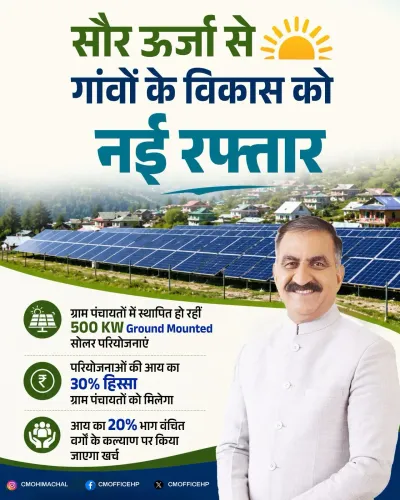
Himachal Pradesh's Chief Minister's Office has announced a five-way revenue split from clean energy projects: 25% each to Gram Panchayats and welfare of orphans and widows, 20% each to the state government and HimUrja, and 10% for operations and maintenance.
Key Takeaways
25% of clean energy project revenues will go to Gram Panchayat development works.
A further 25% is earmarked for the welfare of orphans and widows in the state.
The state government and HimUrja each receive 20% of revenues.
10% is reserved for operation and maintenance of clean energy assets.
The initiative links clean energy revenue directly to rural development and social protection, a model gaining traction across Indian states.
HimUrja , the state's nodal renewable energy agency, is a key implementing partner in the framework.
The Chief Minister's Office of Himachal Pradesh on Tuesday, 14 July 2026 announced a structured revenue-distribution framework for clean energy projects in the state, outlining how proceeds will be divided among village bodies, welfare beneficiaries, the state government, and nodal agencies.
Context
The post details a five-way split of revenue generated from clean energy installations. As stated by the Chief Minister's Office, the allocation is: 25% for development works of the Gram Panchayat; 25% for the welfare of orphans and widow sisters (anāthon evam vidhavā bahinon ke kalyāṇ hetu); 20% to the state government; 20% to HimUrja; and 10% for operation and maintenance. The office described the initiative as one that will provide 'new momentum to rural development and social welfare alongside clean energy.'
The announcement is framed as a policy initiative rather than a project-specific disclosure, suggesting it may apply to a category of renewable energy installations across Himachal Pradesh.
Policy Backdrop
Himachal Pradesh has built its energy identity around hydroelectric power since the early 2000s, leveraging its Himalayan river systems. The state's nodal renewable energy agency, HimUrja, has expanded that mandate to include solar and other clean-energy sources in recent years.
Across India, states have increasingly experimented with revenue-sharing models that tie power generation directly to local-body funding and social welfare, moving away from centralised revenue absorption. Himachal Pradesh's formula is notable for explicitly ring-fencing a quarter of revenues for orphans and widows — a social welfare commitment embedded in an energy policy instrument.
Stakeholders and Impact
Gram Panchayats — the village-level self-governing bodies — stand to receive the largest single share at 25%, giving elected local councils a direct fiscal stake in clean energy projects sited in their jurisdictions. This design creates an incentive for communities to support, rather than resist, renewable installations on local land.
The 25% earmarked for orphans and widows channels energy revenues into a vulnerable-population welfare fund, a model that links infrastructure returns with social protection. HimUrja's 20% share is intended to sustain the agency's capacity to develop and scale future projects, while the 10% operations-and-maintenance tranche addresses a chronic underfunding gap that has hampered renewable assets in several Indian states.
What's Next
Observers will watch whether Himachal Pradesh extends this revenue-sharing template to future solar and small-hydro tenders, and whether periodic audits are mandated to verify that funds actually reach Gram Panchayats and welfare beneficiaries. The model, if implemented transparently, could serve as a replicable blueprint for other hill states seeking to align clean-energy expansion with rural development goals.
The broader implication is a governance shift: clean energy in Himachal Pradesh is being positioned not merely as a power-sector exercise but as a mechanism for redistributive rural finance — a framing that could influence how future project approvals are negotiated at the panchayat level.
Point of View
The Himachal Pradesh government is attempting to build grassroots political support for renewable projects while addressing chronic underfunding of local bodies. The explicit ring-fencing of 25% for orphans and widows is an unusual design choice that signals a welfare-first framing for what is essentially an infrastructure policy. If the fund flows are audited transparently, this model could pressure other states to adopt similar redistributive mechanisms in their renewable energy tenders. The real test, however, will be whether administrative capacity at the panchayat level is sufficient to absorb and deploy these revenues effectively.
NationPress
13 Oct 2026
Frequently Asked Questions
How will Himachal Pradesh distribute revenue from clean energy projects?
The state has announced a five-way split: 25% to Gram Panchayat development works, 25% for welfare of orphans and widows, 20% to the state government, 20% to HimUrja, and 10% for operation and maintenance of the projects.
What is HimUrja and what is its role in this scheme?
HimUrja is the Himachal Pradesh government's nodal agency for promoting renewable energy, including solar and small hydropower projects. Under this framework, it receives 20% of clean energy revenues to fund its ongoing development activities.
How will orphans and widows benefit from Himachal Pradesh's clean energy projects?
The revenue-sharing formula reserves 25% of proceeds specifically for the welfare of orphans and widows in the state, embedding a social protection commitment within the energy policy.
What share of clean energy revenue will go to Gram Panchayats in Himachal Pradesh?
Gram Panchayats will receive 25% of revenues from clean energy projects, which they can use for local development works within their jurisdiction.
Why is Himachal Pradesh linking clean energy revenue to rural development?
The state aims to create community-level incentives for supporting renewable energy installations by giving local bodies a direct financial stake, while simultaneously channelling infrastructure revenues into social welfare — a model increasingly adopted by Indian states.