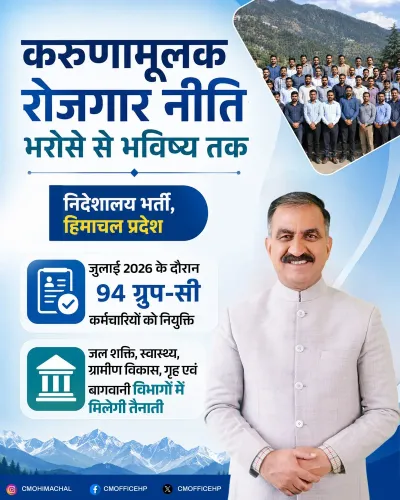
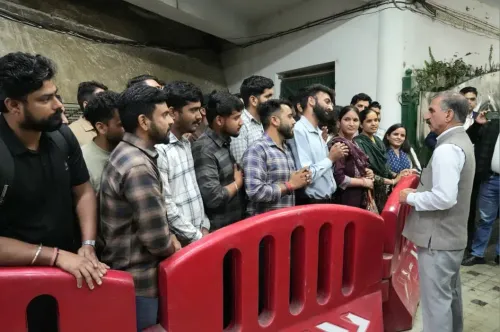
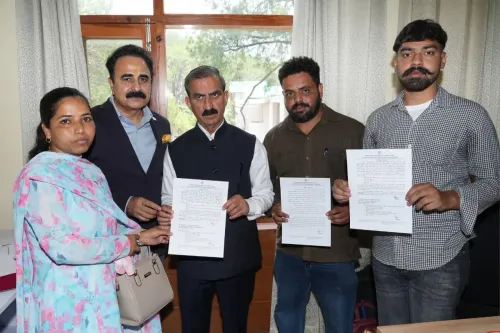
HP CM Office to Review Rejected Compassionate Appointment Cases

Synopsis
The Himachal Pradesh Chief Minister's Office has announced a one-time special initiative to review compassionate appointment cases previously rejected by state departments, aiming to provide government jobs to genuinely eligible families of deceased employees in line with existing policy provisions.
Key Takeaways
The HP Chief Minister's Office announced a one-time special initiative on 26 July 2026 to review previously rejected compassionate appointment cases.
Cases rejected by various state government departments for different reasons will be re-examined under this initiative.
Only genuinely eligible rejected cases will qualify for reconsideration; the review will be conducted in line with existing policy provisions.
The initiative targets families of deceased government employees who were denied compassionate appointments earlier.
Where found eligible upon review, appointments will be made as per the provisions of the state's compassionate appointment policy.
The exercise is described as a government-wide effort spanning multiple departments, not limited to a single wing.
The Chief Minister's Office of Himachal Pradesh announced on Sunday, 26 July 2026 a one-time special initiative to review compassionate appointment cases previously rejected by various state government departments, with the aim of ensuring that genuinely eligible families of deceased government employees receive relief.
Context
The post, shared from the official CMO Himachal Pradesh account, states that cases rejected earlier by different departments for various reasons will be re-examined. The announcement reads: 'एकमुश्त विशेष पहल के तहत वास्तविक एवं पात्र अस्वीकृत मामलों की दोबारा जांच की जाएगी' — ('Under a one-time special initiative, genuinely eligible rejected cases will be re-examined'). Where warranted, appointments will be made in accordance with the provisions of the existing policy.
Compassionate appointments are a welfare mechanism under which a dependent family member of a government employee who dies in service is offered a government job to provide immediate financial support. Himachal Pradesh maintains such a policy aligned broadly with central government guidelines.
Policy Backdrop
Across Indian states, compassionate appointment schemes have historically faced implementation gaps — cases are often rejected on procedural or fiscal grounds, leaving families in distress. Periodic reviews of rejected applications are considered a corrective administrative measure to ensure the spirit of the policy is upheld.
The state government's move to conduct a one-time special review reflects an effort to clear the backlog of disputed cases and bring closure to families who may have been incorrectly denied appointments. The review will cover cases rejected across multiple departments, suggesting a government-wide audit rather than a department-specific exercise.
Stakeholders and Impact
The primary beneficiaries of this initiative are families of deceased Himachal Pradesh government employees whose earlier applications for compassionate appointments were turned down. For many such families, a government job represents not just income but also long-term social security.
State government departments will be required to revisit their earlier decisions, which may place additional administrative responsibility on human resources and personnel wings. The exercise is framed as a welfare measure rather than a policy overhaul, meaning the underlying eligibility criteria remain governed by existing rules.
What's Next
The government is expected to issue department-wise directives outlining the process and timeline for re-examining rejected cases. Families with pending grievances may be required to resubmit documentation or appear before review committees.
The outcome of this initiative — including the number of cases reconsidered and appointments eventually granted — will be a key indicator of the state's commitment to employee welfare. Any policy clarifications arising from the review could also set precedent for how Himachal Pradesh handles such cases going forward.
Point of View
Likely aimed at addressing a longstanding backlog of grievances from families of deceased state employees. Such one-time review exercises are a recurring feature of Indian state governance, often timed to demonstrate responsiveness ahead of key political or administrative milestones. The framing as a 'special initiative' rather than a policy amendment suggests the government is working within existing rules while trying to maximise coverage — a pragmatic balance between fiscal discipline and welfare optics. How rigorously the re-examination is conducted across departments will determine whether this translates into meaningful relief or remains a procedural exercise.
NationPress
25 Oct 2026
Frequently Asked Questions
What is a compassionate appointment in Himachal Pradesh?
A compassionate appointment is a government job given to a dependent family member of a state government employee who dies while in service, providing the family with financial security. Himachal Pradesh maintains a policy for such appointments aligned with central government guidelines.
Why were some compassionate appointment cases rejected in Himachal Pradesh?
Cases were rejected by various state departments for different reasons, which may include procedural non-compliance, eligibility disputes, or departmental fiscal constraints. The new review initiative aims to re-examine such rejections to identify genuinely eligible cases.
Who is eligible for the HP compassionate appointment review?
Families of deceased Himachal Pradesh government employees whose compassionate appointment applications were previously rejected by any state department may be eligible for reconsideration under this one-time special initiative, subject to existing policy provisions.
What will happen after the review of rejected compassionate appointment cases in HP?
Cases found to be genuinely eligible upon review will be considered for appointment in accordance with the provisions of the existing compassionate appointment policy. The state government is expected to issue further directives on the process and timeline.
Is the HP compassionate appointment review a new policy?
No, it is not a new policy. The review is a one-time special initiative conducted within the framework of the existing compassionate appointment policy, aimed at correcting earlier rejections rather than changing eligibility criteria.