HPCL Rajasthan Refinery Fire: Pressure Gauge Leak Blamed, Ops Resume May
Synopsis
A pressure gauge leak in the vacuum residue exchanger line caused the April 20 fire at HPCL's Rs 79,450-crore Rajasthan Refinery — one day before PM Modi's inauguration. Operations are now expected to resume in the second half of May 2026, while a government-appointed four-member probe team investigates the incident independently.
Key Takeaways
Root cause identified: HPCL confirmed the April 20 fire at its Rs 79,450-crore Rajasthan Refinery was likely caused by a pressure gauge leak on the vacuum residue exchanger inlet line in the crude distillation unit.
Damage scope: The fire was localised to the heat exchanger stack , impacting six exchangers and associated equipment; secondary units remain on commissioning schedule.
Restart timeline: Restoration is expected within 3-4 weeks , with CDU restart anticipated in the second half of May 2026 ; trial fuel production including LPG, petrol, and diesel to follow.
Government probe launched: The Ministry of Petroleum and Natural Gas has appointed a four-member team led by M.
Venkatesh , former MD of MRPL, to independently investigate the incident.
Inauguration postponed: The scheduled April 21 dedication by PM Narendra Modi has been deferred; a new date is yet to be announced.
Commercial deadline at risk: The refinery's planned July 1 commercial operations launch — approved by the Union Cabinet on April 8 — now faces uncertainty following the fire and restoration delays.
Hindustan Petroleum Corporation Ltd (HPCL) has officially attributed the devastating fire at its HPCL Rajasthan Refinery Ltd (HRRL) in Balotra district, Rajasthan, to a leak from a pressure gauge tapping point in the crude distillation unit (CDU). The company confirmed on April 26, 2025 that restoration work is underway and the refinery is expected to resume operations in the second fortnight of May 2026, approximately three to four weeks from now.
What Caused the Fire at HPCL Rajasthan Refinery
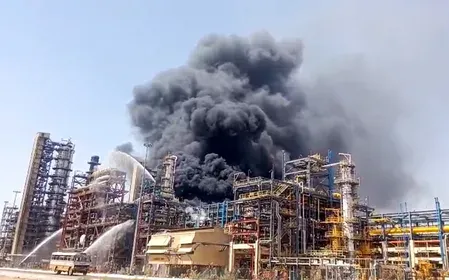
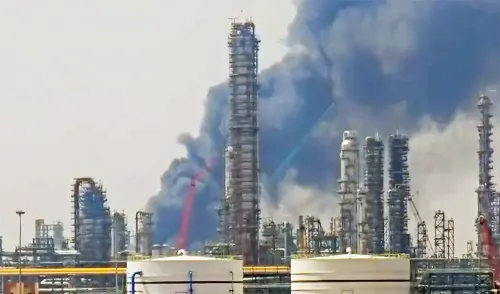
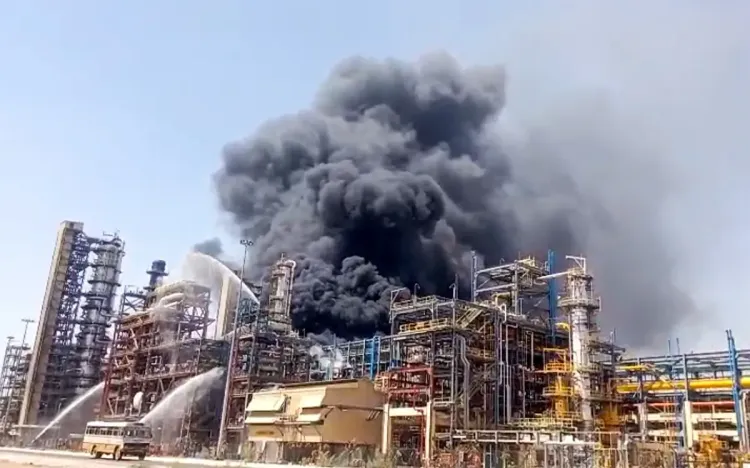
The fire broke out on April 20 — just one day before the refinery's scheduled inauguration by Prime Minister Narendra Modi — sending shockwaves through India's energy sector. A detailed investigation confirmed the blaze was confined to the heat exchanger stack, damaging six exchangers and associated equipment within the crude distillation unit.
In a formal stock exchange filing, HPCL stated: Basis circumstantial evidence, the cause of fire is suspected to be leakage from pressure gauge tapping point on the vacuum residue exchanger inlet line. This type of failure — a hydrocarbon leak from a valve or flange in a heat exchanger circuit — is among the most common ignition triggers in refinery startup incidents globally.
The Rs 79,450-crore greenfield refinery, India's most expensive energy infrastructure project of its kind, was at its most vulnerable stage: the commissioning phase, when hydrocarbons are first introduced into high-pressure, high-temperature systems. Refineries worldwide face the highest risk of fire and explosion during precisely this window.
Restoration Timeline and Restart Plan
HPCL confirmed that restoration work is actively in progress and is expected to be completed within three to four weeks. The Crude Distillation Unit restart is anticipated in the second fortnight of May 2026, the company stated in its regulatory filing.
Secondary units at the refinery are at an advanced stage of commissioning and continue to progress as planned, unaffected by the fire. Trial production of key fuels — including LPG, petrol, diesel, and naphtha — is expected to commence within May, followed by stabilisation and full commissioning of all units.
The originally scheduled April 21 dedication ceremony, which was to be presided over by Prime Minister Modi, has been postponed indefinitely. A revised inauguration date will be announced separately.
Government Probe and Independent Investigation
The Ministry of Petroleum and Natural Gas has launched a separate, independent inquiry into the incident. The investigation is being led by M. Venkatesh, former Managing Director of Mangalore Refinery and Petrochemicals Ltd (MRPL), heading a four-member probe team. This parallel inquiry signals the government's intent to ensure accountability beyond HPCL's internal assessment.
Notably, the Union Cabinet had approved a cost enhancement for the HRRL project as recently as April 8, 2025, just 12 days before the fire. The Central government's statement at that time also confirmed the refinery was scheduled to begin commercial operations on July 1. That timeline now faces uncertainty.
About HRRL: India's 24th Refinery and Its Strategic Importance
HRRL is a joint venture between HPCL (74% stake) and the Rajasthan government (26% share). Designed as a 9 million tonnes per annum (MTPA) refinery-cum-petrochemical complex, it will be India's 24th refinery and the second most complex in the country.
The facility boasts a Nelson Complexity Index of 17 — a global benchmark for handling heavier, cheaper crude oil and converting it into high-value refined products. Its petrochemical yield exceeds 26%, reflecting India's strategic push to reduce import dependence on value-added chemicals.
Once fully operational, HRRL will produce petrol, diesel, LPG, and petrochemicals including polypropylene, polyethylene, benzene, and butadiene — materials critical to sectors ranging from transportation and packaging to pharmaceuticals and construction.
Broader Implications: Risk, Accountability, and India's Energy Ambitions
The timing of the fire — one day before a high-profile Prime Ministerial inauguration — raises serious questions about commissioning protocols and pre-launch safety checks at one of India's most strategically significant energy assets. Critics argue that the pressure to meet a political deadline may have compressed the safety validation window, though HPCL has not confirmed this.
This incident also underscores a systemic challenge: India's rapid expansion of refining capacity, while strategically necessary, must be matched by equally rigorous commissioning safeguards. The HRRL fire is not an isolated event — refinery fires during startup phases have been recorded at facilities globally, but the scale and visibility of this project amplify its consequences for investor confidence and energy policy timelines.
With the July 1 commercial operations deadline now under pressure and the government inquiry underway, all eyes will be on HPCL's next update and the probe team's findings — both of which could reshape the refinery's launch narrative and its long-term credibility as India's flagship downstream energy project.
Point of View
But the HRRL incident must serve as a hard reset on the culture of deadline-driven commissioning in critical national infrastructure.
NationPress
19 Sept 2026
Frequently Asked Questions
What caused the fire at HPCL Rajasthan Refinery on April 20?
The fire at HPCL Rajasthan Refinery was caused by a leak from a pressure gauge tapping point on the vacuum residue exchanger inlet line in the crude distillation unit. HPCL confirmed this based on circumstantial evidence from a detailed investigation into the April 20 incident.
When will the HPCL Rajasthan Refinery restart operations after the fire?
HPCL expects the Crude Distillation Unit to restart in the second fortnight of May 2026, following three to four weeks of restoration work. Trial production of fuels including LPG, petrol, diesel, and naphtha is expected to begin within May.
Who is investigating the HPCL Rajasthan Refinery fire?
The Ministry of Petroleum and Natural Gas has instituted an independent inquiry led by M. Venkatesh, former Managing Director of MRPL, heading a four-member investigation team. This is separate from HPCL's own internal investigation.
What is HPCL Rajasthan Refinery and why is it significant?
HRRL is a Rs 79,450-crore joint venture refinery between HPCL (74%) and the Rajasthan government (26%), designed to process 9 million tonnes per annum. It will be India's 24th refinery and its second most complex, featuring a Nelson Complexity Index of 17 and over 26% petrochemical yield.
Was the HPCL Rajasthan Refinery inauguration postponed due to the fire?
Yes, the April 21 inauguration by Prime Minister Narendra Modi was postponed following the April 20 fire. A revised dedication date has not yet been announced by HPCL or the government.