Is Bangladesh's Political Future in Jeopardy Amidst President's Resignation?
Click to start listening
Synopsis
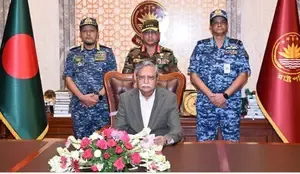
In a dramatic turn, President Mohammed Shahabuddin has announced plans to resign post-elections, citing feelings of humiliation under the interim leadership of Muhammad Yunus. This situation raises critical questions about the legitimacy of the current administration and the future political landscape of Bangladesh. Will this resignation trigger a more profound political upheaval?
Key Takeaways
- President Mohammed Shahabuddin plans to resign after February elections.
- Concerns about the legitimacy of the interim administration arise.
- The resignation reflects deep-rooted issues in Bangladesh's political system.
- International observers will monitor the situation closely.
- The civil-military balance is crucial for stability.
New Delhi, Dec 12 (NationPress) The ongoing political transition in Bangladesh has once again raised concerns regarding the civil-military balance, the authenticity of the interim government led by Muhammad Yunus, and the roadmap following the upcoming elections.
Uncertainties have been triggered by President Mohammed Shahabuddin's announcement of his intention to resign after the February parliamentary elections, citing feelings of being consistently sidelined and humiliated by the Yunus-led interim administration.
The current President was elected unopposed in 2023 as the candidate of the then-ruling Awami League.
Though generally perceived as a ceremonial position, it has gained significant constitutional authority following the 2024 student protests and the subsequent political turmoil that resulted in the Parliament's dissolution.
The office saw an unusual rise in prominence when long-serving Prime Minister Sheikh Hasina left the country in August 2024, leaving Shahabuddin as the last remaining constitutional authority during this uncertain period.
As per reports and local sentiments, the President expressed feelings of humiliation and marginalization by the interim administration led by a Nobel Prize laureate. He has indicated his desire to resign following the general elections scheduled for February next year.
This decision, he claims, is a response to being consistently overlooked and stripped of a substantial role, despite the Presidency maintaining formal responsibilities such as being the commander-in-chief of the armed forces.
There are various pressures and implications that may clarify Shahabuddin’s announcement.
Firstly, as he pointed out, there is a sense of institutional marginalization, where the Yunus interim cabinet appears to wield executive power in a manner that leaves the President politically isolated.
Secondly, the political landscape has been reshaped by public unrest and legitimacy crises stemming from the student protests, which constantly targeted the presidency and the former ruling party, leading to a contested political environment.
Thirdly, changes in party alliances and legal limitations resulting from the Awami League's exclusion from the upcoming elections have altered the incentives for former allies of Hasina, making continued tenure politically precarious.
Shahabuddin’s announcement has sparked political and diplomatic responses and counterclaims.
The interim government will aim to project stability through the February elections, yet the President’s controversial and untimely resignation could be viewed both domestically and internationally as indicative of profound institutional discord rather than a smooth transition.
For the opposition and other factions, his resignation might provide leverage to advocate for more extensive reforms, while remnants of the Awami League’s network will face pressure to rethink their strategies if a figure they once trusted steps down.
As Bangladesh navigates a tumultuous and delicate transition, a mid-term presidential resignation could have severe implications. It threatens to further diminish public faith in constitutional continuity at a time when the legitimacy of the electoral process is already in question.
Moreover, it could lead to a restructuring of civil-military relations: the President is the nominal commander-in-chief, and any power vacuum or disputed succession draws increased scrutiny from security institutions.
Additionally, the political implications are critical for international partners monitoring stability and democratic integrity; donor and diplomatic reactions will depend on whether the February elections are perceived as free, fair, and inclusive.
In light of these developments, Shahabuddin’s decision to resign after the February elections appears to be a personal protest that involves political alignment and reflects the complexities of Bangladesh’s transition. It highlights reported institutional marginalization, political bitterness, and fierce confrontations, complicating the already challenging task of restoring stable governance after the upheaval in 2024.
The responses from the interim government, political parties, and international observers in the coming weeks will determine whether the resignation leads to deeper instability or results in a managed transition that helps recalibrate Bangladesh’s political landscape.
Point of View
It is crucial to recognize that Bangladesh is at a pivotal moment. The President's resignation signals deep-rooted issues within the political framework. It is essential to uphold the principles of democracy and ensure that the voices of the people are respected. This transitional phase requires careful navigation to maintain stability and foster a democratic environment.
NationPress
13/12/2025
Frequently Asked Questions
What prompted President Shahabuddin's resignation?
President Shahabuddin's resignation is prompted by feelings of being sidelined and humiliated by the interim administration led by Muhammad Yunus.
What are the implications of this resignation for Bangladesh's political landscape?
This resignation raises concerns about the legitimacy of the interim government and could lead to further instability during a sensitive transitional phase.
How will international observers react to this situation?
International observers will closely monitor the situation to assess the legitimacy and fairness of the upcoming elections, which could impact diplomatic relations.
What role does the civil-military balance play in this transition?
The civil-military balance is critical, as the President is the commander-in-chief, and instability could lead to increased scrutiny from military institutions.
What should be the focus for political parties moving forward?
Political parties should focus on fostering dialogue, advocating for reforms, and ensuring a transparent electoral process to maintain public trust.