Is Hyderabad on track to achieve Net Zero by 2034?

Synopsis
Telangana's CM A. Revanth Reddy has unveiled an ambitious plan for Hyderabad to attain Net Zero emissions by 2034. This includes significant initiatives in green energy and sustainability, as well as a shift in industrial locations. Learn more about Hyderabad's vision for a sustainable future.
Key Takeaways
Hyderabad targets Net Zero emissions by 2034.
City-wide carbon footprint audit to commence.
Transitioning urban industries out of city limits.
Significant growth goals set for Telangana's economy.
Focus on green energy and sustainability initiatives.
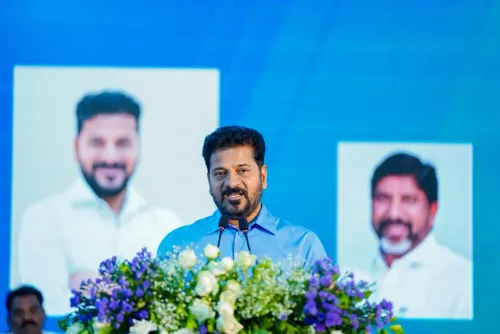
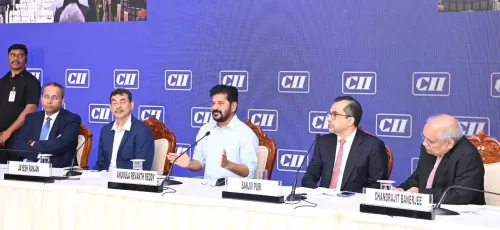
Hyderabad, Feb 18 (NationPress) Telangana's Chief Minister A. Revanth Reddy announced on Wednesday that the city is targeting to reach Net Zero emissions by 2034 and plans to conduct a comprehensive carbon footprint audit across the metropolis.
He revealed that within the next five years, there will be virtually no industries or factories operating in the urban area.
During his address at Mumbai Climate Week, the Chief Minister articulated Telangana's long-term vision for development, intertwining economic growth with environmental sustainability.
As per the Chief Minister’s Office (CMO), he reaffirmed Telangana's goal of expanding from a $200 billion state GDP to a $1 trillion economy by 2034 and aiming for a $3 trillion economy by 2047.
He introduced Telangana's strategic framework categorized into three zones - CURE, PURE, and RARE.
Hyderabad is designated as the Core Urban Region Economy (CURE) within the 160-kilometer Outer Ring Road. The PURE Zone, situated between the Outer Ring Road and the 360-kilometer Regional Ring Road, is dedicated to manufacturing, envisioned as a significant hub powered by green energy, providing a 'China +1' alternative, he noted.
Mentioning the cumulative effects of Covid and climate change, the Chief Minister remarked that both have reshaped governmental approaches, labeling the current scenario as a climate emergency. He stressed that growth, investments, and job opportunities must persist in harmony with sustainability.
In Hyderabad, taxes on electric vehicles have been abolished, leading to a surge in EV adoption, and negotiations are ongoing with EV companies regarding manufacturing investments.
Over 200,000 auto-rickshaws are being converted to green alternatives, more than 3,500 RTC buses are being transitioned to electric models, and the Hyderabad Metro is set to expand from 71 kilometers to over 200 kilometers. Industries are progressively relocating from the core urban region to peri-urban areas.
Highlighting that energy is the true currency of any economy, the Chief Minister noted that development is gauged by power generation and consumption.
Currently, Telangana consumes an average of 16,610 megawatts per day. The peak demand observed last year was 17,162 megawatts, anticipated to surpass 19,000 megawatts this year and projected to exceed 34,000 megawatts by 2034 as the state aims for a $1 trillion economy. Approximately one quarter of the state's energy, around 24.8 percent, is derived from green sources.
The Chief Minister underscored sustainability initiatives such as the rejuvenation of River Musi, restoration of lakes, enhancement of water and energy infrastructures, and the formation of HYDRAA, India's inaugural dedicated environmental police force.
Point of View
Hyderabad's commitment to achieving Net Zero emissions by 2034 represents a significant step towards sustainability. By aligning economic development with environmental goals, Telangana sets a precedent that other regions may follow. This initiative could boost green technology industries and enhance job creation while tackling climate change proactively.
NationPress
30 Sept 2026
Frequently Asked Questions
What is Hyderabad's target year for achieving Net Zero?
Hyderabad aims to achieve Net Zero emissions by 2034.
What significant initiatives are being implemented for sustainability?
Key initiatives include a city-wide carbon footprint audit, tax removal on electric vehicles, and transitioning public transport to electric models.
How is Telangana planning to boost its economy?
Telangana plans to grow its economy from $200 billion to $1 trillion by 2034 and $3 trillion by 2047.
What are the different zones in Telangana's strategic framework?
The framework includes three zones: CURE (Core Urban Region Economy), PURE (manufacturing hub), and RARE.
What percentage of energy in Telangana comes from green sources?
Approximately 24.8% of Telangana's energy is sourced from green power.