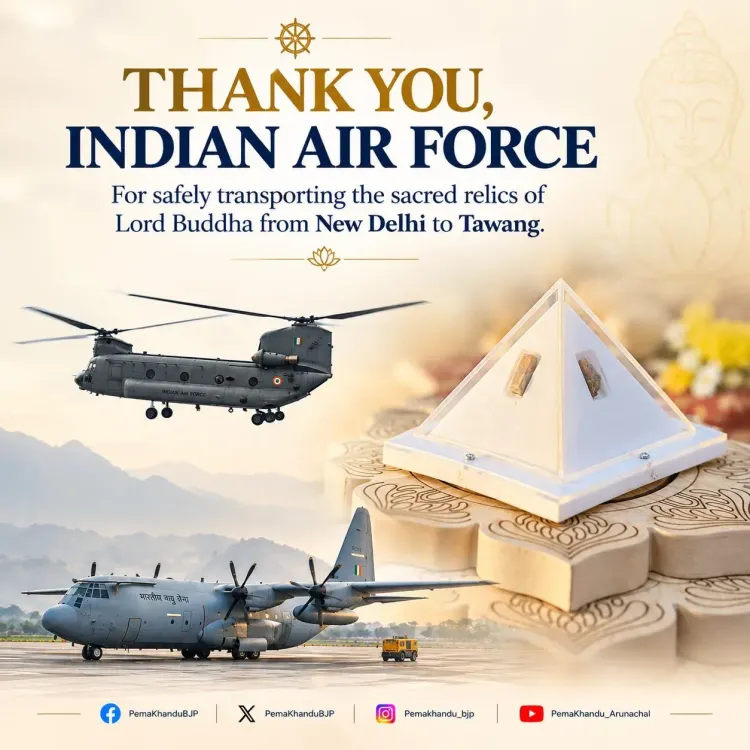
CM Pema Khandu thanks IAF for flying Buddha relics to Tawang
Synopsis
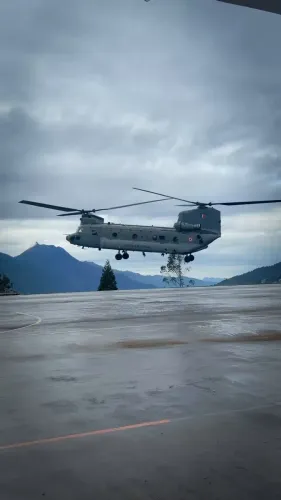
Arunachal Pradesh CM Pema Khandu thanked the Indian Air Force on 31 October 2026 for safely airlifting the sacred relics of Lord Buddha, Shakyamuni, from New Delhi to Tawang — calling the occasion 'historic' and of 'immense spiritual significance' for millions of Buddhist devotees.
Key Takeaways
The Indian Air Force airlifted the sacred relics of Lord Buddha, Shakyamuni from New Delhi to Tawang, Arunachal Pradesh on 31 October 2026 .
CM Pema Khandu publicly thanked the IAF, praising its 'professionalism, dedication and service' in enabling the mission.
Tawang hosts India's largest Buddhist monastery, making it a natural destination for relics of this significance.
The IAF regularly provides logistical support to Tawang due to limited road connectivity and high-altitude terrain near the Line of Actual Control .
India periodically facilitates relic movements to northeastern pilgrimage sites as part of its custodianship of Buddhist cultural heritage.
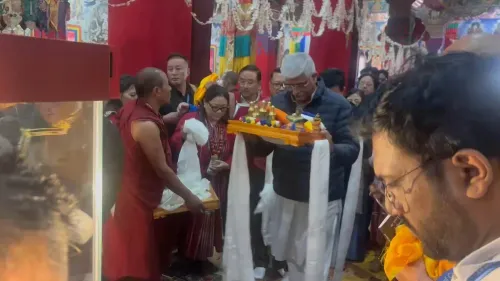
Public veneration events at Tawang Monastery and further government statements are anticipated following the relics' arrival.
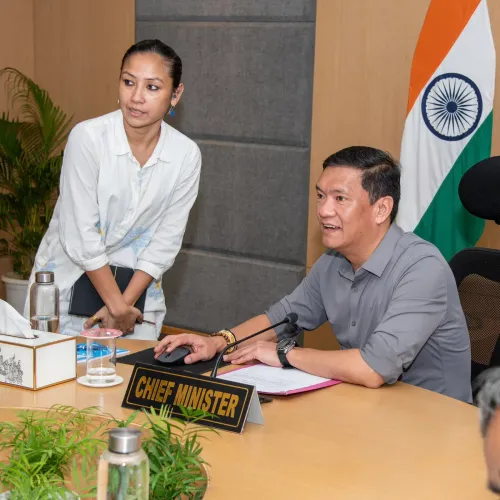
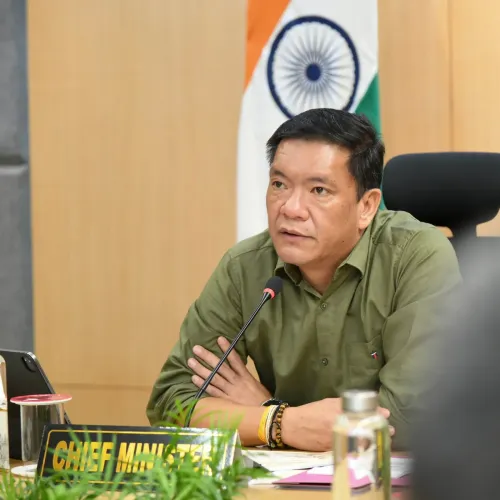
Sacred relics of Lord Buddha, Shakyamuni, touched down in Tawang, Arunachal Pradesh on Saturday, 31 October 2026 — airlifted by the Indian Air Force from New Delhi in a mission that Arunachal Pradesh Chief Minister Pema Khandu called 'a moment of immense spiritual significance' for millions of Buddhist devotees.
Posting on X, CM Khandu extended his 'sincere gratitude' to the IAF for what he described as a 'historic occasion,' crediting the force's 'professionalism, dedication and service' for making the airlift possible. The relics' arrival at Tawang — home to one of the largest Tibetan Buddhist monasteries in the world — is expected to draw pilgrims and devotees from across the region.
Why the IAF, not the highway
Tawang sits at roughly 10,000 feet above sea level, close to the Line of Actual Control with China, accessible by a single mountain road that is frequently cut off by landslides and winter snowfall. The Indian Air Force has long served as the de facto lifeline for the district — ferrying supplies, officials, and now sacred cargo — precisely because road connectivity remains fragile and the terrain unforgiving. For relics of this spiritual weight, air transport also eliminates the risk of damage or delay on a treacherous overland route.
Tawang Monastery and Buddhism's deep roots in Arunachal
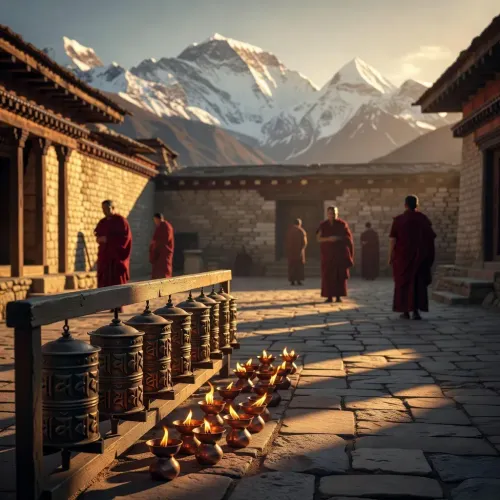
Tawang Monastery, founded in the 17th century, is the largest Buddhist monastery in India and the second largest in the world after Lhasa's Potala Palace. Arunachal Pradesh has a substantial Buddhist population with centuries-old cultural ties to Tibetan Buddhism, and the state government has historically been an active custodian of that heritage. The periodic facilitation of relic movements to pilgrimage sites in the Northeast is part of a broader pattern of using cultural and religious events to reinforce India's living connection to Buddhist traditions.
The strategic backdrop behind a spiritual moment
Tawang's proximity to the India-China border means that any high-profile cultural or religious event in the town carries an implicit dimension of sovereign assertion — quietly underlining India's administrative and cultural presence in a disputed frontier district. CM Khandu's public acknowledgement of the IAF's role is also a reminder that military logistics and civilian life are deeply intertwined in Arunachal Pradesh in ways rarely visible from the plains. The relics' arrival is now expected to trigger public veneration events at Tawang Monastery, with further statements from the state government and possibly the Ministry of Culture to follow.
For the devoted thousands who will queue to pay their respects, the flight path matters far less than the destination — but the Indian Air Force just made sure the two were never in doubt.
Point of View
Facilitating such a high-profile spiritual event in Tawang — a town China claims — serves both devotional and sovereign purposes simultaneously. CM Khandu's conspicuous acknowledgement of the IAF's role subtly frames the military not just as a security instrument but as a partner in cultural stewardship. It is a soft-power move dressed in devotion, and it is unlikely to be accidental.
NationPress
31 Oct 2026
Frequently Asked Questions
What are the relics of Lord Buddha, Shakyamuni?
Relics of Lord Buddha, Shakyamuni, are sacred physical remains or objects associated with the historical Buddha, venerated across the Buddhist world as objects of deep religious significance and pilgrimage.
Why were the Buddha relics taken to Tawang?
Tawang hosts India's largest Buddhist monastery and has one of the most significant Tibetan Buddhist communities in the country, making it a natural destination for sacred relics to be venerated by pilgrims and devotees.
Why did the Indian Air Force transport the relics instead of road convoy?
Tawang is situated at high altitude near the Line of Actual Control and is accessible only via a single mountain road prone to landslides and closures; the Indian Air Force routinely handles critical logistics for the district because of these terrain challenges.
What is Tawang Monastery known for?
Tawang Monastery, founded in the 17th century, is the largest Buddhist monastery in India and the second largest in the world, and is a major centre of Tibetan Buddhism and pilgrimage near the India-China border.