IANS Year Ender 2025: What Major Advances Has India's Education Sector Made?
Click to start listening
Synopsis
As we reflect on 2025, India's education landscape has made significant strides thanks to NEP 2020 and increased funding. From innovative labs to expanded institutions, the focus on quality education is reshaping the future. Discover how these changes are fostering a new generation of learners and innovators.
Key Takeaways
- Education budget increased by 6.22% to enhance access.
- 50,000 Atal Tinkering Labs proposed to boost innovation.
- New regulatory framework for higher education institutions established.
- NIPUN Bharat Mission aims for foundational literacy by 2026-27.
- CBSE Class 10 exams to be conducted twice from next year.
New Delhi, Dec 31 (NationPress) The education landscape in India has witnessed extraordinary advancements in 2025, fueled by reforms initiated under the National Education Policy (NEP) 2020, the expansion of educational institutions, and a surge in global recognition.
In alignment with Prime Minister Narendra Modi's vision of "Sabka Saath, Sabka Vikas, Sabka Vishwas, Sabka Prayaas", the Union Budget for 2025-26 earmarked Rs 1,28,650 crore—a 6.22% increase from the previous fiscal year—for the Ministry of Education, aiming to narrow the skill gap and enhance access to quality education.
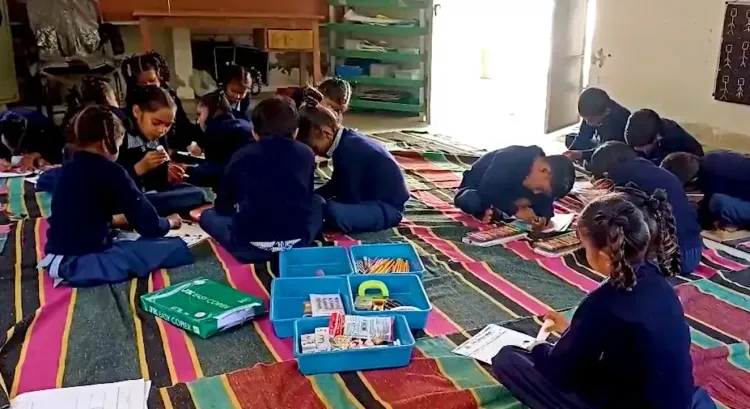
The government has also boosted funding for expanding broadband and internet access in government schools, and proposed the creation of 50,000 Atal Tinkering Labs to nurture innovation skills, including design thinking, computational skills, and adaptive learning.
Moreover, infrastructure support has been proposed for Indian Institutes of Technology (IITs) in Tirupati, Dharwad, Palakkad, Jammu, and Bhilai, which will facilitate an additional 6,500 students, as well as an increase of 10,000 seats for undergraduate and graduate programs in medical colleges.
The budget further comprises provisions to enhance digital classrooms and e-content in Indian languages, along with reinforcing teacher training and skill development initiatives.
This December, Parliament passed a pivotal piece of legislation aimed at granting institutions the status of independent, self-governing bodies, thereby promoting excellence through a robust and transparent accreditation and autonomy framework.
The Viksit Bharat Shiksha Adhishthan Bill, 2025 establishes a singular commission to regulate higher education institutions across India, addressing long-standing issues of regulatory overlap and fragmentation by consolidating multiple bodies into a unified structure.
This bill aligns with NEP, a transformative strategic document for India's educational framework, which aims to separate regulation, accreditation, funding, and academic standards into distinct, empowered entities to stimulate innovation and quality.
Over the last decade, India has implemented transformative reforms under NEP 2020 to bolster both school and higher education.
Innovative initiatives such as the 'National Initiative for Proficiency in Reading with Understanding and Numeracy' (NIPUN) Bharat Mission, the PM SHRI (Schools for Rising India) scheme, the National Curriculum Framework, and the National Credit Framework promote flexibility, multidisciplinarity, and internationalisation of education, thereby enhancing quality across thousands of institutions.
The NIPUN Bharat Mission, launched in 2021, aims to ensure every child achieves foundational literacy and numeracy by the end of Grade 3 by 2026-27, while the PM SHRI initiative, initiated in 2022, seeks to elevate the quality of education and infrastructure in schools by implementing the scheme in over 14,500 institutions between 2022 and 2026-27.
The number of higher education institutions surged by 13.8%, from 51,534 in 2014-15 to an impressive 70,018 as of June 2025.
Colleges expanded from 38,498 in 2014-15 to 52,081 this year, while universities increased from 760 to 1,338 during the same time frame.
In 2014, there were 16 IITs, and this figure rose to 23 by June 2025.
Likewise, the number of Indian Institutes of Management (IIMs) increased from 13 to 21, and AIIMS facilities grew from seven to 20 in the same period.
In a significant move to alleviate student pressure, the Central Board of Secondary Education (CBSE) will conduct Class 10 examinations twice starting next academic year. The first phase will take place in February, while the second will be in May.
The first exam will be mandatory, while the second will be optional for students looking to improve their scores in any three subjects—science, mathematics, social science, and languages. Results for each phase will be announced in April and June, respectively.
Additionally, the launch of the Viksit Bharat Buildathon 2025 marked a significant highlight this year. This initiative engaged school students, with millions participating to tackle real-world challenges, foster critical thinking and creativity, work on STEM (Science, Technology, Engineering, Arts, Mathematics) projects, and promote collaboration and innovation from a young age.
This initiative reflects the nation's shift towards experiential and project-based learning within India’s evolving educational framework.
Point of View
It is evident that India's education sector is on a transformative journey that aligns with national aspirations. The reforms under NEP 2020 and the establishment of a unified regulatory framework reflect a commitment to excellence. This approach will foster innovation and ensure that future generations are equipped with the necessary skills to thrive in a competitive global landscape.
NationPress
03/01/2026