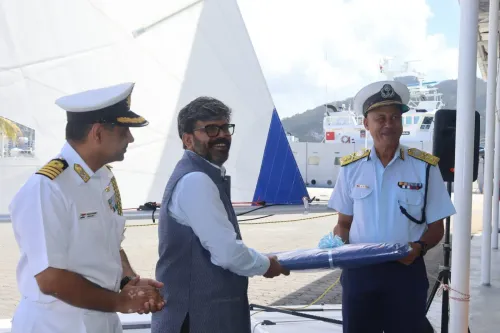
INCOIS deploys Wave Buoys off Seychelles to boost Indian Ocean forecasting
Synopsis
India's ocean forecasting agency INCOIS has begun pre-deployment testing of Wave Rider Buoys and Drifters for Seychelles — a quiet but strategically significant expansion of India's Indian Ocean monitoring network. Simultaneously, INCOIS showcased its disaster-response role at the AJHE-2026 multi-agency HADR drill in Jamnagar, flagging AI-based predictive tools as the new frontier in coastal hazard management.
Key Takeaways
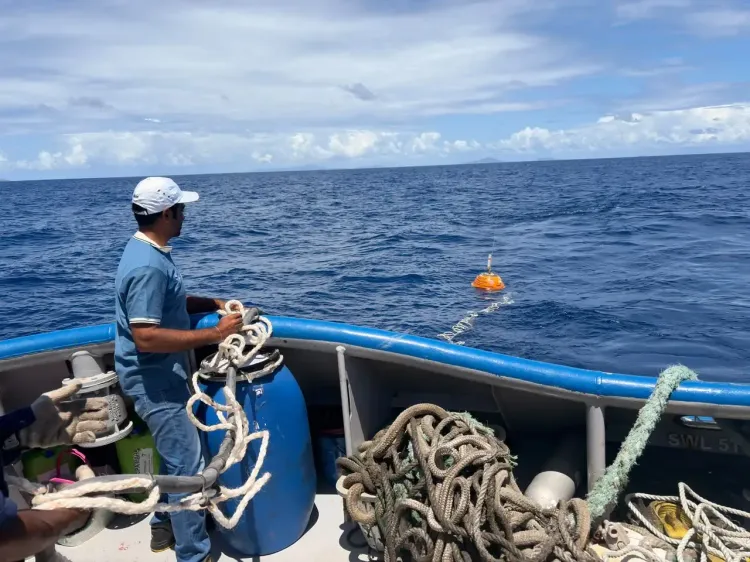
INCOIS has begun integration and pre-deployment testing of a Wave Rider Buoy and Wave Drifters to be deployed off the coast of Seychelles .
The initiative is a bilateral collaboration between INCOIS (under MoES ) and the Seychelles Meteorological Authority (SMA) , aimed at real-time ocean monitoring and early warning.
INCOIS participated in Ex Sahayata Setu (AJHE-2026) at Air Force Station Jamnagar , highlighting its multi-hazard marine forecasting role in disaster response.
Chandra Sekhar presented on coastal hazard alerts covering tsunamis , storm surges , high waves , and swell surges (Kallakkadal) .
The AJHE-2026 drill involved the Indian Air Force , Indian Army , Indian Coast Guard , and NDRF , with focus on AI -based predictive capabilities and Command and Control integration.
The Indian National Centre for Ocean Information Services (INCOIS) has commenced integration and pre-deployment testing of a Wave Rider Buoy and Wave Drifters set to be deployed off the coast of Seychelles, in a significant step forward for ocean observation and marine forecasting across the Indian Ocean Region. The move is part of a bilateral cooperation framework between INCOIS, operating under the Union Ministry of Earth Sciences (MoES), and the Seychelles Meteorological Authority (SMA).
What the Deployment Aims to Achieve
The deployment is designed to strengthen real-time monitoring of wave conditions and ocean dynamics around Seychelles, with the broader goal of improving marine forecasting, maritime safety, and early warning services for the island nation. Wave Rider Buoys and Wave Drifters are precision instruments that track ocean surface behaviour, feeding live data into forecasting models critical for coastal hazard management.
'This collaboration reflects the shared commitment of India and Seychelles towards advancing ocean science, strengthening regional cooperation and promoting a safer and resilient Indian Ocean,' INCOIS said in a statement, adding that effective monitoring of the region relies on sustained international partnerships.
INCOIS at the HADR Exercise in Jamnagar
Separately, an INCOIS delegation participated in the Annual Joint Humanitarian Aid and Disaster Relief (HADR) Exercise (AJHE-2026), codenamed Ex Sahayata Setu, held at Air Force Station Jamnagar. At a seminar during the exercise, INCOIS scientist V. Chandra Sekhar presented a detailed account of how the agency's multi-hazard marine monitoring, forecasting, and early warning services support India's disaster response operations.
The presentation underlined the importance of timely alerts for coastal hazards — including tsunamis, storm surges, high waves, and swell surges (Kallakkadal) — in enabling effective disaster preparedness and mitigation. 'INCOIS's participation reaffirmed its commitment to strengthening inter-agency coordination and supporting effective HADR operations through science-driven ocean information, marine hazard forecasting and early warning services,' the agency stated.
Multi-Agency Drill Tests Disaster Response
A comprehensive multi-agency drill was conducted as part of Ex Sahayata Setu 2026 at Air Force Station Jamnagar to test collective response mechanisms against complex disaster scenarios. Participating agencies included the Indian Air Force, Indian Army, Indian Coast Guard, and the National Disaster Response Force (NDRF), among others.
Deliberations at AJHE-2026 focused on improving inter-agency coordination, synchronised operational planning, integration of Friendly Foreign Countries (FFCs), and a Whole-of-Nation approach to disaster management. Notably, the exercise placed particular emphasis on technology-enabled decision-making, AI-based predictive capabilities, and streamlined Command and Control integration — signalling a broader shift in India's disaster response doctrine.
Significance for Regional Ocean Safety
This comes amid India's expanding maritime engagement across the Indo-Pacific, where real-time ocean data sharing has become central to both scientific and security cooperation. The INCOIS-SMA partnership adds a new node to the region's ocean monitoring network, potentially benefiting not just Seychelles but other small island states that rely on Indian Ocean forecasting infrastructure. The buoy deployment, once complete, is expected to generate continuous wave and current data to feed into regional early warning systems.
Frequently Asked Questions
What is the INCOIS-Seychelles wave buoy deployment about?
INCOIS has commenced pre-deployment testing of a Wave Rider Buoy and Wave Drifters that will be deployed off the coast of Seychelles as part of a bilateral cooperation agreement with the Seychelles Meteorological Authority. The instruments will enable real-time monitoring of wave conditions and ocean dynamics, supporting improved marine forecasting and early warning services around the island nation.
Why is real-time ocean monitoring important for Seychelles?
Seychelles is a small island nation highly vulnerable to coastal hazards including storm surges, high waves, and swell events. Real-time ocean data from wave buoys and drifters feeds directly into forecasting models that can trigger early warnings, giving communities and authorities time to prepare and respond.
What is Ex Sahayata Setu (AJHE-2026)?
Ex Sahayata Setu is the Annual Joint Humanitarian Aid and Disaster Relief Exercise for 2026, held at Air Force Station Jamnagar. It is a multi-agency drill involving the Indian Air Force, Indian Army, Indian Coast Guard, NDRF, and other organisations, designed to test and improve collective disaster response mechanisms, including AI-based decision-making and inter-agency coordination.
What role does INCOIS play in India's disaster response?
INCOIS provides multi-hazard marine monitoring, forecasting, and early warning services that support India's HADR operations. Its alerts cover coastal hazards such as tsunamis, storm surges, high waves, and swell surges (Kallakkadal), and the agency participates in joint exercises to integrate ocean-state intelligence into disaster preparedness frameworks.
How does this cooperation fit into India's broader Indian Ocean strategy?
The INCOIS-SMA partnership is part of India's expanding maritime engagement across the Indo-Pacific, where real-time ocean data sharing underpins both scientific and security cooperation. By adding a monitoring node near Seychelles, India strengthens its role as a leading provider of ocean information services to small island states and regional partners in the Indian Ocean Region.