India and Canada: Pioneering a Sustainable Energy Future Together
Synopsis
India and Canada are on the verge of a transformative partnership in clean energy following Prime Minister Mark Carney's visit. This collaboration promises to enhance climate action and infrastructure development across solar, hydrogen, wind, and low-carbon LNG sectors, setting a new standard for international energy cooperation.
Key Takeaways
India's 500 GW target for non-fossil power by 2030 necessitates annual capacity additions.
Strategic Energy Partnership covers multiple clean energy sectors.
Canada aims to be a reliable supplier of low-carbon LNG and critical minerals.
Collaboration could lead to innovation in clean energy technologies .
Success hinges on genuine commitments to decarbonization and not just green rhetoric.
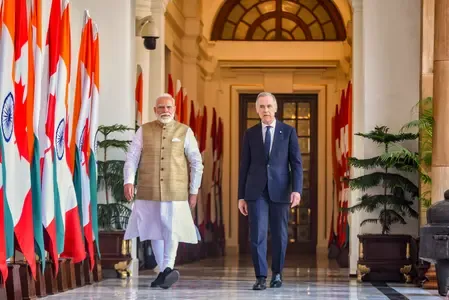
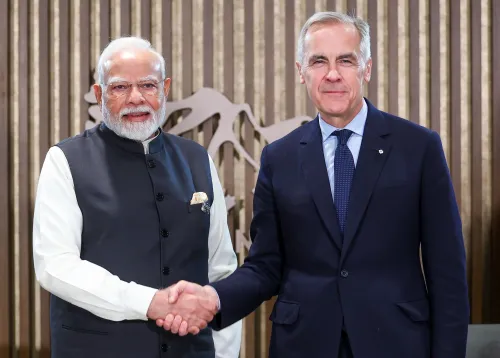
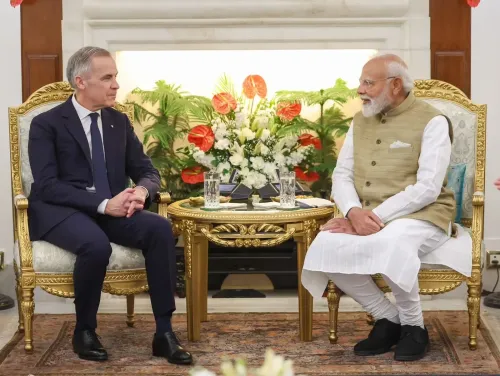
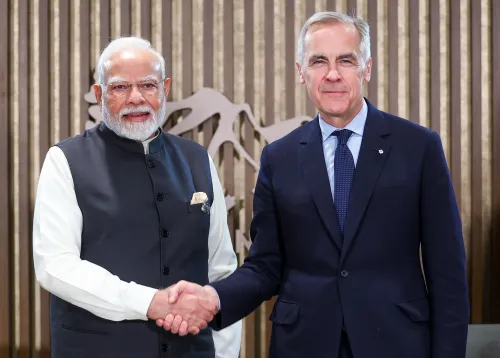
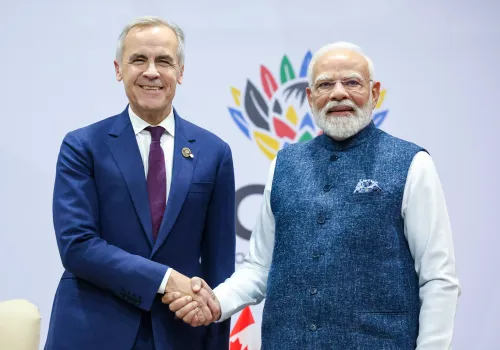
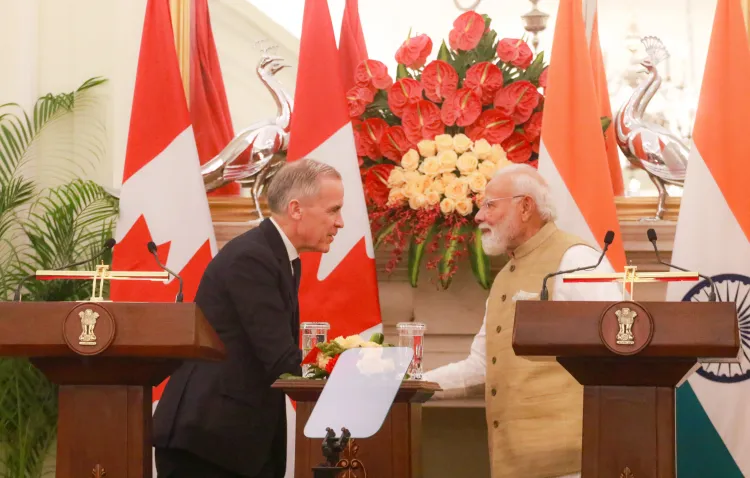
New Delhi, March 26 (NationPress) Following Prime Minister Mark Carney’s recent visit to New Delhi, a new Strategic Energy Partnership has emerged between India and Canada. This collaboration presents an opportunity to transform climate diplomacy into tangible infrastructure in sectors such as solar, hydrogen, wind, and low-carbon LNG, potentially serving as a benchmark for energy cooperation between the North and South, as highlighted in a recent article.
India has set an ambitious goal of achieving 500 GW of non-fossil power capacity by 2030, which necessitates the addition of 40–50 GW of clean capacity annually throughout the decade—figures that significantly exceed historical averages, according to observations made in One World Outlook.
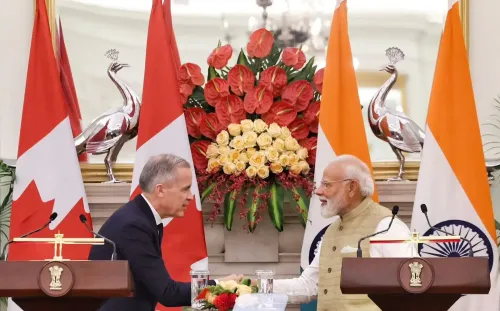
During Carney’s visit, both nations unveiled a Strategic Energy Partnership that encompasses LNG, LPG, uranium, solar, hydrogen, and critical minerals, bolstered by commercial agreements exceeding (Canadian) $5.5 billion. Canada also pledged to participate in the International Solar Alliance led by India and France and to enhance its membership in the Global Biofuels Alliance, thereby joining India’s favored multilateral clean-energy initiatives.
A separate Memorandum of Understanding (MoU) on clean energy outlines collaborative efforts in solar, wind, bioenergy, small hydro, storage, and capacity-building, facilitated by a Joint Working Group.
Canada aims to establish itself as a dependable supplier of some of the globe's lowest-carbon LNG, uranium, and critical minerals, while also partnering in grid expansion and energy storage to satisfy India’s substantial demand.
Carney acknowledged India's intention to nearly double the proportion of LNG in its primary energy composition by 2030, even as it seeks to add 500 GW of clean capacity. Canada plans to produce approximately 50 million tonnes of LNG annually by 2030, targeting India as a vital market. This strategy is framed as a pragmatic approach: substituting coal with lower-carbon gas to provide stable power supporting intermittent renewables, as noted in the article.
Nevertheless, long-term LNG contracts entered into this decade will still be in effect in the 2040s, when pathways aligned with the Paris Agreement and India’s own pledge for net-zero emissions by 2070 require profound decarbonization of both power and industry. The challenge for this partnership will be to ensure that gas is distinctly capped and defined as a transitional energy source, with concurrent investments in the technologies needed for its eventual replacement, the article emphasizes.
The most promising aspect of Carney’s visit lies not in specific agreements, but in the collaborative ecosystem it suggests. Canada and India have committed to intensifying cooperation on investments in clean energy technologies, critical minerals, and “future-oriented industries.” Universities and research institutions are beginning to forge connections, exemplified by Simon Fraser University’s agreement with the Hydrogen Association of India, which has the potential to foster innovation in electrolyser design, storage, and industrial applications.
India’s transition now focuses less on pilot projects and more on actual pipelines—of projects beyond just gas. To achieve the target of 40–50 GW of non-fossil capacity each year, India requires reliable auction schedules, timely grid development ahead of generation, and concessional financing to reduce capital costs for renewables and storage.
Canada's contribution should be evaluated based on whether its development finance entities, pension funds, and export credit agencies actively support solar, wind, storage, and transmission at scale, rather than only focusing on LNG and uranium exports, the article suggests.
If the Strategic Energy Partnership evolves into a platform for joint solar manufacturing zones, battery supply chains, pilot projects for grid balancing, and resilient supply chains for critical minerals, Carney’s visit to India will signify a true turning point. Conversely, if it reverts to the familiar trend of fossil fuel exports disguised in green rhetoric, the opportunity cost will be measured not just in gigawatts, but in trust and credibility, the article concludes.
Point of View
I view the India-Canada Strategic Energy Partnership as a significant opportunity for both nations to lead in the clean energy sector. This collaboration can enhance not only energy security but also foster innovation and investment in sustainable technologies, benefiting both economies and contributing to global climate goals. It's crucial that this partnership remains focused on genuine advancements rather than simply greenwashing fossil fuel initiatives.
NationPress
24 Sept 2026
Frequently Asked Questions
What is the Strategic Energy Partnership between India and Canada?
The Strategic Energy Partnership aims to foster collaboration between India and Canada in clean energy sectors, including solar, hydrogen, wind, and low-carbon LNG, to enhance climate diplomacy and infrastructure.
What are India's clean energy targets?
India aims for 500 GW of non-fossil power capacity by 2030, requiring the addition of 40-50 GW of clean capacity annually.
What commitments did Canada make during Carney's visit?
Canada committed to collaborate on various clean energy sectors and joined the International Solar Alliance while enhancing its role in the Global Biofuels Alliance.
How does this partnership affect India's energy mix?
The partnership is expected to help India nearly double its LNG share in the energy mix by 2030 while also significantly increasing clean energy capacity.
What is the importance of this partnership?
This partnership represents a critical step towards global energy cooperation, innovation in clean technologies, and meeting climate goals effectively.