Giriraj Singh flags 25% rise in India coffee exports
Synopsis
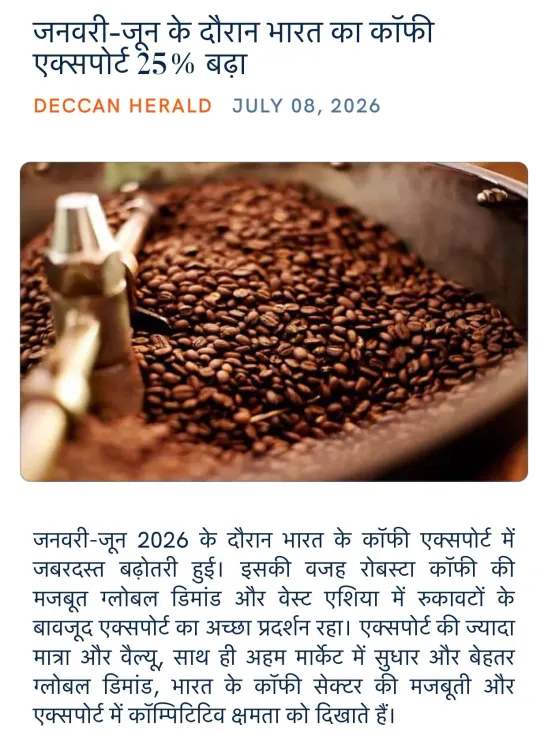
Union Textiles Minister Giriraj Singh on 8 July 2026 highlighted a 25 per cent rise in India's coffee exports during January–June 2026, underscoring the country's growing footprint as a major global coffee exporter.
Key Takeaways
India's coffee exports rose 25 per cent during January–June 2026 , according to data shared by Union Textiles Minister Giriraj Singh .
India is the sixth-largest coffee producer globally, with output centred in Karnataka , Kerala , and Tamil Nadu .
The Coffee Board of India , under the Ministry of Commerce and Industry , is the nodal body for coffee export promotion.
India's Agricultural Export Policy of 2018 targeted doubling agri-shipments through value addition and market diversification.
Full-year 2026–27 Coffee Board data and trade-negotiation outcomes with the EU and US will be key indicators to watch.
Union Textiles Minister Giriraj Singh on Wednesday, 8 July 2026 shared data showing that India's coffee exports rose 25 per cent during the January–June 2026 period, flagging the performance on X via the NaMo App.
Context
Singh shared a link reporting the export surge, writing: 'जनवरी-जून के दौरान भारत का कॉफी एक्सपोर्ट 25% बढ़ा' — 'India's coffee exports rose 25% during January–June.' The post highlights a significant half-year trade performance for one of India's key plantation commodities. Coffee exports are tracked and promoted by the Coffee Board of India, a statutory body under the Ministry of Commerce and Industry.
India is the sixth-largest coffee producer in the world, with cultivation concentrated in Karnataka, Kerala, and Tamil Nadu. The country produces both Arabica and Robusta varieties, a significant share of which is destined for export markets in Europe, Italy, and the United States.
Policy Backdrop
India's Agricultural Export Policy of 2018 set an ambition to double agri-commodity shipments — including coffee — through value addition, quality certification, and market diversification. Successive governments have treated coffee as a flagship plantation export, channelling support through the Coffee Board and APEDA schemes that assist growers in meeting international quality standards.
Export growth in recent years has been driven by enhanced quality certifications and improved market access, including ongoing trade negotiations with major buyer blocs in the European Union and the United States. A strong first half of 2026 would represent a meaningful step in sustaining that momentum.
Stakeholders and Impact
The primary beneficiaries of sustained export growth are coffee growers in southern India — many of them small and marginal farmers — and the export supply chain that includes processors, traders, and shipping firms. A 25 per cent jump in the first half of the year, if maintained, would translate into substantially higher foreign exchange earnings and farm-gate prices for growers.
Industry bodies representing coffee planters have long advocated for stable export incentives and tariff relief in destination markets. Strong half-year numbers strengthen their case ahead of any budget-cycle discussions on plantation-sector support.
What's Next
Attention will now turn to full-year 2026–27 coffee export data from the Coffee Board, which will indicate whether the first-half momentum holds through the post-monsoon harvest season. Outcomes from ongoing trade negotiations with the EU and US on tariff and market-access terms could further shape India's export trajectory for the crop.
The government's periodic highlighting of agri-trade performance data signals continued political attention to export-led agricultural growth as a broader economic priority.
Point of View
Making the Textiles Minister's post an act of broader political messaging rather than a portfolio-specific announcement. The 25 per cent first-half surge, if sustained, would bolster the government's narrative of export-led agricultural growth — a theme central to its economic positioning since the 2018 Agri-Export Policy. The signal to watch is whether this headline number translates into concrete policy action, such as enhanced Coffee Board funding or tariff concessions in ongoing EU and US trade talks.
NationPress
7 Oct 2026
Frequently Asked Questions
How much have India's coffee exports grown in 2026?
India's coffee exports rose 25 per cent during the January–June 2026 period, according to data highlighted by Union Textiles Minister Giriraj Singh on 8 July 2026.
Which ministry oversees coffee exports in India?
Coffee exports are promoted by the Coffee Board of India , a statutory body under the Ministry of Commerce and Industry , not the Textiles Ministry.
Which states produce the most coffee in India?
The bulk of India's coffee is grown in Karnataka , Kerala , and Tamil Nadu , making southern India the heartland of the country's coffee economy.
What is India's rank in global coffee production?
India is the sixth-largest coffee producer in the world, cultivating both Arabica and Robusta varieties for domestic consumption and export.
What government policy supports India's coffee export growth?
The Agricultural Export Policy of 2018 set a target to double agri-exports through value addition and market diversification, with coffee among the key commodities supported via the Coffee Board and APEDA schemes.