How Will the India-EU Free Trade Agreement Boost South Gujarat's Export Sectors?
Synopsis
The recent India-EU FTA is a game-changer for South Gujarat's export sectors. It opens up vast new markets and opportunities, particularly in textiles, gems, and marine products, promising significant economic growth in the region.
Key Takeaways
India-EU FTA opens vast export opportunities.
Textiles and gems sectors are major beneficiaries.
Tariff eliminations enhance competitiveness .
New markets for marine products await.
Surat to strengthen its role in diamond processing .
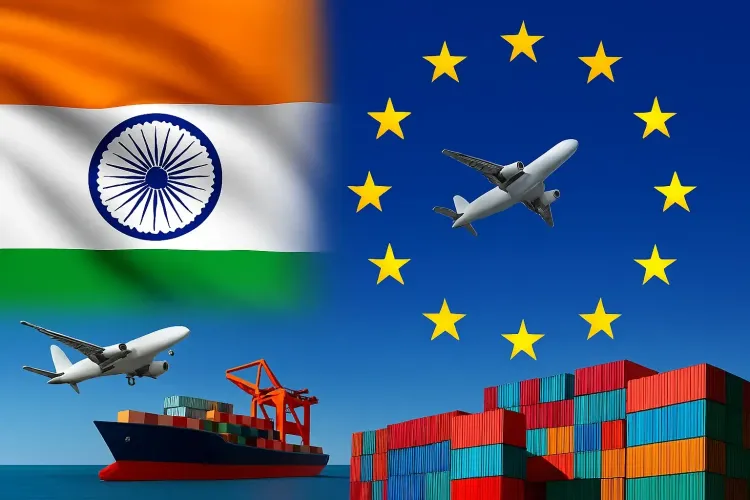
Gandhinagar, Feb 6 (NationPress) The recently finalized Free Trade Agreement (FTA) between India and the European Union is poised to greatly enhance export potential for Gujarat, especially its southern regions, by granting extensive duty-free and preferential access to one of the globe's largest import markets.
This agreement represents a significant leap in India's ambitions to intensify its global trade relations and bolster export-driven industrial development across essential sectors.
Currently, India's exports to the European Union are approximately Rs 1.44 lakh crore (USD 16.6 billion).
With the FTA, India has achieved preferential access on about 97 percent of tariff lines, encompassing 99.5 percent of the total trade value. A swift duty elimination will impact 70.4 percent of tariff lines, which corresponds to 90.7 percent of India’s exports to the EU.
Key sectors like textiles, leather goods, footwear, tea, coffee, spices, toys, sports equipment, gems and jewelry, marine products, processed foods, automobiles, steel, pharmaceuticals, and chemicals stand to gain the most.
In the fiscal year 2024-25, these sectors together accounted for nearly one-fourth of Gujarat’s total exports to the EU. The textiles and apparel industry is anticipated to experience a substantial increase, with the EU remaining India's second-largest export market in this category.
Zero-duty access and tariff reductions of up to 12 percent will further open the EU’s USD 263.5 billion textile and apparel import market to Indian exporters. Currently, India’s global textile and apparel exports total USD 36.7 billion, of which USD 7.2 billion is directed towards the EU. Ready-made garments dominate this export category, followed by cotton textiles and synthetic fiber products.
Surat, a pivotal hub for synthetic textiles and man-made fibers, is expected to reap significant benefits from new opportunities in yarn, apparel, home textiles, and garments.
The gems and jewelry sector is also set for expansion, with preferential access to the EU’s USD 79.2 billion import market.
Surat, recognized as one of the world’s foremost diamond processing centers with over 5,000 units, already fosters a robust export ecosystem. More than 250 jewelry and diamond-related units operating in the Surat SEZ further bolster the sector’s capabilities for high-value exports.
Marine exports, currently valued at USD 1 billion to the EU, are anticipated to benefit from tariff reductions of up to 26 percent, enhancing access to the EU’s USD 53.6 billion seafood import market. This is expected to support a rise in value-added seafood exports from Gujarat.
The chemicals sector is another major winner, with zero duties applicable on 97.5 percent of the value of chemical exports under the FTA.
This effectively eliminates tariffs of up to 12.8 percent, improving competitiveness across inorganic, organic, and agrochemical products. The Surat economic region contributes nearly 70 percent of Gujarat’s chemical gross value added, positioning South Gujarat as a pivotal player in future growth.
Officials assert that the India-EU FTA aligns with the Prime Minister’s vision of a developed India by expanding exports, attracting investments, and enhancing industrial capacity.
The upcoming Vibrant Gujarat Regional Conference (VGRC) for South Gujarat, set to take place in Surat this April, is expected to serve as a vital platform for connecting regional industries with emerging opportunities in the European market and foster sustained export growth.
Point of View
It is vital to recognize the significance of the India-EU Free Trade Agreement. This collaboration not only strengthens India's global trade engagement but also plays a crucial role in enhancing local economies, particularly in South Gujarat. The focus on expanding exports and attracting investment aligns with the broader vision of national growth.
NationPress
14 Sept 2026
Frequently Asked Questions
What is the Free Trade Agreement (FTA) between India and the EU?
The Free Trade Agreement (FTA) is a pact that allows for duty-free and preferential access to trade between India and the European Union, significantly enhancing export opportunities.
How much of India's exports to the EU will benefit from the FTA?
About 90.7 percent of India's exports to the EU will benefit from immediate duty elimination on 70.4 percent of tariff lines under the FTA.
Which sectors are expected to gain the most from the FTA?
Key sectors such as textiles, leather, footwear, gems and jewelry, and marine products are expected to see substantial growth due to the FTA.
What impact will the FTA have on Gujarat's economy?
The FTA is expected to significantly boost Gujarat's economy, particularly in the southern region, by opening new export markets and creating job opportunities.
When will the Vibrant Gujarat Regional Conference be held?
The Vibrant Gujarat Regional Conference (VGRC) for South Gujarat is scheduled for April this year in Surat.