CM Saini Hails India's First Hydrogen Train Flag-Off from Jind
Synopsis
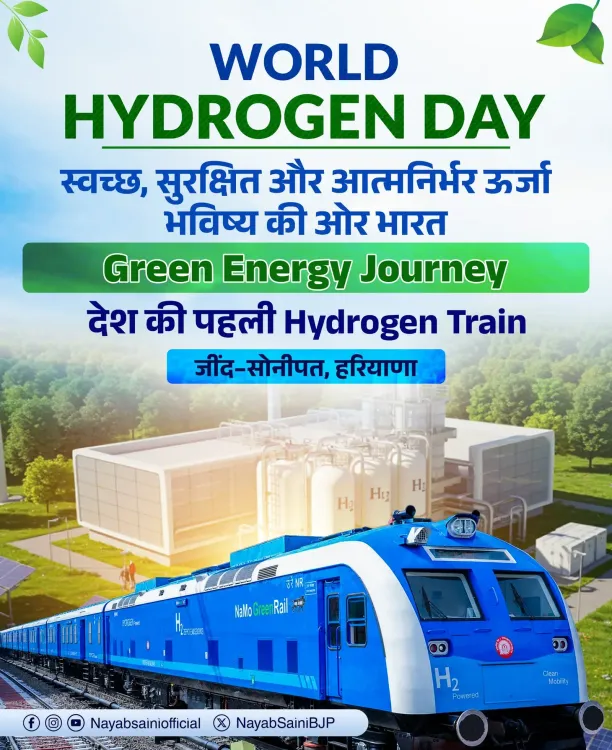
On World Hydrogen Day 2026, Haryana CM Nayab Singh Saini celebrated PM Modi's flag-off of India's first indigenous hydrogen train from Jind, Haryana, citing the National Green Hydrogen Mission as the policy backbone driving India's clean-energy and self-reliance goals.
Key Takeaways
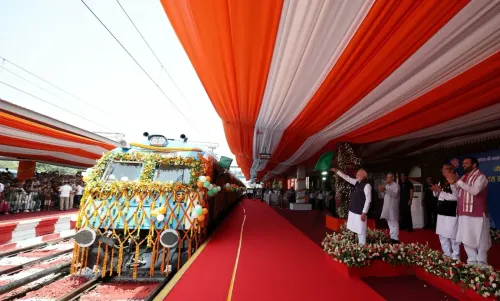
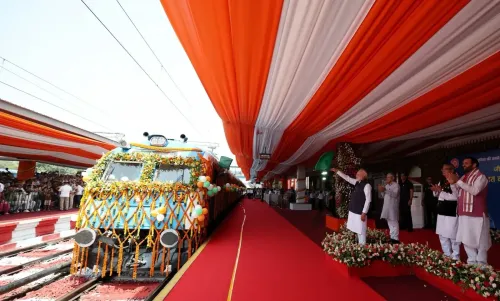
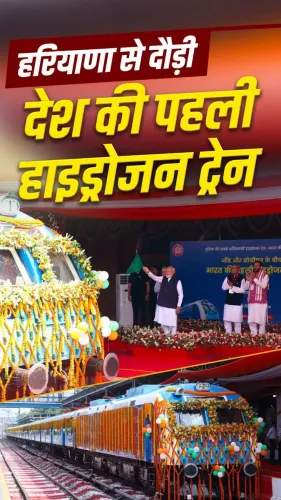
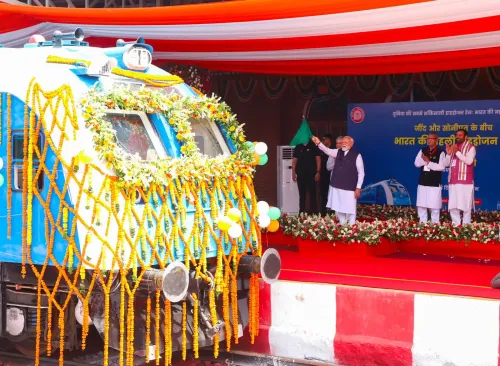
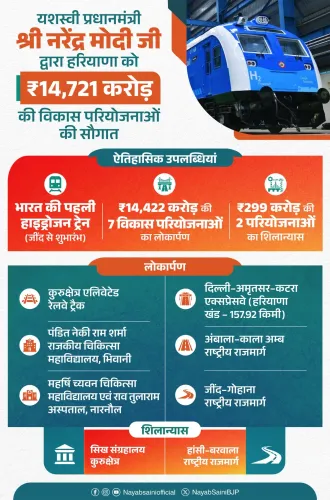
PM Narendra Modi flagged off India's first indigenously developed hydrogen-powered train from Jind, Haryana on 8 October 2026 .
Haryana CM Nayab Singh Saini marked the launch on World Hydrogen Day , calling it a source of national pride.
The train is framed as a flagship demonstration of the National Green Hydrogen Mission , which targets India as a global green-hydrogen hub.
Hydrogen trains use fuel cells to generate electricity, emitting only water vapour — suitable for India's many non-electrified rail corridors.
CM Saini described the train as proof of India's 'technological capability' toward eco-friendly transport and energy self-reliance .
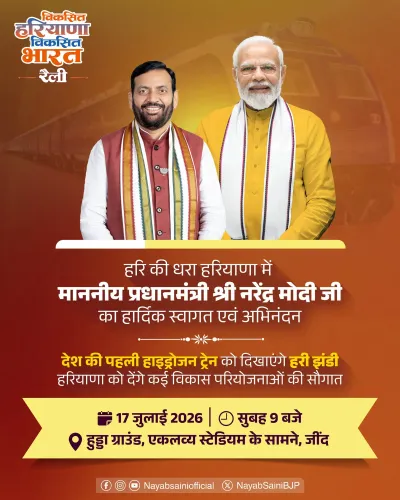
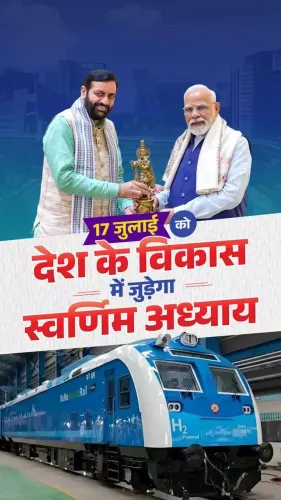
India's green-energy ambitions pulled into a new station on World Hydrogen Day, 8 October 2026, as Haryana Chief Minister Nayab Singh Saini celebrated a landmark the country has been building toward for years: Prime Minister Narendra Modi flagging off India's first indigenously developed hydrogen-powered train — from Jind, Haryana.
Posting on X, CM Saini wrote: 'विश्व हाइड्रोजन दिवस पर स्वच्छ ऊर्जा के क्षेत्र में भारत की प्रगति को देखकर गर्व होता है' — 'On World Hydrogen Day, it fills me with pride to see India's progress in the field of clean energy.' He tied the train's launch directly to the National Green Hydrogen Mission, positioning the locomotive as a living proof-of-concept of that policy framework.
A Train Born from the National Green Hydrogen Mission
The National Green Hydrogen Mission, launched by the Union government, set out to make India a global hub for the production, use, and export of green hydrogen — targeting significant electrolyser manufacturing capacity and a sharp reduction in the cost of green hydrogen production. The hydrogen train flagged off from Jind is precisely the kind of domestic application the Mission was designed to catalyse: home-built, home-fuelled, zero direct emissions at the point of use.
Hydrogen trains generate electricity through a fuel cell that combines hydrogen and oxygen, emitting only water vapour. They are particularly suited for non-electrified rail corridors — of which India has many — offering a cleaner alternative to diesel traction without the capital cost of overhead electrification.
Why Jind, and Why This Moment
The choice of Jind — a mid-sized district headquarters in Haryana's agricultural heartland — as the launch site is itself a signal. It places hydrogen technology visibly in a state that has built its political identity around farm welfare and rural infrastructure, broadening the symbolism of the launch beyond an urban tech showcase. For CM Saini, who has championed Haryana's development narrative ahead of coming electoral cycles, hosting the Prime Minister for this milestone carries clear political as well as policy weight.
World Hydrogen Day provides the global frame. Observed each year on 8 October, it has become an occasion for governments worldwide to announce hydrogen milestones — and India's train launch slots neatly into that international conversation, signalling that the country is moving from mission documents to rolling stock.
Energy Self-Reliance on the Tracks
CM Saini called the train 'an example of India's technological capability in the direction of eco-friendly transport and energy self-reliance' — invoking the Aatmanirbhar Bharat ('self-reliant India') language that has defined the government's industrial policy posture. The emphasis on 'indigenous' development matters: a domestically engineered hydrogen train is not just a transport story but an industrial one, touching rolling-stock manufacturing, fuel-cell technology, and green-hydrogen supply chains simultaneously.
Whether the Jind launch marks the beginning of a wider fleet roll-out or remains a high-profile pilot will be the question India's railway and energy planners will now face. The track has been laid. The train has moved.
Point of View
Visible achievement just as global pressure on clean-energy commitments intensifies. For CM Saini, the event fuses Haryana's development narrative with a futuristic national project — useful optics ahead of electoral cycles. The 'indigenous' framing also plugs directly into the Aatmanirbhar Bharat industrial strategy, extending it from defence and semiconductors into green mobility. The real test, however, will be whether this flagship pilot converts into a scalable fleet programme with domestic hydrogen supply chains to match.
NationPress
8 Oct 2026
Frequently Asked Questions
What is India's first hydrogen train and where was it launched?
India's first indigenously developed hydrogen-powered train was flagged off by PM Narendra Modi from Jind in Haryana on 8 October 2026, World Hydrogen Day.
What is the National Green Hydrogen Mission?
The National Green Hydrogen Mission is a Union government initiative to make India a global hub for the production, use, and export of green hydrogen, targeting lower production costs and large-scale domestic electrolyser manufacturing.
How does a hydrogen train work?
A hydrogen train uses a fuel cell that combines hydrogen and oxygen to generate electricity for its motors, emitting only water vapour — making it a zero direct-emission alternative to diesel traction.
Why did Haryana CM Nayab Singh Saini post about the hydrogen train?
CM Saini posted on World Hydrogen Day to celebrate the train's launch from Jind in his state and to highlight India's clean-energy progress under the National Green Hydrogen Mission.
What is World Hydrogen Day?
World Hydrogen Day is observed on 8 October each year as a global occasion for governments and industries to highlight progress in hydrogen energy technology and policy.