India-Japan Economic Security Dialogue: Supply chain, semiconductors in focus
Synopsis
India and Japan's second Economic Security Dialogue in New Delhi went beyond diplomatic ritual — private sector bodies from both countries formally presented policy recommendations to their governments, and five priority sectors including semiconductors and critical minerals now have a structured cooperation track. With the Middle East crisis adding urgency to energy supply chains, the dialogue's scope is widening fast.
Key Takeaways
India and Japan held the 2nd India-Japan Economic Security Dialogue in New Delhi on 11 May 2025 .
Talks co-chaired by Foreign Secretary Vikram Misri and Japan's Vice Minister Takehiro Funakoshi .
Five priority sectors identified: semiconductors , critical minerals , ICT , clean energy , and pharmaceuticals .
Private sector bodies — Japan Business Federation , JETRO , and CII — presented policy recommendations to both governments.
Both sides agreed to cooperate on energy security and supply chain resilience amid Middle East tensions.
Both nations reaffirmed commitment to the Free and Open Indo-Pacific (FOIP) framework, including within the Quad .
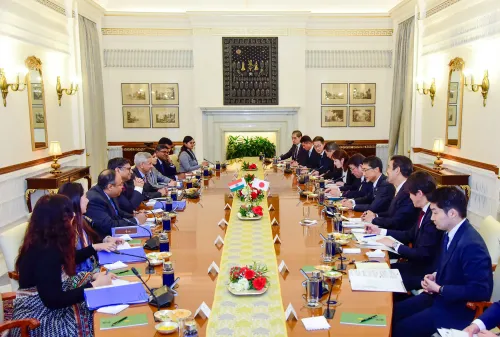
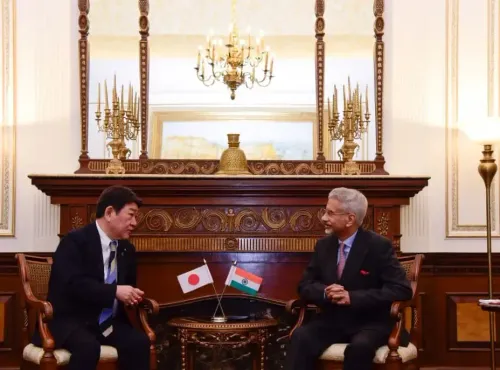
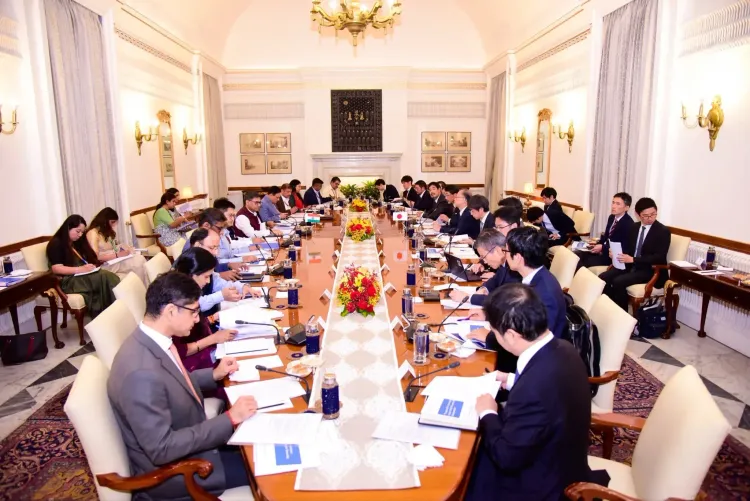
India and Japan on Monday, 11 May concluded the second round of the India-Japan Economic Security Dialogue in New Delhi, with both sides agreeing to deepen collaboration across strategic industrial sectors to strengthen supply chain resilience. The talks were co-chaired by Foreign Secretary Vikram Misri and Japan's Vice Minister for Foreign Affairs Takehiro Funakoshi.
What the Dialogue Covered
Officials from both nations exchanged assessments of shared economic security challenges, including economic coercion, non-market policies and practices, and overproduction. Discussions were anchored around five priority areas identified in the Japan-India Joint Statement from Prime Minister Narendra Modi's visit to Japan in August last year: semiconductors, critical minerals, information and communication technology, clean energy, and pharmaceuticals.
Private Sector at the Table
A notable feature of this round was the participation of private sector representatives. The Japan Business Federation, the Japan External Trade Organization (JETRO), and the Confederation of Indian Industry (CII) reported outcomes from the Japan-India Private Sector Economic Security Dialogue, which was launched during Modi's Japan visit and held on 26 March. Policy recommendations from that forum were formally presented to both governments, signalling a structured public-private coordination mechanism.
Indo-Pacific and Middle East on the Agenda
On the diplomatic front, both sides held the Japan-India Foreign Vice-Ministers' Dialogue, covering the Indo-Pacific region and the Middle East, with specific attention to the situation in Iran. The two nations agreed to cooperate on securing energy and resource supplies and reinforcing supply chain resilience for critical goods, given current Middle East tensions. Vice Minister Funakoshi also outlined Japan's recently announced initiatives on the evolution of a Free and Open Indo-Pacific (FOIP) under Prime Minister Takaichi's administration, with both sides confirming further cooperation within the Quad framework — comprising Japan, Australia, India, and the United States.
The Broader Framework
Both governments reaffirmed their commitment to the 'Japan-India Joint Vision for the Next Decade', announced during Modi's August visit. The joint vision emphasises accelerating cooperation in economic growth through investment and innovation, with the Takaichi administration placing particular weight on economic security as a policy pillar. Ministry of External Affairs (MEA) spokesperson Randhir Jaiswal confirmed the outcomes of the dialogue on social media platform X, noting the agreement to deepen collaboration in strategic industrial sectors. Vice Minister-International Affairs, Ministry of Economy, Trade and Industry, Takehiko Matsuo also co-chaired the economic security segment alongside Funakoshi.
Why This Matters
This dialogue comes amid a broader global reconfiguration of supply chains, driven by geopolitical tensions and the push by major democracies to reduce dependence on single-source suppliers — particularly in semiconductors and critical minerals. India and Japan, both Quad members, have been aligning their economic security architectures with this shift. Notably, this is only the second such structured dialogue between the two nations, yet it already encompasses both government-level and private-sector tracks — a pace that reflects the urgency both sides attach to supply chain diversification. With the Middle East situation adding pressure on energy corridors, the timing of this round carries added strategic weight.
The next steps will include follow-through on the private sector policy recommendations, with both governments expected to outline concrete cooperation measures across the five priority sectors in the months ahead.
Point of View
Not just optics. India and Japan are essentially building a joint industrial policy coordination mechanism — something that typically takes years to formalise. The five priority sectors map almost exactly onto the fault lines of US-China tech competition, which tells you where the strategic logic is coming from. The real test will be whether the policy recommendations from CII and Japan Business Federation translate into binding commitments or remain aspirational. Given that India's semiconductor ecosystem is still nascent and its critical minerals processing capacity limited, Japan's technology and capital will matter more than India's stated intent — and that asymmetry needs to be managed carefully in the next phase of this dialogue.
NationPress
24 Sept 2026
Frequently Asked Questions
What is the India-Japan Economic Security Dialogue?
It is a bilateral government-level forum where India and Japan coordinate on economic security challenges such as supply chain resilience, critical technology, and non-market trade practices. The second round was held in New Delhi on 11 May 2025, co-chaired by Foreign Secretary Vikram Misri and Japan's Vice Minister Takehiro Funakoshi.
What are the five priority sectors in India-Japan economic security cooperation?
The five priority sectors are semiconductors, critical minerals, information and communication technology (ICT), clean energy, and pharmaceuticals. These were identified in the Japan-India Joint Statement during PM Modi's visit to Japan in August last year.
What role did the private sector play in this dialogue?
The Japan Business Federation, JETRO, and CII participated and presented policy recommendations from the Japan-India Private Sector Economic Security Dialogue, which was held on 26 March. This private sector track was launched during PM Modi's Japan visit and feeds recommendations directly into government-level discussions.
How does the Middle East situation affect India-Japan economic security talks?
Both sides agreed to cooperate on securing energy and resource supplies and strengthening supply chain resilience for critical goods, given ongoing tensions in the Middle East, including the situation in Iran. Energy corridor security is a shared concern for both import-dependent economies.
What is the Free and Open Indo-Pacific (FOIP) and how does it relate to these talks?
FOIP is a strategic framework championed by Japan to maintain rules-based order in the Indo-Pacific. Vice Minister Funakoshi outlined new FOIP initiatives under PM Takaichi's administration, and both India and Japan confirmed further cooperation under the Quad framework comprising Japan, Australia, India, and the United States.