Is the India–New Zealand FTA a Game-Changer for Indian Exporters?

Synopsis
The recent signing of the India–New Zealand FTA is hailed as a transformative step for Indian exporters. With zero-duty access and a significant investment commitment from New Zealand, this agreement promises to boost India’s integration into global trade, enhance agricultural exports, and support economic growth, aligning with the nation’s long-term vision.
Key Takeaways
The India–New Zealand FTA offers zero-duty access for all Indian exports.
New Zealand's investment commitment of $20 billion boosts confidence in India's economy.
Progressive provisions on services and mobility benefit skilled professionals.
The agreement focuses on enhancing agricultural exports and supporting farmers.
It aligns with India's vision for economic growth and development.
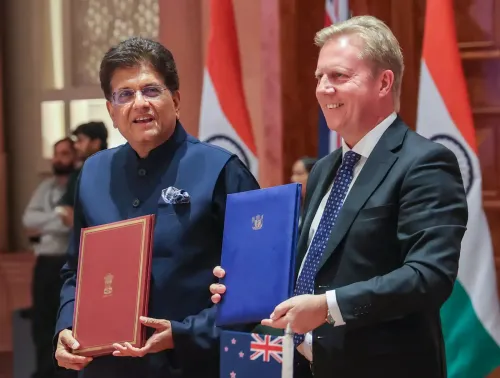
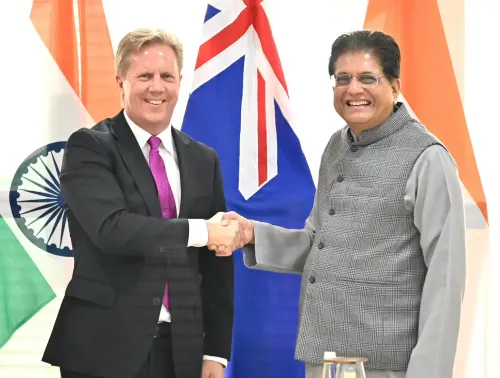
New Delhi, Dec 22 (NationPress): The Federation of Indian Export Organisations (FIEO) expressed its approval for the newly signed India–New Zealand free trade agreement, labeling it as “a transformative opportunity for Indian exporters”. This agreement is set to greatly enhance India’s participation in global value chains.
FIEO President S.C. Ralhan highlighted that finalizing the India–New Zealand FTA in a brief timeframe showcases the robust political will and mutual economic aspirations of both nations.
The zero-duty access granted to Indian exports across all tariff categories is a landmark achievement, which Ralhan believes will improve the competitiveness of Indian products in the New Zealand market and substantially support employment-generating industries.
He also noted that New Zealand's commitment to invest $20 billion under this FTA sends a strong message of confidence in India’s growth trajectory. This investment is expected to make significant contributions to manufacturing growth, innovation, and job creation, thus providing an additional boost to India's export sector.
Ralhan remarked that the progressive provisions concerning services, movement, student opportunities, and traditional medicine are future-oriented and will substantially benefit India’s skilled workforce and its youth.
With an emphasis on the welfare of farmers, this agreement opens up new avenues for Indian agricultural exports to New Zealand, covering items such as fruits, vegetables, coffee, spices, cereals, and processed foods. Initiatives like the Agricultural Productivity Partnership, the establishment of Centres of Excellence, and access to New Zealand’s advanced agricultural technologies are expected to enhance productivity, quality, and farmers’ incomes. Targeted support for horticultural products including honey, kiwifruit, and apples will further fortify sustainable agricultural development, he added.
“FIEO perceives the India–New Zealand FTA as a mutually advantageous and forward-looking agreement that will deepen economic collaboration, strengthen interpersonal connections, and bolster India’s long-term vision of Viksit Bharat 2047,” Ralhan stated.
The business organization PHDCCI also lauded the India-New Zealand free trade agreement as a partnership that aligns with India’s goal of Viksit Bharat 2047.
“The commitments regarding investment, regulatory collaboration, and duty-free inputs will enhance competitiveness, integrating Indian industries into global value chains across all sectors,” said PHDCCI President Rajeev Juneja.
“This agreement represents a next-generation deal that merges trade liberalization with talent mobility, investment, and productivity-led cooperation. It comes with well-defined agricultural safeguards and technology-focused partnerships to protect farmer interests while enhancing productivity. The agreement provides policy certainty and reduces input costs for manufacturing, creating a vision for long-term economic resilience,” added PHDCCI CEO and Secretary General Ranjeet Mehta.
Point of View
I believe that the India–New Zealand FTA marks a significant milestone in strengthening India’s export landscape. The agreement not only fosters economic collaboration but also reflects a mutual commitment to growth and development, resonating with India's ambitious vision for the future.
NationPress
20 Sept 2026
Frequently Asked Questions
What is the significance of the India–New Zealand FTA for Indian exporters?
The India–New Zealand FTA is significant as it provides zero-duty access for Indian exports, enhancing competitiveness in the New Zealand market and creating new opportunities for growth, particularly in agriculture.
How much investment is New Zealand committing under the FTA?
New Zealand is committing $20 billion under the FTA, which is expected to boost manufacturing, innovation, and job creation in India.
What sectors will benefit from the FTA?
The FTA will benefit various sectors, including agriculture, services, and manufacturing, improving trade and investment opportunities across the board.
How will this agreement impact Indian farmers?
The agreement will open new markets for Indian agricultural exports, including fruits, vegetables, and processed foods, while also providing access to advanced agricultural technologies.
What is India's long-term vision related to this FTA?
India's long-term vision is encapsulated in the goal of Viksit Bharat 2047, which aims for a developed and prosperous India, supported by agreements like the India–New Zealand FTA.