India set to exceed $220 bn green energy investment target, 500 GW by 2030 on track
Synopsis
India has already attracted ₹7 lakh crore in renewable energy investment over just two years — and Union Minister Pralhad Joshi says the country is now poised to exceed the $220 billion needed to reach 500 GW of non-fossil power by 2030. The pace of capacity addition has gone from seven decades for the first 100 GW to just two years for the most recent 100 GW, a compression that underscores how dramatically India's energy transition has accelerated.
Key Takeaways
Union Minister Pralhad Joshi declared on 5 November 2026 that India is set to surpass the $220 billion investment target for renewable energy capacity addition by 2030 .
Investments worth ₹7 lakh crore have flowed into the sector over the past two years , combining domestic and foreign direct investment.
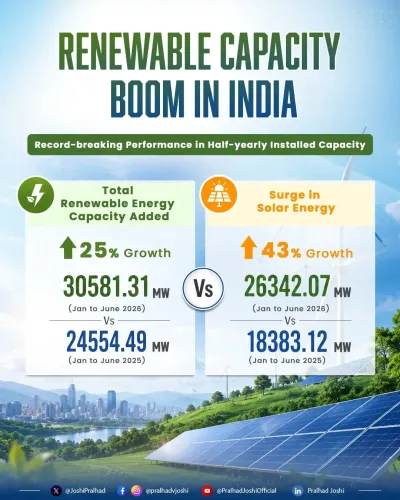
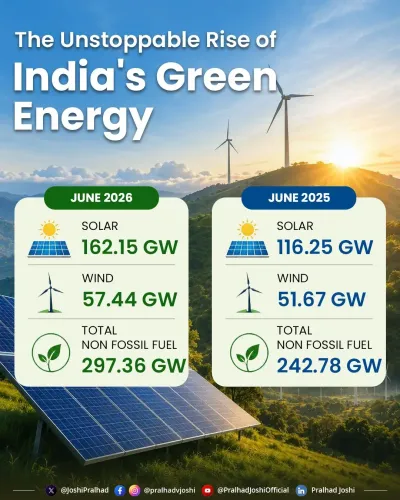
India's installed non-fossil power capacity stands at 310 GW ; the government targets 500 GW by 2030 .
Prime Minister Narendra Modi has directed the Ministry to plan for an additional 300 GW beyond the 500 GW target.
MNRE is drafting new guidelines for solar module waste recycling, mandating higher recyclability for manufacturers.
Suzlon and the Aditya Birla Group have signed an MoU to develop fully recyclable wind turbine blades using recyclable epoxy.
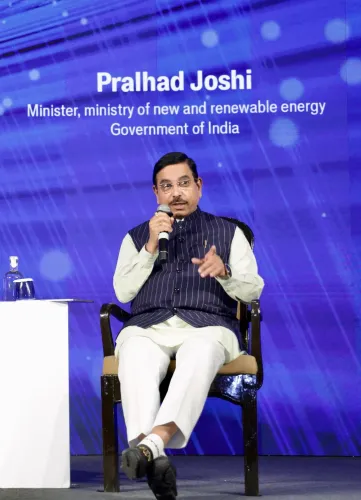
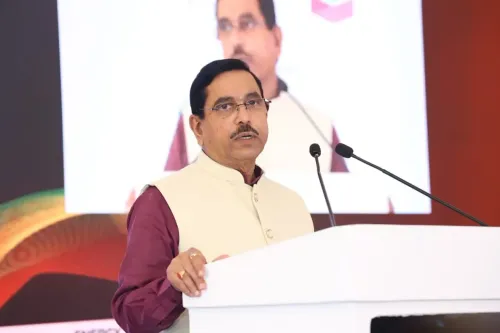
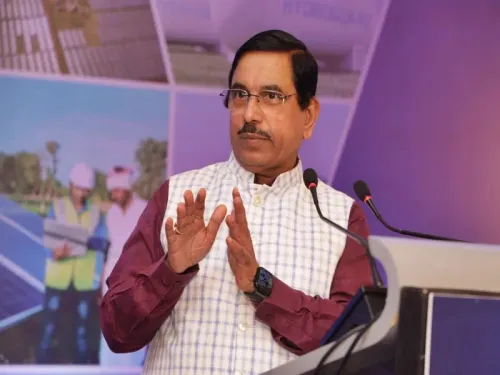
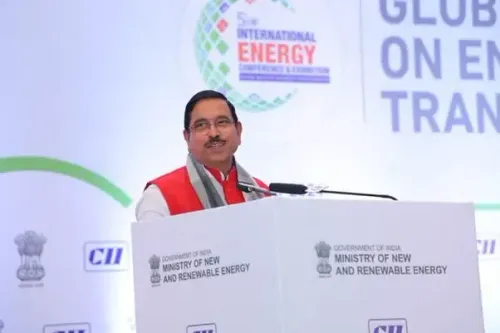
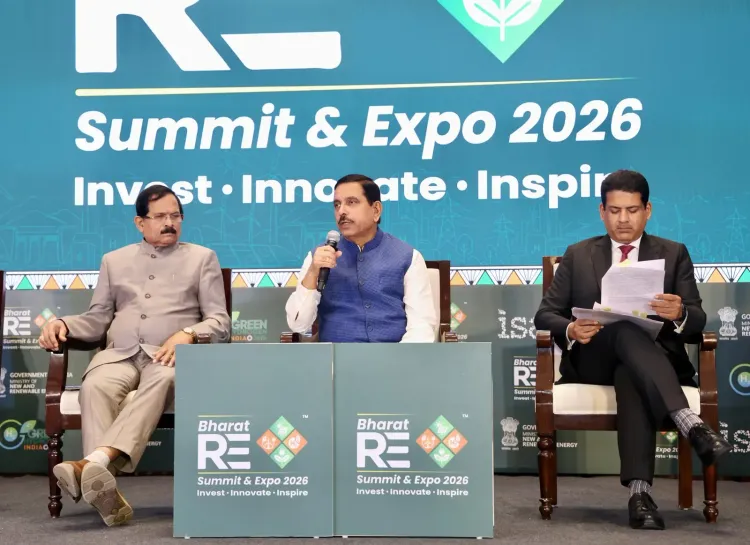
India is on course to surpass the $220 billion investment target needed to add the remaining 190 GW of non-fossil power capacity by 2030, Union Minister of New and Renewable Energy Pralhad Joshi said on Thursday, 5 November 2026. Speaking at the Bharat Renewable Energy Summit and Expo 2026 in New Delhi, Joshi disclosed that investments worth ₹7 lakh crore — combining domestic funds and foreign direct investment — have already flowed into the renewable energy sector over the past two years alone.
India's Renewable Capacity: A Decade-Defining Acceleration
Minister Joshi put the speed of India's energy transition in sharp relief with a striking comparison. 'To achieve the first 100 GW, it took seven decades, another 100 GW was achieved in seven years and the next 100 GW was added in two years,' he said. The country's installed non-fossil power capacity currently stands at 310 GW, with the Union government targeting 500 GW by 2030. Joshi affirmed that this target remains on schedule and that the momentum would continue.
Notably, Prime Minister Narendra Modi has also directed the Ministry to chart strategies for adding a further 300 GW beyond the 500 GW target — signalling ambitions that reach well past the current decade. This comes amid a broader global push to accelerate clean energy transitions ahead of climate commitments under the Paris Agreement, with India frequently cited as one of the fastest-growing renewable energy markets.
Supply Chain Lessons and Future Preparedness
Minister Joshi acknowledged that India had experienced supply chain disruptions in the renewable energy sector and said the government was actively preparing to handle similar challenges going forward. This is a pointed reference to the solar module supply bottlenecks of recent years, partly driven by global semiconductor shortages and over-dependence on Chinese imports, which had temporarily slowed project commissioning timelines.
The Ministry's focus on supply chain resilience aligns with the Centre's broader push for manufacturing self-sufficiency under initiatives such as the Production-Linked Incentive scheme for solar modules.
Solar and Wind Waste Recycling: New Guidelines on the Horizon
Ministry of New and Renewable Energy (MNRE) Secretary Santosh Kumar Sarangi said on the sidelines of the Summit that the Ministry was working urgently to frame new guidelines for solar module waste recycling. 'We are trying to formulate the guidelines as quickly as possible. This will also mandate manufacturers to produce modules which has higher degree of recyclability,' Sarangi said.
He noted that while recyclability of wind turbines is relatively high, technological solutions for recycling turbine blades and the epoxy used in manufacturing them are currently unavailable in India. As a step forward, Suzlon and the Aditya Birla Group have signed a memorandum of understanding (MoU) under which epoxy will be made fully recyclable and used to produce completely recyclable blades. Sarangi indicated that MNRE would formulate a standard operating procedure to mandate similar practices for all other manufacturers.
Currently, recycling of solar module waste and wind turbines falls under the E-Waste (Management) Rules, 2022. However, Sarangi underlined that detailed product-specific guidelines would need to be framed separately. Under existing e-waste rules, waste solar modules must be preserved until 2035, by which time sufficient volumes are expected to make industrial-scale recycling viable, according to Joshi.
What Comes Next
With 190 GW still to be added over the next four years to hit the 500 GW milestone, India's renewable energy build-out will require sustained capital flows, grid integration investments, and policy certainty on tariffs and land acquisition. The recycling guidelines, once finalised, will also shape long-term sustainability costs for the sector. Industry watchers will closely monitor disbursement timelines and whether domestic manufacturing can keep pace with the accelerated capacity addition schedule.
Point of View
But the harder question is whether grid infrastructure and domestic manufacturing capacity are keeping pace with the headline capacity numbers. India has a pattern of announcing ambitious renewable targets and then struggling with land acquisition, transmission bottlenecks, and import dependence on solar components — challenges that raw investment figures do not resolve. The push for 300 GW beyond 500 GW, while politically bold, risks outpacing the regulatory and grid-readiness frameworks needed to absorb that power. The recycling guidelines debate, meanwhile, signals a maturing sector grappling with second-order consequences — which is a positive sign, but the 2035 preservation deadline for solar waste is effectively a deferral, not a solution.
NationPress
5 Nov 2026
Frequently Asked Questions
What is India's green energy investment target and how close is it to achieving it?
India's green energy investment target is $220 billion, required to add the remaining 190 GW of non-fossil power capacity by 2030. Union Minister Pralhad Joshi said on 5 November 2026 that India is poised to surpass this target, with ₹7 lakh crore already invested over the past two years.
What is India's current non-fossil power capacity and what is the 2030 target?
India's installed non-fossil power capacity currently stands at 310 GW. The Union government has set a target of reaching 500 GW by 2030, with an additional 300 GW planned beyond that as directed by Prime Minister Narendra Modi.
How fast has India been adding renewable energy capacity?
According to Minister Pralhad Joshi, India's pace of renewable energy addition has accelerated dramatically — the first 100 GW took seven decades, the next 100 GW took seven years, and the most recent 100 GW was added in just two years.
What are India's new guidelines for solar module waste recycling?
MNRE Secretary Santosh Kumar Sarangi said the Ministry is working to frame new guidelines that will mandate manufacturers to produce solar modules with a higher degree of recyclability. Currently, solar module waste falls under the E-Waste (Management) Rules, 2022, which require waste modules to be preserved until 2035.
What is the Suzlon and Aditya Birla Group MoU about?
Suzlon and the Aditya Birla Group have signed an MoU to develop wind turbine blades made from fully recyclable epoxy, addressing a key gap in India's wind energy waste management. MNRE has indicated it will formulate a standard operating procedure to extend similar mandates to all other wind turbine manufacturers.