India protests Pakistan's Gilgit-Baltistan elections in occupied territory
Synopsis
India's formal protest against Pakistan's Gilgit-Baltistan elections is more than a diplomatic ritual — it is a pointed assertion that electoral exercises in occupied territory cannot legitimise illegal possession. With the MEA invoking the 1947 accession, human rights violations, and the UN resolution Pakistan selectively cites, New Delhi is signalling that no administrative act by Islamabad will alter India's territorial claim.
Key Takeaways
India lodged a formal protest with Pakistan on 5 June 2026 over plans to hold elections to the Gilgit-Baltistan Assembly on 7 June 2026 .
The MEA reiterated that Jammu and Kashmir , Ladakh , and Gilgit-Baltistan are integral parts of India following the 1947 accession.
India categorically rejects any Pakistani attempt to bring material change to territories under illegal occupation.
Pakistani authorities also announced PoK Assembly polling for 27 July .
Bhavika Mangalanandan of India's UN Mission had previously cited civilian killings and open revolt in Pakistan-occupied territories at the UN General Assembly .
India counters Pakistan's plebiscite argument by noting UN Security Council Resolution 47 (1948) required Pakistan to withdraw forces first — a step never taken.
India on Friday, 5 June 2026, lodged a formal and strongly-worded protest with Pakistan over its plans to conduct 'General Elections' to the so-called 'Gilgit-Baltistan Assembly' — scheduled for 7 June 2026 — in territories that New Delhi regards as illegally and forcibly occupied Indian land. The Ministry of External Affairs (MEA) reiterated India's long-standing position that the entire Union Territories of Jammu and Kashmir and Ladakh, including Gilgit-Baltistan, are integral and inalienable parts of India by virtue of the complete, legal, and irrevocable accession of Jammu and Kashmir to India in 1947.
MEA's Formal Position
The MEA statement was unambiguous: India categorically rejects any attempt by Pakistan to bring about a material change in areas under its illegal occupation. The government underlined that such electoral exercises cannot obscure the ground reality — that Pakistan remains in unlawful possession of Indian territories, which it must vacate.
'The Government of India further emphasised that such endeavours by Pakistan cannot mask the underlying issues of grave human rights violations, political repression, economic exploitation and denial of freedom in territories illegally occupied by Pakistan,' the MEA statement read. The protest was lodged after Pakistani authorities announced that polling for all constituencies of the Pakistan-occupied Kashmir (PoK) Assembly would be held on 27 July.
Human Rights Dimension
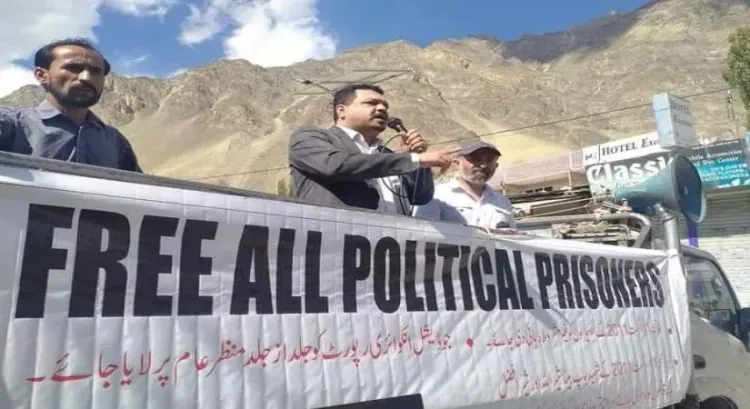
The protest comes against a backdrop of escalating tensions over alleged rights abuses in Pakistan-occupied territories. As recently as last November, India had raised the issue at the UN General Assembly, where Bhavika Mangalanandan, First Secretary at India's UN Mission, stated that Pakistani forces and their proxies had 'killed many innocent civilians who are agitating for their basic rights and freedoms' in the territories Pakistan occupies.
Mangalanandan called on Pakistan to 'stop the grave and ongoing human rights violations in the areas illegally occupied by it, where the population is in open revolt against Pakistan's military occupation, repression, brutality and illegal exploitation of resources.'
India's Stand on the UN Plebiscite Argument
Pakistan has repeatedly invoked UN Security Council Resolution 47 of April 1948 to argue for a plebiscite in Kashmir. India, however, points out that the same resolution required Pakistan to first withdraw its troops and nationals from all of Kashmir — a condition Islamabad has never fulfilled. New Delhi has consistently characterised Pakistan's invocation of self-determination as a 'false equivalence' designed to deflect from its own illegal occupation.
Mangalanandan dismissed Pakistan's arguments at the UN, stating: 'It is unfortunate that Pakistan has resorted to subversion of the principle of self-determination by resorting to false equivalences.' She also cited the participation of Kashmiri voters in Indian elections as evidence of democratic legitimacy, adding that 'the social and economic progress experienced by them is evident for all to see.'
What This Means Going Forward
India's protest is the latest in a series of formal diplomatic objections to Pakistan's administrative actions in Gilgit-Baltistan, a region Islamabad has periodically attempted to integrate more formally into its constitutional framework. Analysts note that holding elections there is part of a broader Pakistani strategy to normalise its control over the territory. New Delhi's consistent rejection of such moves signals that the bilateral fault line over occupied territories remains as sharp as ever, with no diplomatic resolution in sight.
Point of View
While expected, carries genuine diplomatic weight at a moment of heightened bilateral tension post the Pahalgam attack. The MEA's explicit invocation of the 1947 accession and UN Resolution 47 is not boilerplate: it is a legal counter-narrative designed for international audiences. What mainstream coverage underplays is that these elections, if held, will be cited by Islamabad in future multilateral forums as evidence of popular mandate — making India's on-record rejection now strategically necessary, not merely symbolic.
NationPress
21 Oct 2026
Frequently Asked Questions
Why did India protest Pakistan's Gilgit-Baltistan elections?
India protested because it considers Gilgit-Baltistan, along with the entire Union Territories of Jammu and Kashmir and Ladakh, to be an integral and inalienable part of India following the legal accession of 1947. The MEA stated that holding elections there constitutes an illegal attempt to bring material change to occupied Indian territory.
When are the Gilgit-Baltistan elections scheduled?
The elections to the so-called Gilgit-Baltistan Assembly were scheduled for 7 June 2026, according to Pakistan's announcement. Pakistani authorities also announced that polling for all PoK Assembly constituencies would be held on 27 July.
What is India's legal basis for claiming Gilgit-Baltistan?
India's claim rests on the complete, legal, and irrevocable accession of Jammu and Kashmir — which includes Gilgit-Baltistan — to India in 1947. New Delhi also points to UN Security Council Resolution 47 of April 1948, which required Pakistan to withdraw its troops from all of Kashmir before any plebiscite could be considered.
What human rights concerns has India raised about Pakistan-occupied territories?
India has alleged grave human rights violations, political repression, economic exploitation, and denial of basic freedoms in Pakistan-occupied territories. At the UN General Assembly, India's First Secretary Bhavika Mangalanandan stated that Pakistani forces had killed innocent civilians agitating for their rights and called on Pakistan to end the ongoing abuses.
How does Pakistan justify its position on Kashmir?
Pakistan frequently invokes UN Security Council Resolution 47 of 1948 to demand a plebiscite in Kashmir. India counters that the same resolution required Pakistan to first withdraw its troops and nationals from the territory — a precondition Islamabad has never met, making its continued occupation a violation of the very resolution it cites.