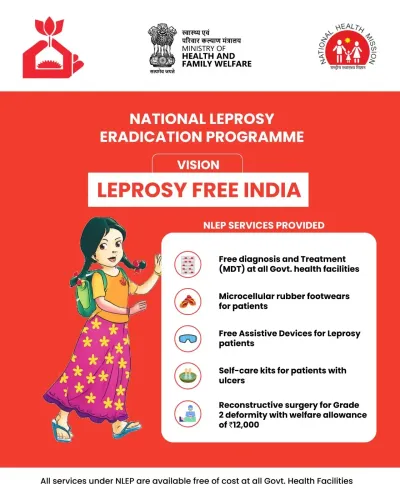
Leprosy-free India: Health Ministry calls for state-specific roadmaps, targets zero transmission
Synopsis
India eliminated leprosy as a public health problem in 2005, but five states still carry half the country's disease burden. At a Nava Raipur workshop, the Health Ministry pushed for state-specific roadmaps and district-level action — signalling that the final stretch to zero transmission demands a sharper, more granular strategy than what got India this far.
Key Takeaways
Additional Secretary Aradhana Patnaik called for state-specific leprosy roadmaps at a regional workshop in Nava Raipur on 12 June .
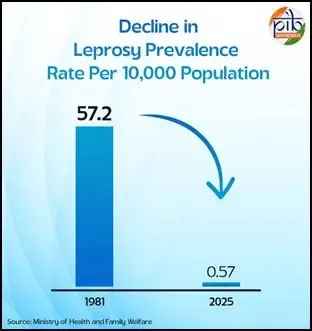
India achieved leprosy elimination at the national level in 2005 , but transmission persists in endemic districts.
Maharashtra, Chhattisgarh, Jharkhand, Odisha, and Madhya Pradesh together account for nearly 50% of India's leprosy burden.
Chhattisgarh has the highest number of high-prevalence districts at 23 , followed by Jharkhand (21) , Maharashtra and Odisha (18 each) , and Madhya Pradesh (10) .
Expanding Post-Exposure Prophylaxis (PEP) via Single-Dose Rifampicin (SDR) and strengthening contact tracing were identified as critical interventions.
States were urged to leverage NHM flexi-pool resources , CBAC, RBSK, and RKSK platforms for enhanced screening and early detection.
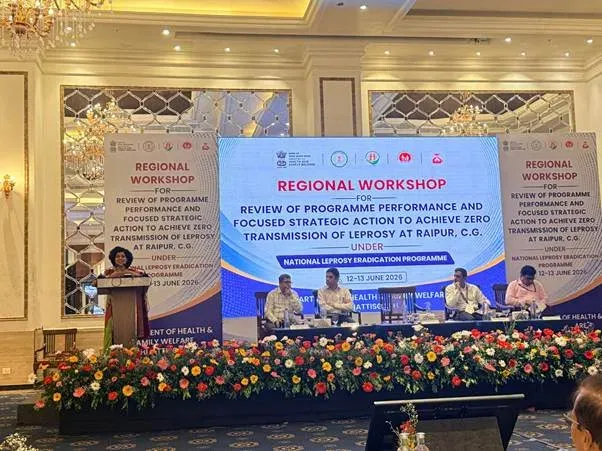
The Union Health Ministry on Friday, 12 June called for state-specific roadmaps to achieve a leprosy-free India, with Additional Secretary, Health and Family Welfare, Aradhana Patnaik stressing that intensified, targeted interventions are essential to completely interrupt transmission in hotspot areas. The appeal came at a two-day Regional Workshop on Review of Programme Performance and Focused Strategic Action for Achieving Zero Transmission of Leprosy held in Nava Raipur, Chhattisgarh.
India's Progress and Persistent Challenges
Patnaik acknowledged that India achieved elimination of leprosy as a public health problem at the national level in 2005, a landmark milestone. However, she cautioned that transmission continues to persist in several endemic districts and hotspot areas, making sustained and targeted action non-negotiable. According to the official statement, she underlined that the challenge now lies in sustaining hard-won gains and accelerating action in remaining endemic pockets.
Five High-Priority States Account for Half India's Burden
Highlighting the epidemiological landscape, Patnaik informed workshop participants that five high-priority states — Maharashtra, Chhattisgarh, Jharkhand, Odisha, and Madhya Pradesh — together account for nearly 50 per cent of India's leprosy burden. These states also record a significant number of districts with prevalence rates above 1 case per 10,000 population: 23 districts in Chhattisgarh, 21 in Jharkhand, 18 each in Maharashtra and Odisha, and 10 in Madhya Pradesh.
Key Interventions Recommended
Patnaik emphasised the critical importance of early diagnosis and prompt treatment, calling for periodic Leprosy Case Detection Campaigns in endemic areas. She also urged states to strengthen contact tracing and expand the coverage of Post-Exposure Prophylaxis (PEP) through Single-Dose Rifampicin (SDR) among eligible healthy contacts of index cases, particularly in vulnerable and hard-to-reach populations. Increasing contact screening and PEP coverage, she noted, is essential for reducing disease transmission and preventing new infections.
Programme Platforms and NHM Resources
Patnaik advocated leveraging existing health platforms — including Community-Based Assessment Checklists (CBAC), the Rashtriya Bal Swasthya Karyakram (RBSK), and the Rashtriya Kishor Swasthya Karyakram (RKSK) — to enhance screening and early detection. She also guided State and District Leprosy Officers on the effective utilisation of flexi-pool resources under the National Health Mission (NHM) framework. Capacity building, Information, Education and Communication (IEC) activities, and convergence under NHM were highlighted as pillars of stronger programme implementation.
Accountability and the Road Ahead
Stressing accountability and timely decision-making, Patnaik urged participating states to regularly review progress, identify implementation bottlenecks, and undertake corrective measures. The workshop signals a renewed federal push to close the gap between national-level elimination and district-level zero transmission — a goal that will require both political will and granular, on-ground execution.
Point of View
But it masked a deepening geographic concentration of the disease. The fact that five states now carry half the national burden suggests that a uniform national strategy has run its course — what remains is a last-mile problem requiring hyper-local, district-level intelligence. The push for state-specific roadmaps is the right instinct, but its success will depend on whether district leprosy officers are given the resources and autonomy to act, not just report. Historically, NHM flexi-pool funds have been underutilised at the district level; without fixing that pipeline, the roadmap risks being a planning exercise rather than an operational one.
NationPress
13 Sept 2026
Frequently Asked Questions
What is India's current status on leprosy elimination?
India achieved elimination of leprosy as a public health problem at the national level in 2005, meaning prevalence fell below 1 case per 10,000 population nationally. However, transmission continues in several endemic districts and hotspot areas, particularly across five high-priority states.
Which states have the highest leprosy burden in India?
Maharashtra, Chhattisgarh, Jharkhand, Odisha, and Madhya Pradesh together account for nearly 50% of India's leprosy burden. Chhattisgarh has the most high-prevalence districts at 23, followed by Jharkhand with 21.
What is Post-Exposure Prophylaxis (PEP) and why is it important for leprosy control?
PEP involves administering a Single-Dose Rifampicin (SDR) to healthy contacts of confirmed leprosy cases to prevent them from developing the disease. The Health Ministry has identified expanding PEP coverage — especially in hard-to-reach and vulnerable populations — as a critical tool for interrupting transmission.
What platforms are being used to strengthen leprosy detection in India?
The Health Ministry has recommended leveraging Community-Based Assessment Checklists (CBAC), the Rashtriya Bal Swasthya Karyakram (RBSK), and the Rashtriya Kishor Swasthya Karyakram (RKSK) to improve screening and early detection, alongside National Health Mission resources.
What did the Nava Raipur workshop aim to achieve?
The two-day Regional Workshop on Review of Programme Performance and Focused Strategic Action for Achieving Zero Transmission of Leprosy, held in Nava Raipur on 12 June, brought together state and district leprosy officers to review programme performance, identify bottlenecks, and chart focused strategies for reaching zero leprosy transmission.