India Criticizes USCIRF for Biased Reports on Religious Freedom
Synopsis
In a strong rebuttal, India denounces the USCIRF's report as distorted and politically motivated, urging the organization to focus on the vandalism of Hindu temples in the US instead. The Indian government emphasizes its commitment to a pluralistic society and calls out the biases in USCIRF's assessments.
Key Takeaways
India has rejected the USCIRF's report as biased.
The report is said to misrepresent India's religious diversity.
India calls for a focus on attacks against Hindu temples in the US.
The MEA emphasizes India's commitment to a pluralistic society.
USCIRF's credibility is questioned by Indian officials.
New Delhi, March 16 (NationPress) Disputing the annual report from the United States Commission on International Religious Freedom (USCIRF), India asserted on Monday that the US-based religious freedom body has consistently portrayed a misleading and selective viewpoint of India for many years, relying on dubious sources and ideological frameworks instead of objective facts.
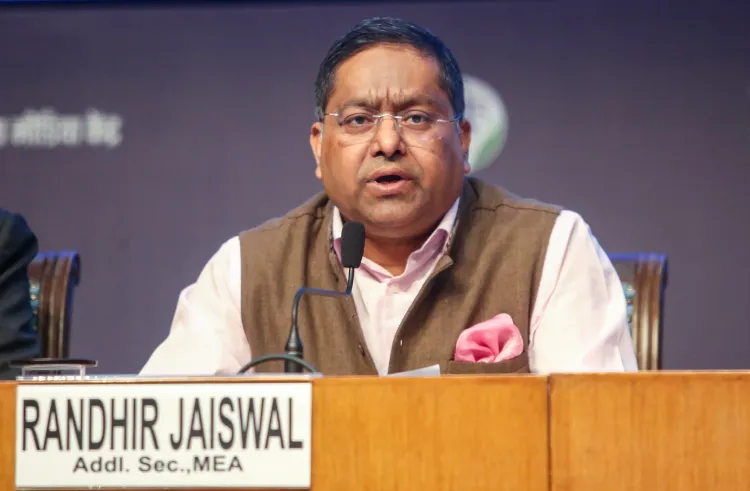
"We have noted the most recent report from the US Commission on International Religious Freedom (USCIRF). We unequivocally reject its biased and motivated representation of India," stated Randhir Jaiswal, spokesperson for the Ministry of External Affairs (MEA), in response to inquiries regarding the 2026 Annual Report of USCIRF.
"For years, USCIRF has continued to present a twisted and selective image of India, depending on questionable sources and ideological narratives rather than objective evidence. Such continual misrepresentations only serve to weaken the credibility of the Commission itself," he added.
India has argued that USCIRF's ongoing attempts to undermine India's vibrant multicultural society reflect a deliberate agenda rather than genuine concern for religious freedom.
"Rather than continuing with selective criticism of India, USCIRF should consider the alarming incidents of vandalism and assaults on Hindu temples in the United States, along with the selective targeting of India and the increasing intolerance faced by members of the Indian diaspora in the US, which require serious attention," the MEA spokesperson remarked on Monday.
This is not the first occasion India has criticized USCIRF, the US federal agency tasked with monitoring the universal right to Freedom of Religion or Belief (FoRB) abroad and providing policy recommendations to the President, Secretary of State, and US Congress.
India has previously accused the US agency of maintaining its pattern of issuing biased and politically motivated assessments.
"India is home to 1.4 billion individuals representing all religions known to humanity. However, we do not expect USCIRF to acknowledge the reality of India’s pluralistic framework or recognize the harmonious coexistence of its diverse communities. Attempts to undermine India's status as a beacon of democracy and tolerance will not prevail. In fact, it is USCIRF that ought to be designated as an entity of concern," the MEA had stated while dismissing the 2025 Annual Report of USCIRF.
New Delhi's stance on the US agency is well established.
"It is a partisan organization with a political agenda, consistently misrepresenting facts and promoting a motivated narrative about India. We reject this malicious report, which only serves to further discredit USCIRF," the MEA has previously asserted.
Point of View
India's criticism of the USCIRF highlights a significant diplomatic concern regarding the portrayal of its religious landscape. While freedom of religion is a vital issue globally, the narrative presented by USCIRF may not fully encapsulate the complexities of India's diverse society. A balanced dialogue on religious freedom that considers all perspectives is crucial.
NationPress
21 Sept 2026
Frequently Asked Questions
Why did India reject USCIRF's report?
India rejected USCIRF's report as it claimed the agency presented a biased and selective portrayal of India's religious landscape, relying on questionable sources.
What incidents did India reference regarding Hindu temples?
India referenced rising incidents of vandalism and attacks on Hindu temples in the United States, urging USCIRF to address these issues instead of focusing solely on India.
What is the significance of India's stance?
India's stance highlights its commitment to protecting its multicultural society and calls for a more accurate representation of its religious freedoms on international platforms.
How does this affect US-India relations?
These criticisms may lead to heightened tensions in US-India relations as both countries navigate their differing views on religious freedom and representation.