India Semiconductor Mission 2.0 gets ₹1.25 lakh crore EFC nod, Cabinet approval next
Synopsis
India's semiconductor ambition just got its biggest financial commitment yet. The Finance Ministry's EFC has cleared ₹1.25 lakh crore for ISM 2.0 — a 64% jump over ISM 1.0's ₹76,000 crore — with Cabinet approval the only remaining hurdle. With a pilot line already running in Sanand and global majors like Applied Materials and Lam Research already invested, India's chip self-reliance drive is moving from policy to production.
Key Takeaways
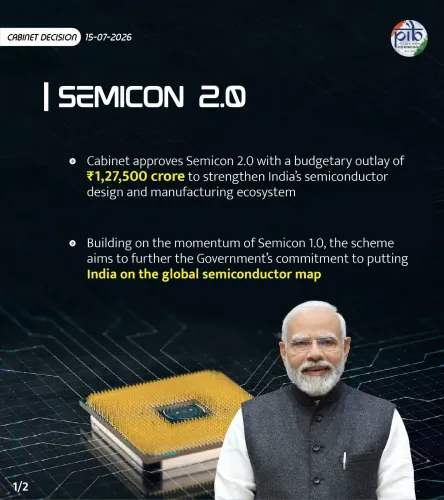
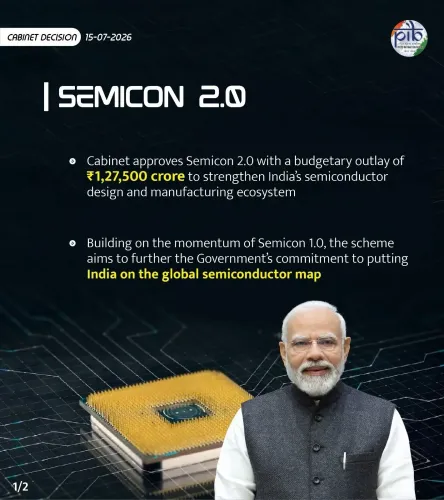
The Finance Ministry's EFC approved a ₹1.25 lakh crore outlay for India Semiconductor Mission (ISM) 2.0 last week.
The proposal now heads to the Union Cabinet for final approval before it becomes operative.
The outlay is a significant increase from the ₹76,000 crore allocated under ISM 1.0 , which approved 10 semiconductor facilities .
ISM 2.0 targets meeting 75 per cent of India's domestic semiconductor demand by 2030 .
A pilot production line is already operational in Sanand, Gujarat ; four more units are expected to begin production within a year.
Global firms including Applied Materials , Lam Research , Merck , and Linde are investing in supporting supply chain infrastructure.
The Finance Ministry's Expenditure Finance Committee (EFC) has cleared an outlay of ₹1.25 lakh crore for India Semiconductor Mission (ISM) 2.0, marking a decisive escalation in the country's ambition to become a self-reliant chip-manufacturing nation. The proposal, approved last week, will now move to the Union Cabinet for final clearance before it becomes operative.
A Sharp Increase from ISM 1.0
The fresh outlay represents a substantial jump from the ₹76,000 crore committed under ISM 1.0, under which the government sanctioned 10 semiconductor facilities spanning chip fabrication, assembly, and design. The expanded programme is designed to go beyond chipmaking itself, extending support to industrial gases, specialty chemicals, capital equipment, MSMEs, and ancillary suppliers — effectively targeting the full semiconductor supply chain rather than just end-product manufacturing.
What ISM 2.0 Aims to Achieve
The government expects the enhanced scheme to help India meet up to 75 per cent of its domestic semiconductor demand by 2030, significantly reducing import dependence. The broader strategic goal is to position India as a credible node in the global electronics manufacturing value chain — a target that has gained urgency as geopolitical tensions continue to disrupt established supply routes from Taiwan, South Korea, and China.
Notably, inter-ministerial consultations for the new scheme had already been completed, with the Ministry of Electronics and Information Technology (MeitY) awaiting the Finance Ministry's green light before proceeding.
The Demand Surge Driving the Push
India's electronics consumption is expanding at an unprecedented pace. The country now has over 65 crore smartphone users, and annual electronics manufacturing output has reached ₹12 lakh crore. Simultaneously, the rapid build-out of AI-based systems, data centres, and electric vehicles (EVs) is creating compounding chip demand that domestic production currently cannot meet.
This convergence of consumer scale and industrial transformation makes securing a place in the global semiconductor supply chain not merely an economic ambition but a strategic necessity, according to government assessments.
Ground Progress Under ISM 1.0
Construction on the 10 approved semiconductor plants is reportedly progressing at pace. A pilot production line has already commenced at one facility in Sanand, Gujarat, and within a year, four more units are expected to enter production. Global industry leaders — including Applied Materials, Lam Research, Merck, and Linde — have committed investments in supporting factories and supply chain infrastructure alongside these facilities.
What Comes Next
With EFC clearance secured, the proposal now awaits Union Cabinet approval, which would formally launch ISM 2.0 and unlock disbursements. If cleared, the scheme would represent the single largest public investment in India's technology manufacturing history. The pace of Cabinet scheduling and the structure of incentive disbursal — whether tied to production milestones or capacity creation — will be closely watched by industry and investors alike.
Point of View
But the harder test lies ahead. ISM 1.0 approved 10 facilities, yet only one pilot line is operational — a reminder that sanctions and production are separated by years of execution risk. The expansion of scope to industrial gases, specialty chemicals, and capital equipment is strategically sound, since chip self-reliance requires the full stack, not just assembly. But the 75% domestic demand target by 2030 is ambitious given that India's fab ecosystem is still in its infancy. Whether ISM 2.0's incentive structure is tied to verifiable output milestones — rather than capacity creation alone — will determine if this becomes a genuine industrial inflection or another well-funded headline.
NationPress
29 Sept 2026
Frequently Asked Questions
What is India Semiconductor Mission 2.0?
India Semiconductor Mission (ISM) 2.0 is the government's next-phase semiconductor push, with a proposed outlay of ₹1.25 lakh crore cleared by the Finance Ministry's Expenditure Finance Committee. It expands on ISM 1.0's ₹76,000 crore framework and aims to cover the full semiconductor supply chain, including industrial gases, specialty chemicals, and capital equipment.
How does ISM 2.0 differ from ISM 1.0?
ISM 1.0 allocated ₹76,000 crore and approved 10 semiconductor facilities focused on chip fabrication, assembly, and design. ISM 2.0 raises the outlay to ₹1.25 lakh crore and broadens the scope to include MSMEs, ancillary suppliers, and supply chain infrastructure — targeting a more self-sufficient domestic ecosystem.
When will ISM 2.0 receive final approval?
The EFC cleared the proposal last week, and it will now be sent to the Union Cabinet for final approval. No specific date has been announced for the Cabinet decision.
What is India's semiconductor demand target by 2030?
The government expects ISM 2.0 to help India meet up to 75 per cent of its domestic semiconductor demand by 2030, reducing the country's heavy reliance on chip imports from Taiwan, South Korea, and China.
Which global companies are investing in India's semiconductor supply chain?
Applied Materials, Lam Research, Merck, and Linde are among the global industry leaders investing in supporting factories and supply chain infrastructure alongside the semiconductor plants approved under ISM 1.0.