How is India Strengthening Trade Relationships in 2025 Amid Global Challenges?
Synopsis
In a strategic move to strengthen its economy, India has advanced its trade partnerships in 2025 amidst global uncertainties. With key agreements signed with the UK, New Zealand, and Oman, India aims to enhance trade, attract investments, and protect its agricultural sector. Discover how these initiatives are shaping India's economic landscape and creating new opportunities.
Key Takeaways
Increased Trade: New agreements enhance India's trade landscape.
Investment Opportunities: Significant foreign investments are on the horizon.
Sectoral Benefits: Key industries such as textiles and engineering will thrive.
Global Relationships: Strengthened ties with the UK, New Zealand, and Oman.
Farmers' Protection: Safeguards for the agricultural sector remain intact.
New Delhi, Dec 25 (NationPress) In 2025, India has intensified its initiatives to establish new economic and trade alliances in response to the escalating global economic uncertainties precipitated by the turmoil surrounding US tariffs.
This year, India has signed three significant free trade agreements with the UK, New Zealand, and Oman. Ongoing discussions with the European Union (EU) are set to not only boost trade but also enhance competitiveness, draw in high-quality foreign investments, and grant better access to advanced technologies and markets.
The agreements have enabled India to secure fair and equitable terms, allowing increased access for India’s manufactured goods and skilled professionals while also safeguarding the agricultural sector from foreign competition, thus protecting the livelihoods of the nation’s farmers.
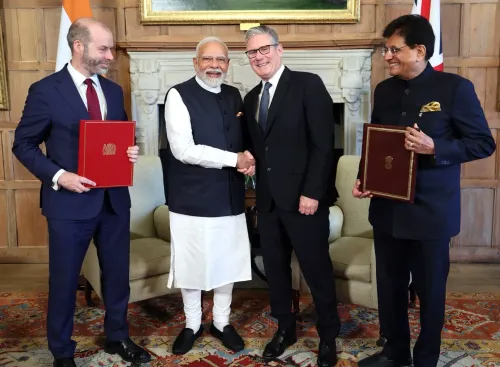
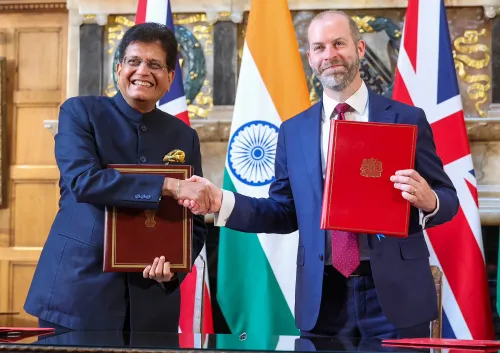
In July, India finalized a Comprehensive Economic and Trade Agreement (CETA) with the United Kingdom, which grants unparalleled duty-free access to 99% of India’s exports to the UK. This encompasses nearly all trade value, benefiting labor-intensive sectors like textiles, leather, marine products, gems, engineering goods, chemicals, and auto parts.
Importantly, the agreement extends beyond goods to include services, which are a pivotal strength of India’s economy. In 2023, India exported over US$ 19.8 billion in services to the UK, with CETA poised to further expand this figure.
Additionally, CETA facilitates mobility for professionals across sectors such as IT, healthcare, finance, and education, easing entry for contractual service suppliers, business visitors, intra-corporate transferees, and independent professionals.
India’s trade partnership with the EFTA countries—Switzerland, Norway, Iceland, and Liechtenstein—was operationalized in October after being signed in 2024, improving market access for over 99% of India’s exports to these nations, including pharmaceuticals, engineering goods, and services. The four countries have committed to investing USD 100 billion in India, leading to the creation of one million jobs.
The recently signed India-New Zealand free trade agreement (FTA) will ensure zero duty on all of India’s exports, benefiting farmers, MSMEs, and labor-intensive sectors such as textiles, apparel, leather, and footwear.
Sectors like engineering, manufacturing, automobiles, electronics, machinery, and pharmaceuticals are also expected to gain significantly.
Moreover, New Zealand has pledged to facilitate $20 billion in foreign direct investment (FDI) into India over the next 15 years, focusing on manufacturing, infrastructure, services, innovation, and job creation.
The FTA opens new avenues for India’s services sector, including IT, finance, education, tourism, and construction. New Zealand’s first-ever provisions on health, traditional medicine, student mobility, and post-study work present exciting prospects for Indian professionals and students.
Furthermore, during Prime Minister Narendra Modi's visit to Muscat, India and Oman signed the Comprehensive Economic Partnership Agreement (CEPA), unlocking new economic opportunities in the Gulf region.
The CEPA ensures significant tariff concessions from Oman, providing zero-duty access on 98.08% of its tariff lines, covering 99.38% of India’s exports to Oman. Major labor-intensive sectors, including gems and jewelry, textiles, leather, footwear, sports goods, and pharmaceuticals, will benefit from complete tariff elimination.
The services sector, which is a key driver of India's economy, will also gain considerable advantages. Oman imports global services worth USD 12.52 billion, with India's share at 5.31%, indicating substantial untapped potential for Indian service providers.
The agreement includes a broad and forward-thinking services package, with Oman making significant commitments across various sectors, including computer-related services, business and professional services, audiovisual services, R&D, education, and health services.
According to Commerce and Trade Minister Piyush Goyal, “More nations are eager to deepen relationships with a resurgent and aspirational India, as the country's growing consumer demands, rapid economic growth, and focus on sustainable development are creating vast trade opportunities.”
Point of View
It is evident that India's proactive approach to establishing new trade agreements showcases its commitment to economic resilience. While global uncertainties pose challenges, India's ability to secure favorable terms in these partnerships demonstrates a strategic foresight that will benefit the nation in the long run.
NationPress
19 Sept 2026
Frequently Asked Questions
What are the major trade agreements India signed in 2025?
India signed significant free trade agreements with the UK, New Zealand, and Oman in 2025, enhancing trade and economic partnerships.
How will the agreements benefit India's economy?
These agreements will increase trade competitiveness, attract foreign investments, and provide better access to advanced technologies, benefiting various sectors.
What sectors are expected to benefit from the India-New Zealand FTA?
The FTA will benefit sectors including textiles, apparel, leather, engineering, manufacturing, and more, supporting farmers and MSMEs.
What are the implications of the CEPA with Oman?
The CEPA allows zero-duty access for 99.38% of India's exports to Oman, significantly benefiting labor-intensive sectors.
How does CETA support India's service sector?
CETA promises to expand India's service exports to the UK, facilitating mobility for professionals in various sectors.